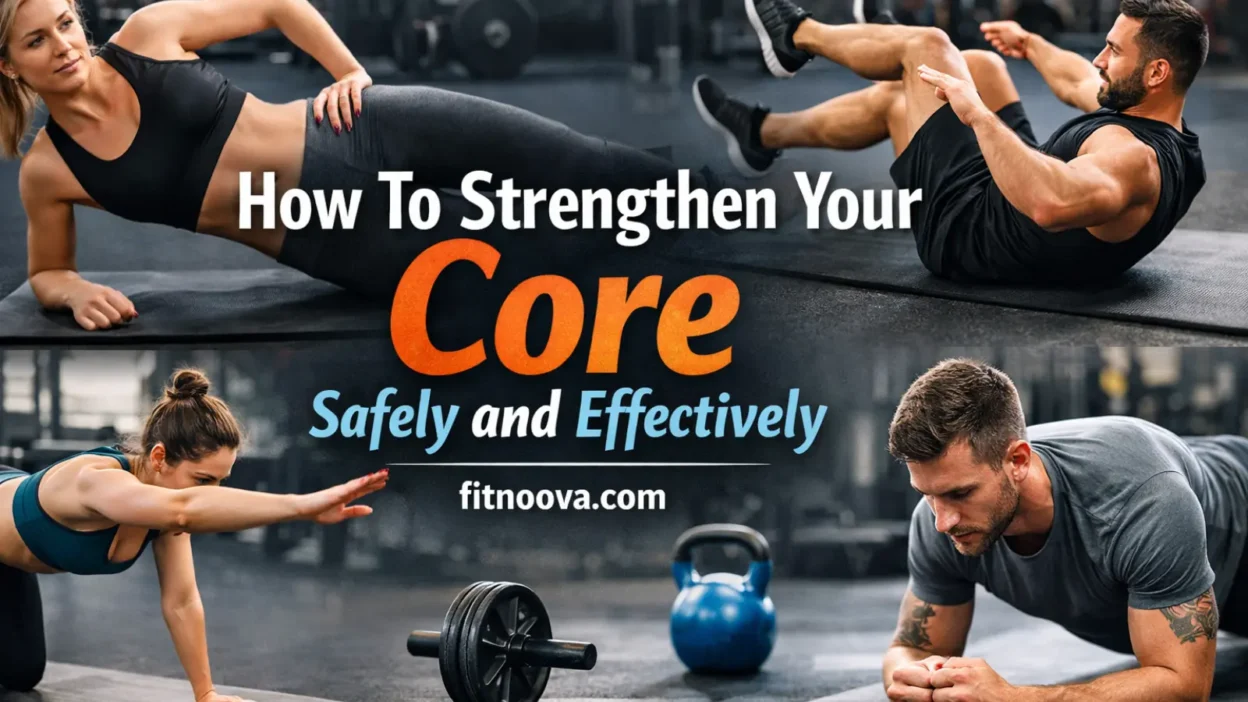
A stronger core starts with simple, controlled exercises done consistently. For most beginners, the safest and most useful approach is to train core stability two to three times per week with moves like dead bugs, bird-dogs, glute bridges, and modified planks, while breathing steadily and stopping before form breaks down. Public health guidance also recommends muscle-strengthening work on at least two days each week.
A strong core is not just about your abs. It includes muscles around your abdomen, back, pelvis, hips, and even breathing system that help you stay stable, transfer force, and move with more control. Mayo Clinic and Healthline both describe the core as more than the front of the midsection alone.
The goal is not to make your stomach burn as much as possible. The goal is to build better control through your trunk so everyday movement, strength training, and balance feel more supported.
Quick Answer
To strengthen your core, focus on simple exercises that train your trunk to resist movement and stay stable, not just bend forward. For most beginners, that means practicing moves like planks, dead bugs, bird-dogs, and glute bridges two to three times per week, using controlled reps, steady breathing, and gradual progression. U.S. activity guidance also recommends muscle-strengthening work on at least two days per week.
What Core Strength Really Means
Core strength is your ability to keep your trunk steady while your arms and legs move, or while outside forces try to pull you out of position. That is why beginner core training usually works best when it focuses on resisting movement first.
This is one reason modern beginner programs lean so heavily on dead bugs, bird-dogs, bridges, and plank variations. They teach bracing, position, and control before harder dynamic work.
Why Core Strength Matters
A stronger core can support balance, posture, trunk control, and everyday movement. It can also make other exercises feel steadier because your trunk is better able to hold position while your hips and shoulders work. Mayo Clinic, ACE, and Healthline all emphasize these stability and function benefits.
That said, core work is not magic. It is one part of a well-rounded training plan. It does not guarantee visible abs, remove back pain, or replace full-body strength work.
How To Brace Your Core Before You Start
Before every rep, think about creating light, steady tension around your middle.
Try this:
• Breathe in through your nose.
• Exhale gently.
• Tighten your midsection as if you are preparing for a light poke to the stomach.
• Keep breathing while you hold that tension.
You should feel firm, not rigid. If you have to hold your breath to stay in position, the move is probably too hard or the set is too long. Mayo Clinic specifically advises breathing freely and deeply during core exercises.
A Simple Warm-Up Before Core Training
Use this short prep before your workout:
• 5 slow breaths lying on your back with knees bent
• 6 pelvic tilts
• 6 heel taps per side
• 5 glute bridges
• 20 seconds of all-fours bracing
This should make the session feel smoother, not tiring.
The Best Beginner Core Exercises
Dead Bug
The dead bug teaches your core to stay steady while your limbs move. It is one of the best beginner choices because the floor gives feedback and limits sloppy motion. ACE and SELF both support supine core work as a strong starting point.
How to do it:
• Lie on your back with knees bent to tabletop and arms pointed up
• Brace your core gently
• Slowly lower one arm and the opposite leg
• Return with control
• Switch sides
Form cues:
• Keep your ribs down
• Do not let your lower back arch away from the floor
• Move slowly enough to stay steady
Make it easier: tap the heel down instead of straightening the leg.
Make it harder: slow the lowering phase or pause before returning.
Bird-Dog
Bird-dogs train balance, trunk control, and hip stability. Mayo Clinic includes a quadruped version of this pattern as a core-strength move.
How to do it:
• Start on hands and knees
• Brace your midsection
• Reach one arm forward and the opposite leg back
• Pause briefly
• Return and switch sides
Form cues:
• Think long, not high
• Keep your hips level
• Avoid twisting or lifting the leg too high
Make it easier: move only the arm or only the leg.
Make it harder: add a longer pause.
Glute Bridge
Bridges help with pelvic control, hip extension, and trunk stability. Mayo Clinic includes the bridge as a core-strength exercise.
How to do it:
• Lie on your back with knees bent and feet flat
• Brace lightly
• Press through your feet
• Lift your hips until your body forms a gentle line from shoulders to knees
• Lower with control
Form cues:
• Keep the ribs down
• Do not push into a hard low-back arch at the top
• Squeeze the glutes, not just the lower back
Make it easier: do partial reps.
Make it harder: pause at the top before lowering.
Modified Front Plank
A modified plank teaches full-body bracing without forcing beginners into a long floor hold too soon. Mayo Clinic includes a forearm-and-knees version as a core-strength option.
How to do it:
• Set up on your forearms and knees
• Keep shoulders over elbows
• Brace your core
• Hold a straight line from head through hips to knees
• Breathe steadily
Form cues:
• Do not let your lower back sag
• Do not lift your hips too high
• Stop when you lose alignment
Make it easier: shorten the hold.
Make it harder: move from knees to toes only when your body stays aligned.
Side Plank From Knees
Side planks build lateral core strength and help train the muscles that stop you from collapsing sideways.
How to do it:
• Lie on one side with knees bent
• Prop yourself up on one forearm
• Lift your hips
• Hold a straight line from shoulders to knees
• Repeat on the other side
Form cues:
• Keep the chest open
• Do not roll backward
• Keep the neck relaxed
Make it easier: reduce the hold time.
Make it harder: straighten the legs.
A Safe Beginner Core Routine
Start with this no-equipment routine two or three times per week:
• Dead Bug — 2 sets of 6 to 8 reps per side
• Bird-Dog — 2 sets of 6 to 8 reps per side
• Glute Bridge — 2 sets of 8 to 12 reps
• Modified Front Plank — 2 sets of 15 to 25 seconds
• Side Plank From Knees — 2 sets of 10 to 20 seconds per side
Rest about 30 to 60 seconds between exercises if needed.
This routine matches the broad beginner pattern seen across Mayo Clinic, ACE, and major fitness publishers: simple bodyweight exercises, short holds, moderate reps, and gradual progression.
The Minimum Version If You Are Very New
If the full routine feels like too much, start here:
• Dead Bug — 1 to 2 sets
• Glute Bridge — 1 to 2 sets
• Modified Front Plank — 1 to 2 short holds
That is enough to begin building skill. A smaller routine done consistently is more useful than a bigger one you cannot recover from or do not repeat.
How Often To Train Your Core
Most adults do well with two to three focused core sessions each week. That fits well with public guidance recommending muscle-strengthening work on at least two days weekly.
You usually do not need a hard core workout every day. Your core also works during carries, squats, rows, lunges, and many other full-body exercises.
A simple weekly example:
• Monday — Core routine
• Wednesday — Core routine
• Friday or Saturday — Core routine or full-body strength training
How Hard Should Core Work Feel
For beginners, moderate effort is enough.
You should feel:
• tension through the trunk
• steady breathing
• control through the full set
• mild shaking near the end of a hold, not instant collapse
You should not feel:
• sharp pain
• strong neck strain
• uncontrolled back arching
• breath-holding through the whole set
• form falling apart for the sake of finishing
How To Progress Safely
The safest order is:
First, Clean Up The Rep
Make the movement smoother. Reduce wobbling. Keep your ribs and pelvis in a better position.
Then, Add Time Or Reps
Add 5 to 10 seconds to holds or 1 to 2 reps per side.
Then, Increase Leverage
Examples:
• dead bug from heel tap to straighter leg reach
• bird-dog with a longer pause
• plank from knees to toes
• side plank from knees to feet
ACE’s beginner guidance follows a similar pattern: start with short holds and modest reps, then build gradually.
Common Mistakes That Slow Progress
Doing Too Much Too Soon
Long planks and advanced variations are not better if you cannot control them.
Using Crunches As Your Entire Plan
Crunches can have a place, but they do not cover the full job of the core by themselves. Stronger beginner programs usually include anti-extension, anti-rotation, and lateral stability work.
Holding Your Breath
Bracing helps. Breath-holding usually does not.
Letting Your Lower Back Take Over
If your back arches hard during planks, dead bugs, or bridges, you are no longer training the pattern you wanted.
Training For Burn Instead Of Control
A hard set is not automatically a good set. Better control usually matters more than more discomfort.
What To Do If Planks Bother Your Back Or Wrists
Use one of these changes:
• switch to forearms
• shorten the hold
• use knees instead of toes
• replace planks with dead bugs or bird-dogs for now
Planks are useful, but they are not mandatory. Many beginners build a stronger core with other stability drills first.
Core Training If You Have Back Pain
General core exercise can be reasonable for some people, but back pain is not one simple category. Reviews suggest core stabilization can help some people with nonspecific low back pain, yet it is not a universal fix and does not replace individual medical care when symptoms are significant.
A cautious starting approach may include:
• shorter holds
• smaller ranges of motion
• more supine or hands-and-knees exercises
• slower pacing
• stopping movements that clearly worsen symptoms
General fitness guidance is not the same as personal medical advice. If pain is severe, radiates down the leg, keeps worsening, or you are not sure what is causing it, get individualized care before pushing ahead.
Normal Effort Vs. Warning Signs
Normal training can involve muscle effort, mild shaking, and some next-day soreness.
Stop the session and get medical advice promptly if you have symptoms such as chest pain, marked dizziness, feeling faint, unusual shortness of breath, or symptoms that feel severe or clearly abnormal for you. Chest pain with dizziness or breathlessness can be a medical emergency.
Can You Strengthen Your Core At Home Without Equipment?
Yes. Many of the best starting exercises need no equipment at all.
Dead bugs, bird-dogs, bridges, and modified planks are enough to build a strong beginner base. Equipment can be useful later, but bodyweight control is often the missing skill at the start.
FAQ
How long does it take to strengthen your core?
Many beginners notice better control within a few weeks of consistent practice. The exact timeline depends on your starting point, exercise quality, recovery, and how often you train.
Are planks enough for core strength?
Planks are useful, but they are not enough on their own. A better plan uses more than one pattern, including dead bugs, bird-dogs, bridges, and side planks.
Should I train my core every day?
Usually not. Two to three focused sessions per week is enough for most people, especially when you also do other strength work.
Do I need sit-ups to get a stronger core?
No. Many people build a stronger, more useful core with stability-based exercises instead.
Can core exercises help support posture?
They can support better trunk control and endurance, which may help posture. But posture is also affected by overall strength, mobility, and how long you stay in the same positions.
What if my neck hurts during ab exercises?
Try neck-friendlier moves such as dead bugs, bird-dogs, bridges, and modified planks. Neck strain often means the exercise choice, setup, or difficulty needs to change.
Conclusion
The safest way to strengthen your core is to start with controlled basics, train them consistently, and progress only when your form stays solid.
For most beginners, that means dead bugs, bird-dogs, glute bridges, and modified plank variations two to three times per week. Keep the effort moderate, breathe through each set, and treat quality as the goal.