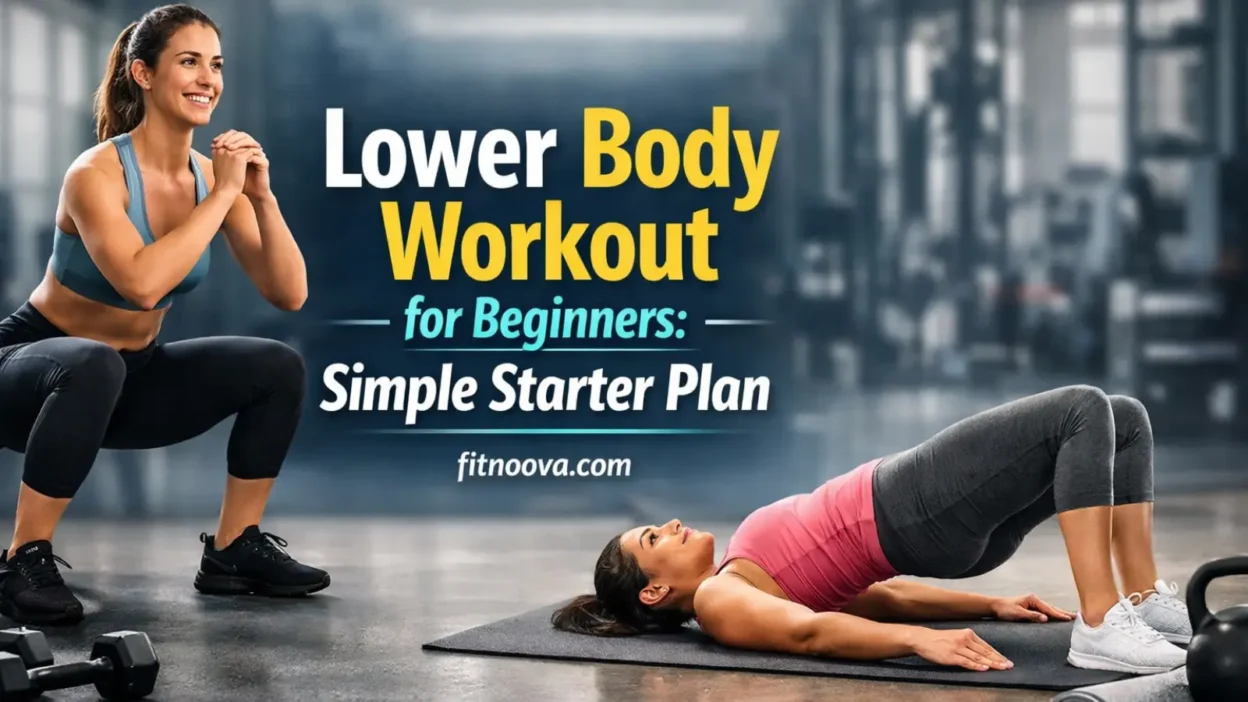
If you are new to strength training, the best lower body workout for beginners is a short routine built around a squat, a bridge, a split-stance movement, a hip hinge, and a calf raise. You do not need a punishing leg day, advanced lifts, or a long list of exercises. You need a plan you can learn, repeat, and recover from.
A good starting point is 2 lower-body sessions per week on nonconsecutive days. That fits public-health guidance for muscle-strengthening work on at least 2 days per week and gives most beginners enough practice without turning recovery into the main problem.
Quick Answer
A simple lower body workout for beginners usually includes 5 basic exercises:
- squat or sit-to-stand
- glute bridge
- split squat hold or reverse lunge
- hip hinge
- calf raise
Start with 2 sets of each exercise, train 2 times per week, and stop each set while your form is still steady. The workout should feel challenging, but controlled.
Who This Plan Is For
This plan is a good fit for adults who are new to exercise, coming back after a long break, or starting lower-body strength work without much confidence.
It is designed to help you learn the main lower-body movement patterns, build basic strength for daily life, and improve exercise tolerance without jumping straight into advanced leg training. That beginner-first approach is consistent with how many strong competing pages frame lower-body training: start with foundational patterns first, then progress once those feel stable.
This is general fitness guidance, not personal medical advice. If you have a recent injury, recent surgery, uncontrolled cardiovascular symptoms, major balance issues, or a condition that affects exercise safety, speak with a clinician or physical therapist before starting.
The Beginner Lower Body Workout
Do this routine 2 times per week on nonconsecutive days.
- Box Squat Or Sit-to-Stand — 2 sets of 8 to 12 reps
- Glute Bridge — 2 sets of 10 to 15 reps
- Split Squat Hold Or Reverse Lunge — 2 sets of 6 to 10 reps per side
- Hip Hinge With Body Weight Or Light Dumbbells — 2 sets of 8 to 12 reps
- Standing Calf Raise — 2 sets of 10 to 15 reps
Rest about 60 to 90 seconds between sets.
If the whole workout feels too easy after a couple of weeks, add reps first. Then add a third set to one or two exercises. Only after that should you worry about adding load.
How To Choose Your Starting Version
Start with the easiest version you can control well.
Choose a box squat or sit-to-stand if regular bodyweight squats feel awkward, deep, or unstable. Chair-based squat patterns are a common beginner entry point because they teach the basic movement without forcing depth you cannot control yet.
Choose a split squat hold if lunges feel too shaky. A static split stance lets you work on balance and leg strength without the extra timing demand of stepping forward or backward. ACE’s beginner lower-body guidance uses this kind of introductory progression well.
Choose a bodyweight hip hinge with hands on hips if you are still learning how to move from the hips without rounding your back. Add light dumbbells later.
Choose supported calf raises if balance is your main limitation. Holding a wall or chair is a smart adjustment, not a shortcut.
A Simple Warm-Up
You do not need a long warm-up for this workout. You do need to avoid starting cold.
Try this:
- 2 to 3 minutes of easy walking or marching
- 8 shallow bodyweight squats
- 8 hip hinges
- 6 split-stance weight shifts per side
- 10 calf raises
- 1 easy practice set of the first exercise
That is enough for most beginners to feel more prepared without turning the warm-up into its own workout.
How To Do Each Exercise
Box Squat Or Sit-to-Stand
Stand in front of a chair or bench with feet about hip- to shoulder-width apart. Push your hips back, bend your knees, and lower until you lightly touch the seat. Stand back up by pushing through the floor.
Think “sit back, not collapse down.” Keep your feet planted and your spine neutral. Mayo Clinic’s squat guidance emphasizes keeping the back neutral, keeping the knees centered over the feet, using support for balance if needed, and only going as low as you can control.
Glute Bridge
Lie on your back with your knees bent and feet flat. Press through your feet and lift your hips until your body forms a line from shoulders to knees. Lower with control.
Do not chase a huge range of motion. A smaller bridge with good control is better than cranking into your lower back.
Split Squat Hold Or Reverse Lunge
For the hold, set your feet in a split stance and lower a short distance into the position. Hold for 10 to 20 seconds per side, or perform slow reps if you are ready.
For the reverse lunge, step one foot back, bend both knees, then return to standing.
Mayo Clinic’s lunge guidance emphasizes a neutral back, smooth movement, and only going as low as you can control.
If balance is shaky, lightly hold a wall, railing, or chair.
Hip Hinge
Stand tall with soft knees. Push your hips back while keeping your chest long and spine neutral. Stop when you feel your hamstrings load, then stand tall again.
The goal is to learn the hinge pattern, not to touch the floor. A lot of beginners turn this into a squat or round through the lower back. Keep the movement centered at the hips.
Standing Calf Raise
Stand with feet about hip-width apart. Rise onto the balls of your feet, pause briefly, then lower slowly.
You can hold onto a wall for support. Calf raises are a simple beginner-friendly way to train the lower leg, and beginner guidance commonly starts with bilateral assisted reps before adding harder versions.
How Hard It Should Feel
This workout should feel like strength training, not survival.
A good beginner target is to finish each set knowing you could probably do 2 or 3 more reps with solid form. That gives you enough challenge to make the workout worthwhile without pushing into sloppy technique too early. Competing beginner routines commonly use controlled rep ranges and leave room for progression instead of pushing all-out effort from day one.
If your form changes noticeably near the end of the set, stop there. The rep only counts if it still looks like the exercise you meant to do.
How Often To Train Lower Body
Most beginners do well with 2 lower-body workouts per week.
You can add a third session later if your total training volume stays modest and you recover well. Public-health guidance from CDC and NHS supports muscle-strengthening work on at least 2 days per week, which makes 2 sessions a practical baseline for beginners.
A simple weekly setup could look like this:
- Monday: lower body
- Wednesday: upper body or walking
- Friday: lower body
How To Progress Without Overdoing It
Progression should be boring in the best way. Small changes work.
Use this order:
First, add reps within the target range.
Next, add a third set to one or two exercises.
Then add a small amount of weight.
After that, move to a slightly harder variation.
Examples:
- sit-to-stand becomes bodyweight squat
- split squat hold becomes reverse lunge
- bodyweight hinge becomes light dumbbell Romanian deadlift
- regular calf raise becomes slower tempo or assisted single-leg calf raise
This is also how many beginner-friendly competitors structure progress: master the basic version first, then add load or complexity once the movement looks steady.
Home And Gym Options
This routine works in either setting.
At home, you can use a chair, your body weight, a backpack, or a pair of dumbbells.
At the gym, you can use a bench for box squats, dumbbells for squats and hinges, and a leg press as a squat substitute if you are comfortable using it. Gym-focused competitor pages often include machines like the leg press and leg curl to make lower-body training less intimidating for beginners, which is useful as an option, not a requirement.
You do not need to force gym-only exercises into a beginner plan. The best version is the one you can perform with control and repeat consistently.
Common Mistakes Beginners Make
Doing Too Much Too Soon
You do not need a marathon leg workout. A short routine done consistently is more useful than a big first session that leaves you unable to train again for a week.
Choosing Variations You Cannot Control
A shallow squat with good balance is better than a deep squat that folds you forward. A supported split squat is better than a wobbly lunge you cannot repeat well.
Treating Soreness Like The Goal
Soreness can happen, especially when you are new, but it is not proof that the workout was better. Progress is better judged by better control, more reps with good form, or an easier recovery between sessions.
Rushing Reps
Beginners often move too fast to feel stable. Slower reps usually make it easier to learn the pattern.
Skipping Balance Support
Using a wall, rail, or chair is often the fastest way to learn the movement safely.
Normal Soreness Vs Warning Signs
Mild muscle fatigue during a set is normal. Mild to moderate soreness the next day or two can also be normal when you are new to training or after you increase the workload.
Back off and reassess if you have sharp joint pain, pain that changes your movement pattern, swelling that seems unusual, or soreness so intense that normal walking or stairs feel significantly impaired beyond the expected beginner adjustment.
Stop exercising and get medical help if you develop chest pain, unusual breathlessness, dizziness, faintness, or palpitations during exercise. Mayo Clinic specifically flags chest pain, breathlessness, palpitations, and dizziness during exercise as reasons to stop and seek medical help, and its chronic-disease exercise guidance also flags dizziness, unusual shortness of breath, chest pain, and irregular heartbeat as warning signs.
A Simple Four-Week Starter Progression
Week 1
Do 2 sets of each exercise and stay at the easier end of the rep range.
Week 2
Keep the same exercise versions and add a few reps where you can.
Week 3
Add a small amount of load to one or two exercises if your form is stable.
Week 4
Add a third set to your first one or two exercises, or progress one movement to a slightly harder variation.
That is enough for a solid first month. You do not need a dramatic overhaul. You need a repeatable plan.
FAQ
Can beginners do a lower body workout every day?
Usually, no. Most beginners do better with 2 lower-body sessions per week, or at most 3 if the workouts are still manageable. Recovery matters because muscles, joints, and connective tissues all need time to adapt.
Is bodyweight enough for beginner leg training?
Yes. Bodyweight is often enough at the start, especially if the movements are new to you and the reps are controlled. Once bodyweight gets too easy, add reps, add a set, slow the tempo, or add a light external load.
What if lunges hurt my knees?
First, switch to a split squat hold, shorten the range of motion, or lightly hold onto support. If the discomfort is mild and improves with better control, the setup may be the issue. If the pain is sharp, worsening, or clearly joint-based, stop that variation and consider getting individual guidance.
How long should a beginner lower body workout take?
Around 20 to 35 minutes is enough for most people. A short warm-up plus 5 controlled exercises with moderate rest is plenty for a beginner session.
Should beginners do a separate lower body day or a full-body routine?
Either can work. If you train 2 days per week total, a full-body plan is often practical. If you train 3 or more days per week, a separate lower-body day can fit well. What matters most is total weekly consistency, not whether the workout split looks advanced.
Conclusion
The best lower body workout for beginners is not the one with the most exercises. It is the one you can perform well, recover from, and repeat next week.
Start with a few foundational movements, train twice per week, keep your reps controlled, and progress slowly. That approach is usually safer, more sustainable, and more useful than trying to copy an advanced leg-day routine before you are ready.