Dumbbells are one of the simplest ways for beginners to start strength training at home or in the gym. They are flexible, easy to scale, and strong enough to train all major muscle groups with a small number of movements. For most beginners, the best dumbbell workout is a full-body routine built around squats, hinges, presses, rows, split-leg work, carries, and basic core training. Public-health guidance recommends muscle-strengthening work on at least 2 days per week, and dumbbells are a practical way to do that.
If you want the fastest useful answer, here it is: start with 2 to 3 full-body dumbbell workouts per week, use light-to-moderate weights you can control with good form, train the major muscle groups, and leave at least one recovery day before hitting the same muscles hard again. Warm up first, move the weights in a smooth, controlled way, and add reps or load gradually over time.
Why Dumbbells Work So Well For Beginners
Dumbbells are beginner-friendly because they let you learn strength training without needing a full gym or a complicated split. They work at home, in small spaces, and in most gym settings. They also teach balance and side-to-side control because each arm or leg has to do its own share of the work. That is one reason beginner dumbbell guides consistently rely on them for full-body training.
They are also easy to scale. You can start with one pair, learn the movements, and progress by adding reps, slowing the tempo, adding sets, or moving to slightly heavier weights. NIH guidance for strength beginners is consistent with that approach: start with small amounts of weight, focus on form, use smooth and steady movements, and increase load slowly.
Quick Answer
A dumbbell workout for beginners is a simple full-body strength routine built around basic exercises like squats, presses, rows, hinges, and core work. The best beginner plan uses light-to-moderate dumbbells, controlled reps, and 2 to 3 workouts per week to build strength, improve form, and create steady progress without making training feel complicated.
Who This Plan Is For
This plan fits you well if you are new to strength training, training mostly at home, using limited equipment, or looking for a simple routine you can repeat for several weeks without needing advanced programming. It is especially useful if barbells, machines, or crowded gym setups feel overwhelming.
What You Need Before You Start
You do not need a full home gym. A beginner can get started with one pair of dumbbells, enough floor space to squat and hinge safely, and a stable surface for support if needed. Two dumbbells are more flexible than one, and adjustable dumbbells make progression easier if you plan to keep training. A mat is helpful for floor work, but not essential. These setup basics are common across the stronger home dumbbell guides in the results.
How Heavy Should Your Dumbbells Be?
Start lighter than you think you need. A beginner load should feel easy at the start of the set and challenging by the last few reps, but it should not break your form. If the weight feels effortless all the way through, it is too light. If your range of motion shortens, your posture collapses, or you have to jerk the weight to finish reps, it is too heavy. That “last 2 to 3 reps feel hard but controlled” standard is a better beginner rule than chasing heavy numbers. NIH and Mayo guidance both support starting light, prioritizing form, and using controlled movement instead of momentum.
If you only have light dumbbells, do not assume they are useless. Beginners can still progress by doing more reps, slowing the lowering phase, reducing rest slightly, or using one-arm and one-leg variations that make the same weight feel more challenging. Several competitor pages do this well; your routine should too.
How Often Should Beginners Do Dumbbell Workouts?
Most beginners do best with 2 to 3 full-body sessions per week. That is enough to build strength, practice technique, and recover. The CDC recommends muscle-strengthening activities on 2 or more days per week that train the major muscle groups, and the National Institute on Aging advises avoiding the same muscle groups on consecutive days so recovery can happen between sessions.
A simple weekly setup looks like this:
- Monday: Workout A
- Wednesday: Workout B
- Friday: Workout A
- Weekend: Walking, easy cardio, or recovery work
The next week, switch the order and start with Workout B.
How To Warm Up Before A Dumbbell Workout
Do not go straight from sitting still to squatting, hinging, and pressing with weights. Mayo Clinic guidance recommends warming up for 5 to 10 minutes before strength work because cold muscles are more injury-prone than warm muscles.
A good beginner warm-up:
- 3 to 5 minutes of brisk walking, marching, or cycling
- 10 bodyweight squats
- 8 hip hinges
- 8 reverse lunges or split-stance step-backs
- 10 arm circles each direction
- 20 seconds of plank or 6 dead bugs per side
The goal is to feel ready, not exhausted.
The Best Beginner Dumbbell Exercises
The strongest beginner dumbbell plans repeatedly come back to the same movement patterns: squat, hinge, push, pull, split-leg work, carry, and core control. That is because those patterns train the major muscle groups and build useful strength without unnecessary complexity.
1. Goblet Squat
What it trains: quads, glutes, core
How to do it: Hold one dumbbell at your chest, keep your chest tall, sit down between your hips, and stand back up by pushing through your feet.
Beginner cue: Keep the dumbbell close to your body and keep your heels down.
Avoid: collapsing forward or rushing the bottom.
2. Dumbbell Romanian Deadlift
What it trains: hamstrings, glutes, hips
How to do it: Hold dumbbells in front of your thighs, soften your knees, push your hips back, lower the weights along your legs, then stand tall again.
Beginner cue: Think “hips back” instead of “bend down.”
Avoid: rounding your back or turning it into a squat.
3. Dumbbell Floor Press
What it trains: chest, shoulders, triceps
How to do it: Lie on the floor with knees bent, start with the dumbbells by your chest, press up, then lower until your upper arms touch the floor.
Beginner cue: Keep your wrists stacked and lower under control.
Avoid: flaring the elbows too wide or dropping the weights fast.
4. One-Arm Dumbbell Row
What it trains: upper back, lats, arms
How to do it: Brace one hand on a bench or stable surface, pull the dumbbell toward your hip, then lower it with control.
Beginner cue: Pull your elbow back, not just the hand up.
Avoid: twisting your torso to cheat the rep.
5. Dumbbell Shoulder Press
What it trains: shoulders, triceps, upper body pressing strength
How to do it: Start with the dumbbells at shoulder height, press overhead, then lower with control.
Beginner cue: Keep your ribs down and your body tall.
Avoid: arching your lower back to finish reps.
6. Dumbbell Split Squat
What it trains: quads, glutes, balance, single-leg control
How to do it: Step into a split stance, lower straight down, then drive through the front foot to stand.
Beginner cue: Keep most of your balance over the front leg.
Avoid: taking too short a stance and crowding the movement.
7. Dumbbell Carry
What it trains: grip, posture, core stability
How to do it: Pick up the dumbbells, stand tall, and walk slowly under control.
Beginner cue: Keep your shoulders down and ribs stacked over hips.
Avoid: leaning side to side.
8. Dead Bug Or Plank
What it trains: core control, trunk stability
How to do it: Use a dead bug if you want more controlled beginner core work, or a short plank if you can keep a stable body line.
Beginner cue: Keep your low back steady.
Avoid: holding the position longer than you can keep good form.
The Best Beginner Dumbbell Workout Plan
This is a practical full-body plan you can do at home or in the gym. It is simple enough for beginners, but structured enough to produce real progress.
Workout A
- Goblet Squat — 3 sets of 8 to 10 reps
- Dumbbell Floor Press — 3 sets of 8 to 10 reps
- One-Arm Dumbbell Row — 3 sets of 8 to 10 reps per side
- Dumbbell Romanian Deadlift — 3 sets of 8 to 10 reps
- Plank — 2 sets of 20 to 30 seconds
- Dumbbell Carry — 2 rounds of 20 to 40 steps
Workout B
- Dumbbell Split Squat — 3 sets of 8 reps per side
- Dumbbell Shoulder Press — 3 sets of 8 to 10 reps
- One-Arm Dumbbell Row — 3 sets of 8 to 10 reps per side
- Glute Bridge With Dumbbell — 3 sets of 10 to 12 reps
- Dead Bug — 2 sets of 6 to 10 reps per side
- Dumbbell Carry — 2 rounds of 20 to 40 steps
This structure is consistent with the strongest beginner dumbbell plans in the results: full-body, repeatable, simple, and built around compound patterns.
Sets, Reps, Rest, And Tempo
Beginners do not need advanced programming. A clean starting point is:
- Sets: 2 to 3 per exercise
- Reps: 8 to 12 for most movements
- Rest: 60 to 90 seconds between sets
- Tempo: lower the weight under control, pause briefly if needed, then lift without jerking
Mayo and NIH guidance both support controlled movement rather than rushing or using momentum. Mayo also notes that about one minute of rest between exercises is reasonable for general strength work.
A Simple 4-Week Beginner Progression
Week 1
Do 2 workouts. Learn the movements. Keep the load conservative.
Week 2
Do 3 workouts if recovery feels good. Keep the same exercise list.
Week 3
Add 1 to 2 reps to your main lifts or increase the load slightly if all reps are controlled.
Week 4
Keep the same structure. Try to improve form quality, confidence, and consistency rather than changing everything.
This progression model is stronger than random weekly variety because beginners usually improve fastest by repeating basics long enough to actually learn them. That pattern is common across the better beginner dumbbell plans in the results.
How To Know When To Increase Weight
Increase the weight when you can complete all prescribed sets and reps with good form and still feel like you had 1 to 2 reps left in reserve on most sets. If your technique breaks down early, keep the same load. If you miss reps for two sessions in a row, reduce the weight slightly or stay there until your form catches up.
This is a better beginner rule than trying to add weight every workout.
Home Vs Gym Adjustments
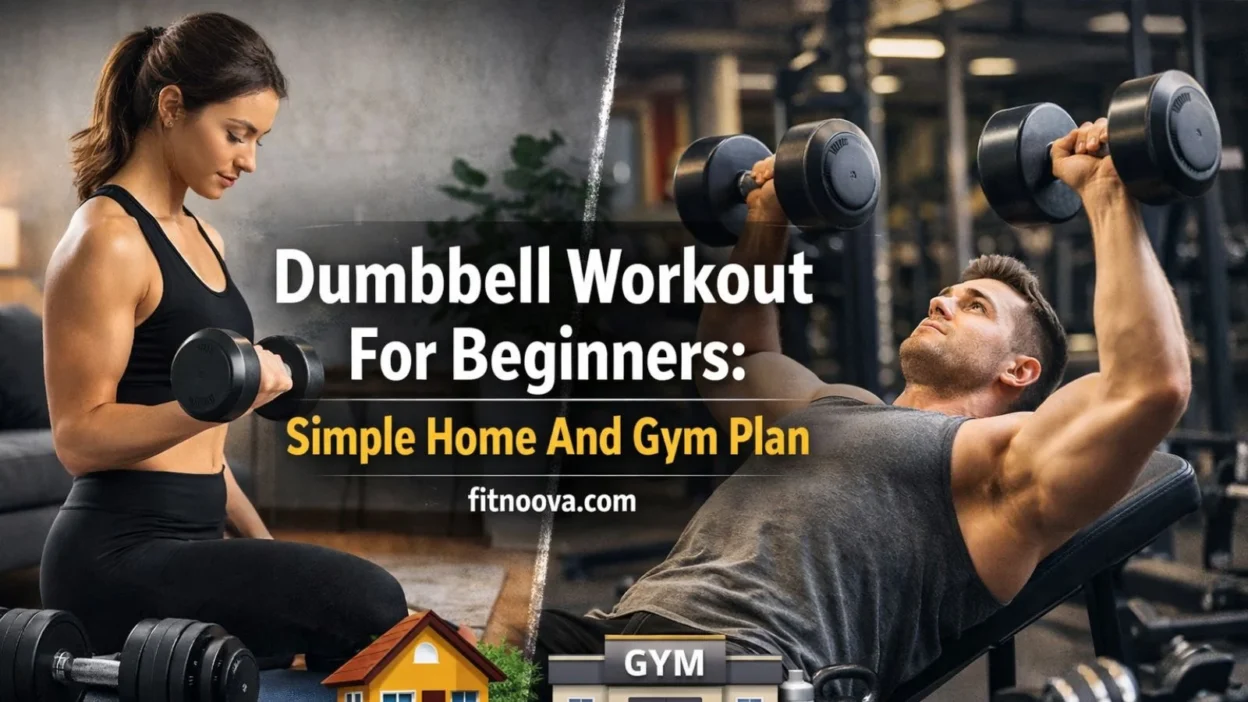
At home, use the floor press instead of a bench press, carries instead of machine work, and glute bridges if setup options are limited. In the gym, you can swap the floor press for a dumbbell bench press and use a bench for extra row support. The routine should not change just because the setting changes. The setting should only change the setup.
Common Beginner Mistakes To Avoid
Starting Too Heavy
The fastest way to make dumbbell training feel awkward is to choose a weight that forces bad form from the first set. NIH recommends starting with small amounts of weight and progressing slowly.
Rushing Reps
Mayo and NIH both recommend controlled movement. Fast, jerky reps make it harder to learn the movement and easier to lose position.
Skipping The Warm-Up
Cold muscles are more injury-prone than warm ones. Even 5 to 10 minutes helps.
Training The Same Muscles Hard On Consecutive Days
The National Institute on Aging advises avoiding the same muscle groups on back-to-back days to allow recovery.
Holding Your Breath
NIH specifically advises against holding your breath during strength exercises. Exhale during the hard part of the rep and inhale during the easier part.
Changing The Plan Too Soon
A beginner routine should look boring enough to repeat. You need enough repetition to learn the lifts and enough time to actually progress.
What To Do On Non-Lifting Days
You do not need total inactivity between dumbbell sessions. Good off-day options include brisk walking, easy cycling, light mobility work, or a short recovery routine. The CDC recommends regular aerobic activity in addition to muscle-strengthening work, so walking on off days fits well with a beginner strength plan.
Safety Notes Before You Start
If you have been inactive for a long time, have a chronic condition, or are unsure whether resistance training is appropriate for you, it is reasonable to check with a qualified clinician before starting. During training, stop and get medical help if you notice symptoms such as chest pain, severe dizziness, or pain that feels sharp, unusual, or worsening rather than like normal exercise effort. Mayo and NIH both emphasize paying attention to your body and not pushing through warning-sign symptoms.
What To Do
- warm up for 5 to 10 minutes
- train 2 to 3 times per week
- use full-body sessions
- start light and move with control
- leave at least one recovery day before training the same muscles hard again
- repeat the plan long enough to improve
- add reps or load gradually
What To Avoid
- starting too heavy
- skipping the warm-up
- jerking the weight up
- copying advanced bodybuilder splits
- training hard on back-to-back days for the same muscles
- chasing soreness instead of progress
- changing exercises every session
FAQ
Is a dumbbell workout enough for beginners?
Yes. A dumbbell workout is enough for beginners if it trains the major muscle groups, uses progressive overload, and is repeated consistently. Dumbbells are a valid way to do the muscle-strengthening work recommended for adults.
Can I build muscle with just dumbbells?
Yes. Beginners can build strength and muscle with dumbbells if the exercises are challenging enough, the routine is consistent, and the load or reps gradually increase over time. That is exactly why so many strong beginner guides use dumbbell-only plans.
Can I do dumbbell workouts at home?
Yes. Dumbbells work very well at home because they take little space and can train the whole body without machines.
How long should a beginner dumbbell workout be?
Most beginner dumbbell sessions work well in about 30 to 45 minutes, including a short warm-up. Shorter sessions can still work if they cover the main movement patterns and are done consistently.
Should I use one dumbbell or two?
Either can work. Two dumbbells give you more options and better balance between sides, but one dumbbell is enough to start many beginner movements such as goblet squats, Romanian deadlifts, rows, and carries.
Should beginners train to failure?
Usually not. Beginners make strong progress by leaving a little room in the tank, keeping form clean, and progressing steadily. Training to technical breakdown is a worse beginner strategy than training under control.
How sore should I be after a dumbbell workout?
Some soreness is normal, especially at first. Sharp pain, joint pain, swelling, or pain that changes how you move is different and should not be ignored. NIH guidance specifically warns that sore joints or muscle pain can mean you are overdoing it.
Is it okay to repeat the same beginner dumbbell workout every week?
Yes. Beginners usually progress better by repeating a simple plan long enough to improve technique, reps, and weight rather than constantly switching programs.
Conclusion
A beginner dumbbell workout should be simple, repeatable, and hard enough to matter without being so hard that it ruins your recovery. Train the full body, use weights you can control, warm up first, rest between hard sessions, and progress slowly. That is what makes a beginner plan work.
You do not need a fancy split, a crowded gym, or a huge equipment setup. You need a smart routine you can still follow next week.