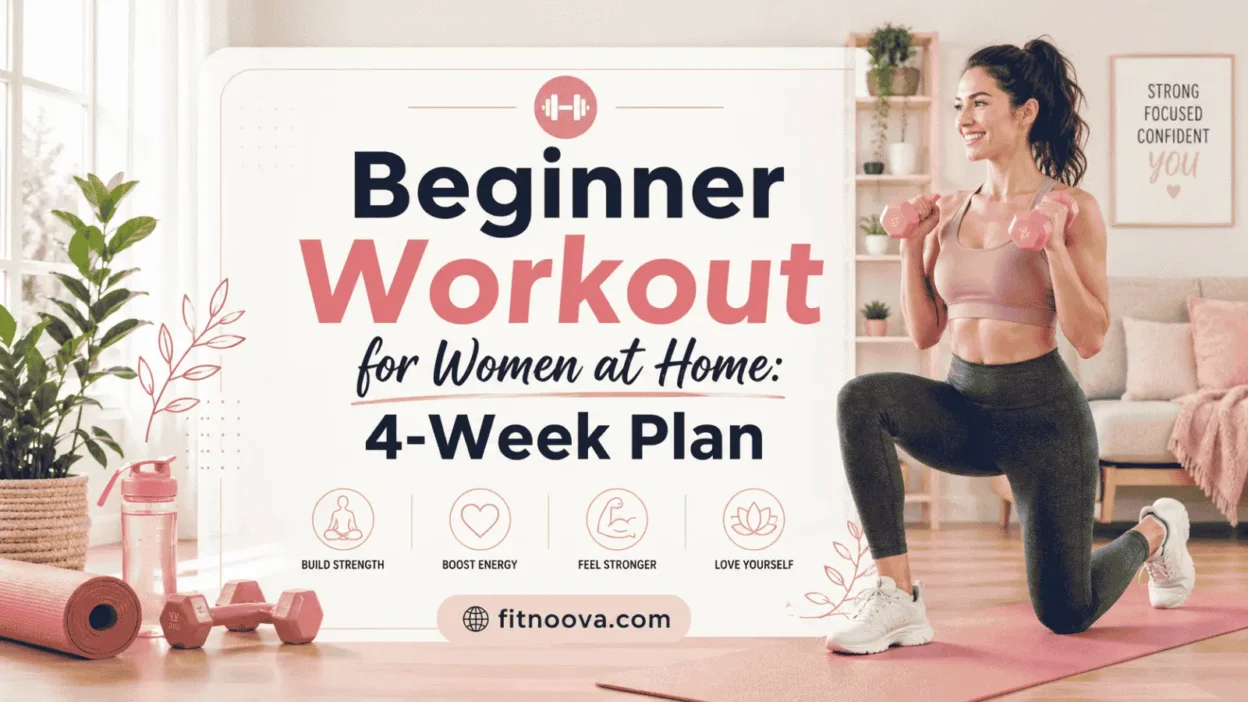
A beginner workout for women at home should be simple, safe, and realistic enough to repeat. You do not need a gym membership, complicated equipment, or hour-long sessions to start building strength, improving endurance, and feeling more confident with movement.
The best place to begin is with short full-body workouts that train basic movement patterns: squatting, hinging, pushing, pulling, bracing your core, and stepping or marching for light cardio. For most beginners, three home workouts per week is enough to build consistency without feeling overwhelmed.
This guide gives you a clear 4-week routine, beginner-friendly exercise instructions, modifications, progression tips, and safety guidance so you can start at home with confidence.
Quick Answer
The best beginner workout for women at home is a 20- to 30-minute full-body routine done three times per week, with rest or light walking between sessions. Focus on simple bodyweight exercises such as squats, glute bridges, wall push-ups, bird dogs, step-backs, and planks. Start at an effort level that feels manageable, progress gradually, and stop if you feel chest pain, dizziness, unusual shortness of breath, or sharp joint pain.
Why Home Workouts Work Well For Beginners
Home workouts remove many of the barriers that keep people from starting. There is no commute, no waiting for equipment, no pressure to know gym etiquette, and no need to perform in front of anyone.
For beginners, that matters. The first goal is not to create the hardest workout possible. It is to create a routine you can repeat long enough for your body to adapt.
A good beginner home workout can help you:
- Build basic strength in your legs, hips, core, arms, back, and shoulders
- Improve balance and coordination
- Support better daily movement, such as climbing stairs or carrying groceries
- Increase cardiovascular fitness when paired with walking or low-impact cardio
- Build exercise confidence without overtraining
Public health guidance recommends that adults aim for at least 150 minutes of moderate-intensity physical activity per week and include muscle-strengthening activity on two or more days weekly. You do not need to reach that all at once; starting with shorter sessions still counts and can build momentum.
Who This Beginner Home Workout Is Best For
This routine is designed for women who are new to exercise, returning after a break, or looking for a low-pressure plan they can do at home.
It works well if you:
- Prefer bodyweight workouts or minimal equipment
- Want a beginner strength routine without jumping
- Need a short workout that fits around work, caregiving, or a busy schedule
- Feel unsure where to start
- Want a plan that supports fitness, strength, and healthy habits without extreme rules
You can do the routine with no equipment. A yoga mat is helpful but optional. If you want to add resistance later, a pair of light dumbbells or resistance bands can make the workouts more challenging.
Before You Start: Safety And Intensity
For a beginner, the right workout should feel challenging but controlled. You should be able to breathe steadily, maintain good form, and finish with the sense that you could do a little more.
A simple way to measure effort is the 0-to-10 effort scale:
- 1–2: Very easy
- 3–4: Moderate and comfortable
- 5–6: Challenging but sustainable
- 7–8: Hard
- 9–10: Max effort
For your first few weeks, aim for about a 4 to 6 out of 10 during strength exercises. ACSM materials describe moderate exercise as roughly a 3 to 4 on a 0-to-10 perceived exertion scale, while vigorous exercise feels harder. For this beginner plan, you do not need to train at maximum effort.
Stop exercising and seek medical guidance if you experience chest pain, dizziness, palpitations, faintness, severe breathlessness, or sharp pain during exercise. Mayo Clinic and Cleveland Clinic guidance both emphasize not pushing through concerning symptoms such as chest pain or dizziness during exercise.
You may also want to check with a healthcare professional before starting if you are pregnant, recently postpartum, recovering from injury or surgery, managing a heart condition, or have been advised to limit activity.
The Best Beginner Workout Schedule For Women At Home
Start with three workouts per week. Leave at least one rest day or lighter day between strength sessions when possible.
A simple weekly schedule could look like this:
| Day | Plan |
|---|---|
| Monday | Full-Body Workout A |
| Tuesday | Walk, mobility, or rest |
| Wednesday | Full-Body Workout B |
| Thursday | Rest or easy movement |
| Friday | Full-Body Workout A |
| Saturday | Walk, stretch, or light activity |
| Sunday | Rest |
The next week, switch the order:
| Day | Plan |
|---|---|
| Monday | Full-Body Workout B |
| Wednesday | Full-Body Workout A |
| Friday | Full-Body Workout B |
This gives you variety without making the plan complicated.
Warm-Up: 5 Minutes Before Every Workout
A warm-up should make your body feel ready, not tired. Move slowly at first, then increase your range of motion as you loosen up.
Do this before each workout:
- March In Place — 60 seconds
Keep your posture tall and swing your arms naturally. - Shoulder Rolls — 30 seconds forward, 30 seconds backward
Relax your neck and move smoothly. - Hip Circles — 30 seconds each direction
Keep the movement controlled. - Bodyweight Good Mornings — 10 reps
Place your hands on your hips, soften your knees, push your hips back, and return to standing. - Easy Squat To Chair — 8 reps
Sit back toward a chair, lightly tap it, then stand tall. - Wall Push-Ups — 8 reps
Place your hands on a wall and move through a comfortable range of motion.
Full-Body Workout A: Strength And Stability
Do this workout at a steady pace. Rest 30 to 60 seconds between exercises, or longer if needed.
1. Chair Squat
Reps: 8 to 12
Sets: 2
Stand in front of a sturdy chair with your feet about hip-width apart. Push your hips back, bend your knees, lightly touch the chair, then stand up.
Make it easier: Use a higher chair or place your hands on your thighs for support.
Make it harder: Slow down the lowering phase or hold a light dumbbell at your chest.
2. Glute Bridge
Reps: 10 to 15
Sets: 2
Lie on your back with your knees bent and feet flat. Press through your heels, lift your hips, squeeze your glutes, then lower with control.
Form tip: Do not arch your lower back at the top. Think about lifting your hips with your glutes, not your spine.
3. Wall Push-Up
Reps: 8 to 12
Sets: 2
Place your hands on a wall at chest height. Step your feet back slightly. Bend your elbows to bring your chest toward the wall, then press away.
Make it harder: Use a countertop or sturdy bench instead of the wall.
4. Bird Dog
Reps: 6 to 10 per side
Sets: 2
Start on hands and knees. Extend your right arm and left leg, pause, then return to the start. Switch sides.
Form tip: Keep your hips level. Move slowly instead of rushing.
5. Step-Back Lunge Or Supported Step-Back
Reps: 6 to 8 per side
Sets: 2
Stand tall and step one foot back. Bend both knees slightly, then push through the front foot to return to standing.
Make it easier: Hold a chair or counter for balance and keep the range of motion small.
Swap option: If lunges bother your knees, do reverse step-backs without bending deeply.
6. Dead Bug
Reps: 6 to 10 per side
Sets: 2
Lie on your back with your knees bent over your hips and arms reaching up. Slowly lower one heel toward the floor while lowering the opposite arm behind you. Return and switch sides.
Form tip: Keep your lower back gently connected to the floor. Reduce the range of motion if your back arches.
Full-Body Workout B: Low-Impact Cardio And Core
This session keeps things joint-friendly while adding a little more movement. Rest as needed.
1. March With Arm Reach
Time: 45 seconds
Sets: 2
March in place while reaching your arms overhead or forward. Keep the pace comfortable.
Make it easier: Slow down and keep your arms lower.
Make it harder: Pick up the pace without jumping.
2. Sit-To-Stand
Reps: 8 to 12
Sets: 2
Sit on a sturdy chair with your feet flat. Stand up without using momentum, then sit down slowly.
Form tip: Keep your knees tracking in the same direction as your toes.
3. Incline Push-Up
Reps: 8 to 10
Sets: 2
Place your hands on a sturdy countertop or bench. Keep your body in a straight line as you lower and press back up.
Make it easier: Use the wall.
Make it harder: Use a lower surface.
4. Standing Hip Hinge
Reps: 10 to 12
Sets: 2
Stand with feet hip-width apart. Push your hips back as if closing a car door with your hips. Keep your spine long, then stand tall.
Why it matters: This teaches the basic movement pattern used in deadlifts and many daily activities.
5. Side Step With Reach
Time: 45 seconds
Sets: 2
Step to the right, bring your feet together, then step to the left. Add an easy arm reach if comfortable.
Make it harder: Lower slightly into your hips as you step.
6. Modified Plank
Time: 10 to 25 seconds
Sets: 2
Place your forearms on a countertop, bench, or the floor with knees down. Brace your core as if preparing for a gentle cough.
Form tip: Stop before your lower back sags or your shoulders shrug.
The 4-Week Beginner Home Workout Plan
This plan builds gradually. The goal is to finish each week feeling more capable, not exhausted.
Week 1: Learn The Movements
Do three workouts this week. Use Workout A twice and Workout B once, or alternate based on preference.
Goal: Learn form and keep the effort moderate.
Sets: 1 to 2 per exercise
Rest: 45 to 90 seconds as needed
Effort: 4 to 5 out of 10
Do not worry about doing more. The win is completing the sessions with good control.
Week 2: Build Consistency
Do three workouts again.
Goal: Repeat the routine with better confidence.
Sets: 2 per exercise
Rest: 30 to 75 seconds
Effort: 5 to 6 out of 10
If an exercise feels too easy, slow it down before adding reps.
Week 3: Add A Little Volume
Stay with three workouts, but add a small challenge.
Choose one:
- Add 2 reps to each strength exercise
- Add 5 seconds to each plank or cardio interval
- Add a third set to one or two exercises
- Reduce rest slightly while keeping good form
Goal: Progress without rushing.
Effort: 5 to 6 out of 10, occasionally 7 if form stays solid
Week 4: Make It Feel Like A Routine
By week 4, the workout should feel familiar. That does not mean easy; it means you understand the movements.
Goal: Complete three steady workouts and notice what feels stronger or smoother.
Sets: 2 to 3 for selected exercises
Rest: As needed for quality reps
Effort: 5 to 7 out of 10
At the end of week 4, you can repeat the plan with slightly harder variations, add resistance bands or dumbbells, or continue with the same routine until it feels too easy.
How To Progress Without Overdoing It
Progress does not have to mean longer, harder, sweatier workouts. For beginners, the safest progress usually comes from small changes.
Try one progression at a time:
- Add 1 to 2 reps per exercise
- Add one extra set to two exercises
- Slow the lowering phase of squats, bridges, or push-ups
- Use a lower surface for incline push-ups
- Hold a light weight during squats or glute bridges
- Add a short walk on non-strength days
Avoid changing everything in the same week. If you add more reps, do not also add more sets, shorter rest, and harder variations all at once.
Resistance training programs generally progress over time by adjusting factors such as exercise selection, load, volume, and training frequency, but beginners do best when those changes are gradual and controlled.
What A Beginner Workout Should Feel Like
A good beginner workout should feel like work, but it should not feel punishing.
Normal sensations may include:
- Warm muscles
- Mild burning during the last few reps
- Faster breathing
- Light sweating
- Mild muscle soreness one or two days later
Back off or stop if you feel:
- Sharp pain
- Chest pain or pressure
- Dizziness or faintness
- Pain that changes your movement pattern
- Numbness or tingling
- Shortness of breath that feels unusual for you
- Joint pain that worsens as you continue
Mild soreness can happen when you start exercising, but pain is not a requirement for progress. You should not need to “earn” a workout by feeling wrecked afterward.
Beginner Form Tips That Matter Most
You do not need perfect form to start, but a few basics can make your workouts safer and more effective.
Move Slowly Enough To Stay In Control
Fast reps often hide poor control. Slower reps help you feel which muscles are working and where your position changes.
Keep Your Knees Tracking Naturally
During squats, sit-to-stands, and lunges, let your knees point in the same general direction as your toes. They do not need to stay perfectly still, but they should not collapse inward dramatically.
Brace Your Core Without Holding Your Breath
Think about gently tightening your midsection before each rep. You should still be able to breathe.
Use A Comfortable Range Of Motion
You do not have to squat deeply or plank for a full minute. Start with the range you can control, then build from there.
Stop A Set Before Your Form Falls Apart
For beginners, a clean set of 8 reps is more useful than 12 messy reps. Quality matters more than chasing numbers.
Can This Workout Help With Weight Loss?
A beginner workout for women at home can support weight loss, but it should not be treated as a guaranteed fat-loss plan. Exercise is only one part of the picture. Nutrition, sleep, stress, daily movement, consistency, and medical factors can all influence body weight.
The most useful approach is to focus on behaviors you can repeat:
- Strength train two to three times per week
- Walk or do low-impact cardio on some non-strength days
- Eat regular meals with protein, fiber, and satisfying portions
- Sleep as consistently as your schedule allows
- Avoid using exercise as punishment for eating
Strength training is especially helpful because it builds or maintains muscle, improves physical function, and supports long-term health. But the scale is not the only measure of progress. Better stamina, improved mood, easier daily movement, and stronger exercises are all meaningful signs that your routine is working.
What Equipment Do You Need?
You can start with no equipment. For the first few weeks, your body weight, a wall, a chair, and a small amount of floor space are enough.
Helpful optional equipment includes:
- Exercise mat
- Resistance band
- Light dumbbells
- Sturdy chair
- Step or low platform
- Supportive shoes if exercising on hard floors
Do not buy equipment before you know what you enjoy. A consistent bodyweight routine is more valuable than unused gear.
Common Mistakes To Avoid
Doing Too Much In The First Week
Motivation often runs high at the beginning, but your muscles, joints, and connective tissues need time to adapt. Start smaller than you think you need to. You can always add more later.
Skipping The Warm-Up
A few minutes of easy movement can make your workout feel better and help you practice the same patterns you will use in the session.
Choosing Exercises That Feel Too Advanced
You do not need burpees, jump squats, full push-ups, or long planks to get started. Easier variations are not “less real.” They are how you build a base.
Training Through Pain
Muscle effort is normal. Sharp pain, joint pain, chest symptoms, dizziness, or unusual breathlessness are not signals to push harder.
Changing The Plan Too Often
A routine only works if you repeat it. Give the plan at least four weeks before deciding whether it is effective.
Measuring Progress Only By Weight
Weight can fluctuate for many reasons. Also track strength, consistency, energy, mood, sleep, and how the exercises feel.
FAQ
How many days a week should a beginner woman work out at home?
Three days per week is a good starting point for beginner home workouts, especially if the sessions include full-body strength training. You can add walking, stretching, or gentle mobility on other days if you feel good, but you do not need intense daily workouts to make progress.
Is 20 minutes enough for a beginner workout?
Yes. A focused 20-minute workout can be enough for a beginner, especially when it includes compound movements such as squats, glute bridges, push-ups, hinges, and core exercises. Short workouts are often easier to repeat, which matters more than doing one long workout and then stopping.
Can I do this workout without equipment?
Yes. The routine uses bodyweight exercises and household support, such as a chair or wall. If you want to progress later, you can add resistance bands or dumbbells, but they are not required at the start.
Should I do cardio or strength training first?
For this plan, do strength training first after your warm-up, then add easy cardio or walking later if you want more movement. If your main goal is general fitness, a mix of strength training and moderate cardio across the week works well.
What should I do if squats hurt my knees?
First, reduce the range of motion and try sitting to a higher chair. Keep your feet planted and move slowly. If knee pain continues, swap squats for glute bridges, supported step-backs, or a smaller sit-to-stand movement. Ongoing or sharp knee pain is a reason to check with a qualified healthcare or fitness professional.
How long should I follow this beginner workout plan?
Follow it for at least four weeks. After that, you can repeat it with slightly harder variations, add light resistance, increase reps, or move to a more structured beginner strength program.
Conclusion
A beginner workout for women at home works best when it is simple, repeatable, and matched to your current fitness level. Start with three full-body sessions per week, use controlled bodyweight exercises, rest when needed, and progress in small steps.
You do not need to exhaust yourself to build strength. You need a routine that feels doable enough to come back to—and challenging enough to help your body adapt over time.