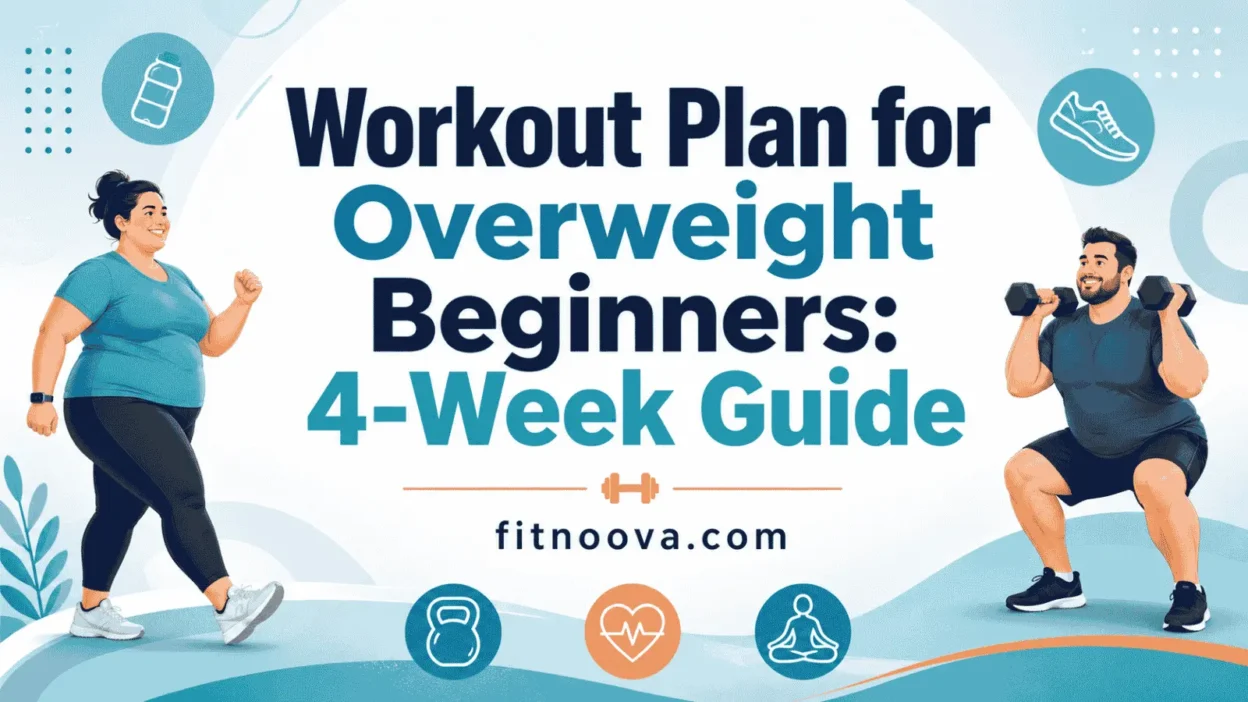
Starting a workout plan for overweight beginners does not mean jumping into hard workouts, chasing soreness, or trying to exercise every day. The best plan is simple, joint-friendly, repeatable, and built around gradual progress.
For most beginners, that means a mix of walking, basic strength training, mobility work, and rest days. The goal is not to prove how hard you can push on day one. It is to build enough consistency that exercise becomes something your body can adapt to instead of something you have to recover from for a week.
Quick Answer
A good workout plan for overweight beginners should start with 3 to 5 days of gentle movement per week, including walking and 2 beginner-friendly strength sessions. Keep the effort moderate, use low-impact exercises, and increase time, repetitions, or intensity gradually. Federal physical activity guidance recommends adults work toward 150 minutes of moderate aerobic activity per week plus 2 days of muscle-strengthening activity, but beginners can build toward that in smaller steps.
Before You Start: What This Plan Is Designed To Do
This plan is for adults who are new to exercise, returning after a long break, or starting from a higher body weight and want a practical routine that feels manageable.
It is designed to help you:
- Build basic stamina without high-impact cardio
- Strengthen your legs, hips, core, back, chest, and shoulders
- Improve confidence with simple movements
- Reduce the “all or nothing” approach that makes many beginners quit
- Create a routine you can repeat, adjust, and progress over time
It is not a crash fat-loss plan, a boot camp, or a punishment for being out of shape. Weight loss, if it happens, depends on many factors beyond workouts alone, including food intake, sleep, stress, medical history, medications, and consistency. Exercise is still valuable even when the scale moves slowly.
Who Should Check With A Healthcare Professional First
Most people can begin with light walking and gentle strength exercises, but it is smart to get medical guidance before starting if you have chest pain, dizziness, uncontrolled blood pressure, diabetes complications, recent surgery, severe joint pain, heart disease, breathing problems, or any condition that limits daily activity.
You should also slow down and seek guidance if exercise causes sharp pain, faintness, chest pressure, unusual shortness of breath, or pain that changes the way you walk. Normal beginner discomfort may feel like mild muscle soreness or effort. Warning signs feel sharper, more intense, or unusual for you.
The American Academy of Orthopaedic Surgeons emphasizes that safe exercise programs should start slowly and build gradually in frequency, intensity, and duration.
How Hard Should Beginner Workouts Feel?
Most workouts in this plan should feel like a 4 to 6 out of 10 effort.
That means you are working, breathing a little heavier, and aware that your body is active, but you are not gasping, straining, or counting the seconds until it ends.
A simple way to check intensity is the talk test:
- Easy effort: You can speak in full sentences comfortably.
- Moderate effort: You can talk, but you would not want to sing.
- Too hard for now: You can only say a few words before needing air.
For overweight beginners, moderate effort is usually the sweet spot. You do not need high-impact jumping, sprinting, or intense circuits to make progress.
The 4-Week Workout Plan For Overweight Beginners
This plan uses three types of training: walking, strength, and mobility. You can do it at home, outdoors, or in a gym.
Weekly Schedule
| Day | Workout |
|---|---|
| Monday | Walk + Mobility |
| Tuesday | Beginner Strength Workout A |
| Wednesday | Rest Or Easy Walk |
| Thursday | Walk + Mobility |
| Friday | Beginner Strength Workout B |
| Saturday | Optional Easy Walk Or Light Activity |
| Sunday | Rest |
This gives you 4 structured workout days, 1 optional day, and 2 recovery days. If that feels like too much, start with 3 days per week and repeat Week 1 until it feels comfortable.
Weeks 1 And 2: Build The Habit
The first two weeks are about showing up, learning the movements, and finishing workouts feeling like you could have done a little more.
Walking Plan
Walk 3 days per week for 10 to 20 minutes.
Choose a pace that feels comfortable but purposeful. You should not need to stop repeatedly to catch your breath. If 10 minutes feels like too much, do 5 minutes out and 5 minutes back, or split the walk into two shorter sessions in the same day.
Strength Plan
Do 2 strength workouts per week. Rest at least one day between them.
Use slow, controlled movement. Stop each set before your form breaks down.
Beginner Strength Workout A
Do 1 to 2 rounds of the following exercises.
Chair Sit-To-Stand
Sit on a sturdy chair with your feet flat on the floor. Stand up, then slowly sit back down.
Do 6 to 10 reps.
This builds strength in the thighs, hips, and glutes while using a familiar movement. If it feels too hard, use your hands lightly on the chair or choose a higher seat.
Wall Push-Up
Stand facing a wall with your hands at chest height. Bend your elbows to bring your chest toward the wall, then press back.
Do 6 to 12 reps.
Move your feet closer to the wall to make it easier. Step farther away to make it harder.
Standing March
Stand tall and slowly lift one knee, then the other, as if marching in place.
Do 20 to 30 seconds.
Hold a counter or chair for balance if needed.
Seated Band Row Or Towel Row
If you have a resistance band, loop it around a secure point and pull your elbows back. If not, hold a towel in both hands, gently pull it apart, and squeeze your shoulder blades.
Do 8 to 12 reps.
This helps train the upper back, which is important for posture and shoulder support.
Standing Calf Raise
Hold a chair or wall. Rise onto the balls of your feet, then lower slowly.
Do 8 to 12 reps.
Keep the movement controlled instead of bouncing.
Beginner Strength Workout B
Do 1 to 2 rounds of the following exercises.
Supported Step-Back
Stand near a wall or counter. Step one foot back, tap the floor, then return to standing. Alternate sides.
Do 6 to 8 reps per side.
This is a beginner-friendly way to train balance and leg strength without doing full lunges.
Incline Counter Push-Up
Place your hands on a sturdy counter. Step back slightly, bend your elbows, then press away.
Do 6 to 10 reps.
This is harder than a wall push-up but usually easier than a floor push-up.
Glute Bridge
Lie on your back with knees bent and feet flat. Gently tighten your glutes and lift your hips, then lower slowly.
Do 6 to 10 reps.
If lying on the floor is uncomfortable, replace this with another round of chair sit-to-stands.
Standing Side Leg Lift
Hold a chair or counter. Lift one leg out to the side without leaning your torso. Lower slowly.
Do 6 to 10 reps per side.
This trains the hips, which can help with walking comfort and lower-body stability.
Dead Bug Arms Only
Lie on your back with knees bent. Reach both arms toward the ceiling, then slowly lower one arm overhead and bring it back. Alternate sides.
Do 6 to 8 reps per side.
Keep your ribs relaxed and your lower back comfortable. If lying down does not work for you, do seated marches instead.
Weeks 3 And 4: Add A Little More
Once the workouts feel familiar, progress gently. You do not need to make every exercise harder at once.
Walking Progression
Walk 3 to 4 days per week for 15 to 25 minutes.
On one walk each week, add very short “brisk but controlled” intervals:
- Walk easy for 3 minutes
- Walk slightly faster for 30 seconds
- Repeat 3 to 5 times
- Finish with easy walking
This should still feel manageable. Avoid turning it into a sprint workout.
Strength Progression
Keep 2 strength workouts per week.
Choose one progression:
- Add 1 extra round
- Add 2 reps per exercise
- Slow down the lowering phase
- Use a slightly stronger resistance band
- Reduce how much you rely on the chair or wall for support
Small progressions are enough. The body responds well to consistency, not constant punishment.
Warm-Up And Cool-Down
A beginner workout should never start at full speed.
Simple 5-Minute Warm-Up
Do each movement for about 30 to 60 seconds:
- Easy walking in place
- Shoulder rolls
- Arm swings
- Gentle side steps
- Heel taps
- Slow sit-to-stands
The warm-up should make your body feel more prepared, not tired.
Simple Cool-Down
After your workout, walk slowly for 2 to 3 minutes. Then do gentle stretches for the calves, thighs, chest, and hips if they feel good.
Do not force deep stretching. Mild tension is fine. Pain is not.
How To Progress Without Overdoing It
One of the biggest beginner mistakes is changing too much too soon. A safer approach is to increase only one thing at a time.
You can progress by adding:
- A few more minutes to a walk
- One extra set of an exercise
- A few extra reps
- A slightly harder variation
- One additional workout day after several consistent weeks
Do not increase duration, intensity, and frequency all in the same week. That is when knees, feet, hips, and lower backs often start complaining.
The CDC notes that some physical activity is better than none and that weekly activity can be broken into smaller chunks, which is especially useful for beginners building capacity.
Best Low-Impact Exercises For Overweight Beginners
Low-impact exercise means at least one foot usually stays on the ground, reducing repeated pounding on the joints. That makes it a strong starting point for many beginners.
Good options include:
- Walking
- Chair exercises
- Water aerobics
- Stationary cycling
- Elliptical training
- Resistance band exercises
- Beginner strength training
- Gentle mobility work
You do not need to do all of them. Pick the ones that feel accessible and repeatable.
What To Do If Your Knees, Back, Or Feet Hurt
Discomfort does not always mean something is wrong, but pain deserves attention.
If Your Knees Hurt
Shorten your range of motion on sit-to-stands, use a higher chair, and avoid deep squats or lunges for now. Walking on flat ground may feel better than hills or stairs.
If Your Lower Back Hurts
Reduce exercises done on the floor, avoid fast twisting, and focus on supported movements. During strength work, keep reps slow and stop before your form changes.
If Your Feet Hurt
Check your shoes, reduce walking time, and consider softer walking surfaces. If foot pain is sharp, persistent, or worsening, get it evaluated instead of pushing through.
Mayo Clinic’s weight-training guidance is clear: if an exercise causes pain, stop, try again later with less load, or choose a different exercise.
Common Mistakes To Avoid
Starting With Workouts That Are Too Intense
A workout does not need to leave you exhausted to be effective. If you are sore for days, dreading the next session, or needing frequent breaks because you feel overwhelmed, scale back.
Skipping Strength Training
Walking is a great start, but strength training helps build the muscles that support daily movement. Public-health guidance recommends muscle-strengthening activity at least 2 days per week for adults.
Doing Random Workouts Every Day
Beginner progress is easier when your routine is predictable. Repeating the same basic exercises for several weeks helps you learn form and notice improvement.
Treating Rest Days Like Failure
Rest days are part of the plan. They give your muscles, joints, and nervous system time to adapt.
Letting The Scale Decide Whether Exercise Is Working
Exercise can improve stamina, strength, mood, sleep, mobility, and blood-sugar control even when weight changes slowly. For a beginner, those early wins matter.
How To Make The Plan Easier
If the plan feels too hard, reduce it. That is not quitting; it is adjusting the dose.
Try this version:
- Walk 5 to 10 minutes, 3 days per week
- Do 1 strength workout per week
- Use only 3 exercises per session
- Do 1 set of each exercise
- Rest longer between movements
Once that feels comfortable for two weeks, add more.
How To Make The Plan Harder
If the plan feels too easy after a few weeks, progress gradually.
Try one of these:
- Add 5 minutes to one walk
- Add a second round to strength workouts
- Use a stronger resistance band
- Do counter push-ups instead of wall push-ups
- Add one optional low-impact cardio day
Keep the effort controlled. Harder should not mean sloppy, painful, or stressful.
FAQ
How many days a week should an overweight beginner work out?
A good starting point is 3 to 4 days per week. That might include 2 walking days and 1 or 2 strength sessions. After a few weeks, you can build toward 150 minutes of moderate weekly activity and 2 strength-training days, which aligns with adult physical activity guidance.
Is walking enough for overweight beginners?
Walking is one of the best starting exercises because it is accessible, low-impact, and easy to adjust. Over time, adding strength training is helpful because it builds muscle, improves function, and supports everyday movement.
Should beginners work out every day to lose weight?
No. Daily intense workouts are not necessary and may increase soreness or injury risk. A realistic plan with rest days is usually better for consistency. Weight loss depends on overall habits, not exercise frequency alone.
What is the best workout for an overweight beginner at home?
A strong home workout includes chair sit-to-stands, wall push-ups, standing marches, supported side leg lifts, calf raises, and short walks. These movements train the major muscle groups without requiring a gym.
How long should the first workout be?
For many beginners, 10 to 20 minutes is enough. Some people may need to start with 5 minutes. The right first workout is one you can finish safely and repeat again.
What should I do if I feel embarrassed exercising?
Start privately at home, walk during quieter times, or choose simple routines that do not require equipment. Confidence often grows after a few consistent weeks. You do not need to look fit to begin training; beginning is how fitness improves.
Conclusion
The best workout plan for overweight beginners is not the hardest one. It is the one you can repeat safely, recover from, and build on.
Start with walking, basic strength exercises, and enough rest to feel ready for the next session. Keep the effort moderate, progress slowly, and adjust the plan when your joints, energy, or schedule need it. Over time, those small sessions can become a strong foundation for better fitness, more confidence, and a healthier routine.