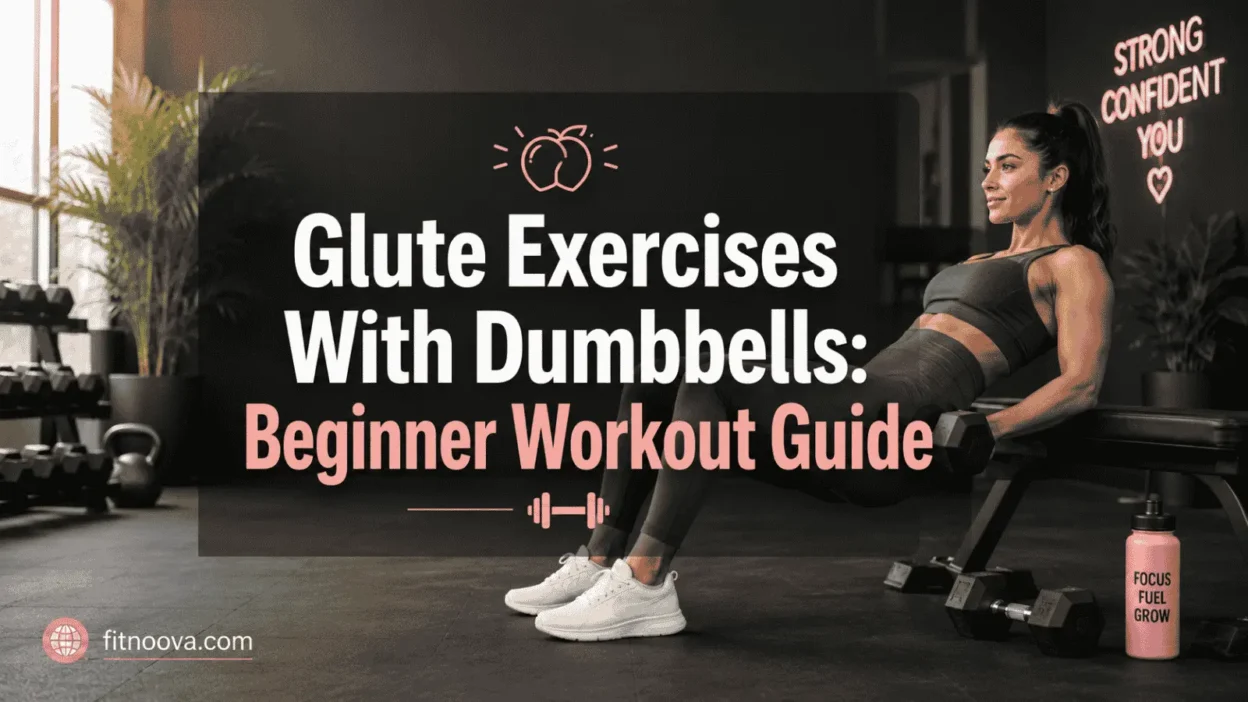
Dumbbells are one of the simplest tools for training your glutes because they let you load squats, hinges, bridges, lunges, and step-ups without needing a barbell or large gym setup. The best glute exercises with dumbbells train your hips through several movement patterns: hip extension, single-leg stability, squatting, and controlled lowering.
This guide covers the most useful dumbbell glute exercises, how to perform them, how to build them into a beginner-friendly routine, and how to progress without turning every workout into a max-effort session.
Quick Answer
The best glute exercises with dumbbells include dumbbell hip thrusts, Romanian deadlifts, goblet squats, Bulgarian split squats, reverse lunges, step-ups, sumo squats, and single-leg glute bridges. For most beginners, training glutes 2 to 3 times per week with controlled form, moderate effort, and gradual weight increases is enough to build strength and consistency.
Why Dumbbells Work Well For Glute Training
Your glutes are involved in hip extension, hip abduction, pelvic control, and lower-body stability. That means a strong glute workout does not need one “perfect” exercise. It needs a small group of movements that challenge the glutes from different angles.
Dumbbells are especially useful because they are easy to adjust, beginner-friendly, and practical for both home workouts and gym sessions. They also let you train one leg at a time, which can help you notice strength differences and improve control.
For general health, adults are advised to include muscle-strengthening activity at least 2 days per week, along with regular aerobic activity. Strength training does not have to be complicated to be useful. Proper technique, consistency, and gradual progression matter more than chasing heavy weights before your body is ready. Mayo Clinic also emphasizes proper form as an important part of reducing injury risk during strength training.
The Best Glute Exercises With Dumbbells
Dumbbell Hip Thrust
The dumbbell hip thrust is one of the most direct ways to train hip extension, which is a major function of the glutes.
Sit on the floor with your upper back against a bench, couch, or sturdy step. Place a dumbbell across your hips, hold it securely with both hands, and plant your feet about hip-width apart. Drive through your heels, lift your hips, and pause briefly at the top without over-arching your lower back.
Keep your ribs down, chin slightly tucked, and pelvis controlled. The top of the movement should feel like your glutes are doing the work, not your lower back.
Best For: Glute strength, home workouts, beginners learning hip extension
Try: 3 sets of 8 to 12 reps
Dumbbell Romanian Deadlift
The dumbbell Romanian deadlift, often called an RDL, trains the glutes and hamstrings through a hip-hinge pattern. It is one of the most valuable lower-body exercises to learn because it teaches you how to move from the hips instead of bending mostly through the lower back.
Hold a dumbbell in each hand in front of your thighs. Soften your knees, push your hips back, and lower the weights close to your legs. Stop when you feel a strong stretch through your hamstrings and glutes, then drive your hips forward to stand tall.
Your back should stay neutral, not rounded. Think “hips back” rather than “weights down.”
Best For: Glutes, hamstrings, hip hinge strength
Try: 3 sets of 8 to 10 reps
Goblet Squat
The goblet squat trains the glutes, quads, and core while helping beginners stay more upright than they might with a barbell squat.
Hold one dumbbell vertically at chest height. Stand with your feet about shoulder-width apart, then sit down into a squat while keeping the dumbbell close to your body. Push the floor away to stand.
To make it more glute-focused, use a stance that feels natural, allow your knees to track over your toes, and control the lowering phase. Do not force a depth that causes your back to round or your heels to lift.
Best For: Beginner strength, lower-body coordination, glutes and thighs
Try: 3 sets of 8 to 12 reps
Dumbbell Bulgarian Split Squat
The Bulgarian split squat is challenging, but it is excellent for glute strength because each leg works independently.
Stand a few feet in front of a bench or sturdy chair. Place the top of one foot behind you on the bench. Hold dumbbells at your sides, lower your back knee toward the floor, and press through the front foot to stand.
A slightly forward torso angle can make the movement feel more glute-focused. Keep the front knee tracking in line with the toes and move slowly enough to stay balanced.
Best For: Single-leg glute strength, balance, home or gym training
Try: 2 to 3 sets of 8 to 10 reps per side
Dumbbell Reverse Lunge
Reverse lunges are often more beginner-friendly than forward lunges because they can feel easier on balance and knee control.
Hold dumbbells by your sides. Step one foot back, lower into a lunge, then press through the front foot to return to standing. Keep your torso controlled and avoid pushing off aggressively with the back foot.
To bias the glutes, take a comfortable step back and focus on driving through the heel and midfoot of the front leg.
Best For: Glutes, legs, coordination, beginner progression
Try: 2 to 3 sets of 8 to 12 reps per side
Dumbbell Step-Up
The step-up is practical and highly useful, but the height of the step matters. A box or bench that is too high can shift the movement away from good control.
Hold dumbbells at your sides and place one foot fully on a sturdy step or bench. Press through that foot to stand up, then lower slowly. Try not to bounce off the back leg.
Choose a height where you can keep your working foot planted, your knee controlled, and your hips level.
Best For: Glutes, everyday strength, single-leg control
Try: 2 to 3 sets of 8 to 10 reps per side
Dumbbell Sumo Squat
A sumo squat uses a wider stance than a standard squat and can feel natural for people who want a glute and inner-thigh emphasis.
Hold one dumbbell vertically between your hands. Step your feet wider than shoulder-width, turn your toes slightly out, and lower into a squat. Keep your knees moving in the same direction as your toes.
Do not assume wider is always better. Use a stance that lets you move smoothly without hip pinching or knee discomfort.
Best For: Glutes, inner thighs, squat variation
Try: 3 sets of 10 to 12 reps
Single-Leg Dumbbell Glute Bridge
The single-leg dumbbell glute bridge is a useful option when you have limited equipment or want to train each side separately.
Lie on your back with one knee bent and one foot planted. Place a dumbbell across the hip of the working side and hold it securely. Lift your hips by squeezing the glute of the planted leg, pause briefly, then lower with control.
Keep the movement smaller if your lower back takes over.
Best For: Glute activation, single-leg strength, home workouts
Try: 2 to 3 sets of 8 to 12 reps per side
A Beginner Dumbbell Glute Workout
Use this routine 2 times per week at first. Leave at least one day between sessions so your muscles and joints have time to recover.
Workout A
- Goblet Squat — 3 sets of 8 to 12 reps
- Dumbbell Romanian Deadlift — 3 sets of 8 to 10 reps
- Dumbbell Hip Thrust — 3 sets of 10 to 12 reps
- Reverse Lunge — 2 sets of 8 to 10 reps per side
- Single-Leg Glute Bridge — 2 sets of 10 reps per side
Rest 60 to 90 seconds between sets. Use a weight that feels challenging but still lets you keep clean form. A good beginner target is finishing most sets with 1 to 3 reps left in the tank.
Workout B
- Dumbbell Step-Up — 3 sets of 8 to 10 reps per side
- Dumbbell Sumo Squat — 3 sets of 10 to 12 reps
- Dumbbell Romanian Deadlift — 3 sets of 8 to 10 reps
- Bulgarian Split Squat — 2 sets of 8 reps per side
- Dumbbell Hip Thrust — 2 sets of 12 reps
Alternate Workout A and Workout B if you train glutes twice per week. For example, do Workout A on Monday and Workout B on Thursday.
How Heavy Should Your Dumbbells Be?
Choose dumbbells based on the exercise, not your ego. You will usually be able to use more weight on hip thrusts, RDLs, and goblet squats than on Bulgarian split squats or single-leg glute bridges.
A practical rule: the last 2 to 3 reps of each set should feel challenging, but your form should not break down. If you are rushing, wobbling, rounding your back, or cutting the range of motion short, the weight is probably too heavy for that exercise right now.
Beginners can start with:
- Light dumbbells: single-leg bridges, lunges, step-ups
- Moderate dumbbells: goblet squats, sumo squats
- Heavier dumbbells: hip thrusts, Romanian deadlifts once form is solid
How Often To Train Glutes With Dumbbells
Most beginners do well with 2 glute-focused sessions per week. If you recover well and enjoy training, you can move to 3 sessions per week, but that does not mean every session should be hard.
The CDC recommends muscle-strengthening activity at least 2 days per week for adults. ACSM also notes that adults should perform activities that maintain or increase muscular strength and endurance at least 2 days per week. For a glute-focused plan, that usually means spacing sessions across the week instead of training the same muscles hard on back-to-back days.
A simple weekly structure:
- 2 days per week: best for beginners and busy adults
- 3 days per week: useful if workouts are shorter or split by intensity
- 4+ days per week: usually unnecessary for beginners unless volume is carefully managed
How To Progress Your Dumbbell Glute Workouts
Progress does not have to mean adding weight every workout. In fact, beginners often improve fastest by cleaning up technique first.
Use one progression at a time:
- Add 1 to 2 reps per set.
- Add one extra set to one or two exercises.
- Increase the dumbbell weight slightly.
- Slow down the lowering phase.
- Add a pause at the hardest point.
- Improve range of motion without losing control.
For example, if you can do 3 sets of 12 dumbbell hip thrusts with solid form, move to a heavier dumbbell and return to 3 sets of 8 to 10 reps. Build back up from there.
Form Tips That Make Dumbbell Glute Exercises More Effective
Keep Your Foot Pressure Stable
For squats, lunges, step-ups, and split squats, keep pressure through the heel, big toe, and little toe. This “tripod foot” position helps you stay balanced and avoid collapsing inward.
Control The Lowering Phase
Dropping quickly into a squat or lunge makes the movement harder to control. Lower slowly, own the bottom position, then stand with purpose.
Do Not Over-Arch At The Top
In hip thrusts and bridges, stop when your hips are extended and your glutes are squeezed. Pushing past that point by arching your lower back does not make the exercise better.
Match The Range Of Motion To Your Body
Deeper is not always better if it changes your form. Use a range you can control, then gradually improve it as mobility and strength allow.
Breathe Instead Of Bracing Too Hard
Do not hold your breath through every rep. Mayo Clinic advises remembering to breathe during strength training. A simple approach is to inhale before lowering and exhale as you stand, lift, or drive the hips up.
Common Mistakes To Avoid
Going Too Heavy Too Soon
Heavy dumbbells are useful only when you can control them. If your lower back, knees, or balance become the limiting factor before your glutes are working, reduce the load.
Turning Every Set Into A Max Effort
You do not need to train to failure on every set. Most beginner workouts work better when you stop slightly before form breaks down.
Skipping Hip-Hinge Exercises
Squats and lunges are valuable, but glute training is incomplete without a hinge pattern. Romanian deadlifts are one of the best ways to train that skill with dumbbells.
Rushing Single-Leg Exercises
Step-ups, lunges, and Bulgarian split squats reward control. Slow down, use lighter dumbbells if needed, and make the working leg do the work.
Ignoring Pain Signals
Muscle fatigue and mild soreness can be normal after strength training, especially when you are new or returning after time off. Sharp pain, chest discomfort, dizziness, unusual swelling, numbness, or pain that changes your movement is different. NHS guidance advises people with medical conditions, concerns, or a long break from exercise to speak with a GP before starting or increasing activity.
When To Modify Or Back Off
Modify your workout if your form changes, your joints feel irritated, or soreness affects normal movement for several days. That might mean reducing weight, cutting a set, shortening the range of motion, or choosing a more stable exercise.
Back off and seek medical guidance if you experience chest pain, faintness, severe dizziness, sudden sharp pain, unusual shortness of breath, or symptoms that do not improve with rest. General exercise discomfort should feel manageable and muscular. Warning signs should not be pushed through.
FAQ
Can you build glutes with dumbbells only?
Yes. Dumbbells can build stronger glutes when you use enough resistance, train consistently, and progress over time. Hip thrusts, Romanian deadlifts, squats, split squats, lunges, and step-ups can all be effective without machines or barbells.
What is the best dumbbell exercise for glutes?
There is no single best exercise for everyone, but dumbbell hip thrusts and Romanian deadlifts are two of the most useful. Hip thrusts directly train hip extension, while Romanian deadlifts train the glutes through a stretched hinge position.
How many dumbbell glute exercises should I do in one workout?
Most people only need 4 to 6 exercises in a glute workout. A strong beginner session might include one squat, one hinge, one thrust or bridge, and one single-leg movement.
Are dumbbell squats enough for glutes?
Dumbbell squats can help train the glutes, but they are better when combined with hip thrusts, Romanian deadlifts, lunges, or step-ups. The glutes respond well to multiple movement patterns, not just squatting.
How long does a dumbbell glute workout need to be?
A good beginner dumbbell glute workout can take 30 to 45 minutes. Quality matters more than length. Controlled reps, appropriate weight, and enough recovery are more useful than adding extra exercises just to make the workout longer.
Should beginners train glutes every day?
No. Beginners usually recover better with 2 to 3 glute sessions per week. Daily hard glute training can make soreness, poor form, and overuse more likely.
Conclusion
The best glute exercises with dumbbells are the ones that let you train hard enough while keeping your form controlled: hip thrusts, Romanian deadlifts, goblet squats, split squats, reverse lunges, step-ups, sumo squats, and glute bridges. Start with 2 weekly sessions, use weights you can control, and progress gradually as your strength improves.
A smart dumbbell glute workout does not need to be extreme. It needs consistent effort, clean movement, enough recovery, and exercises that match your current ability.