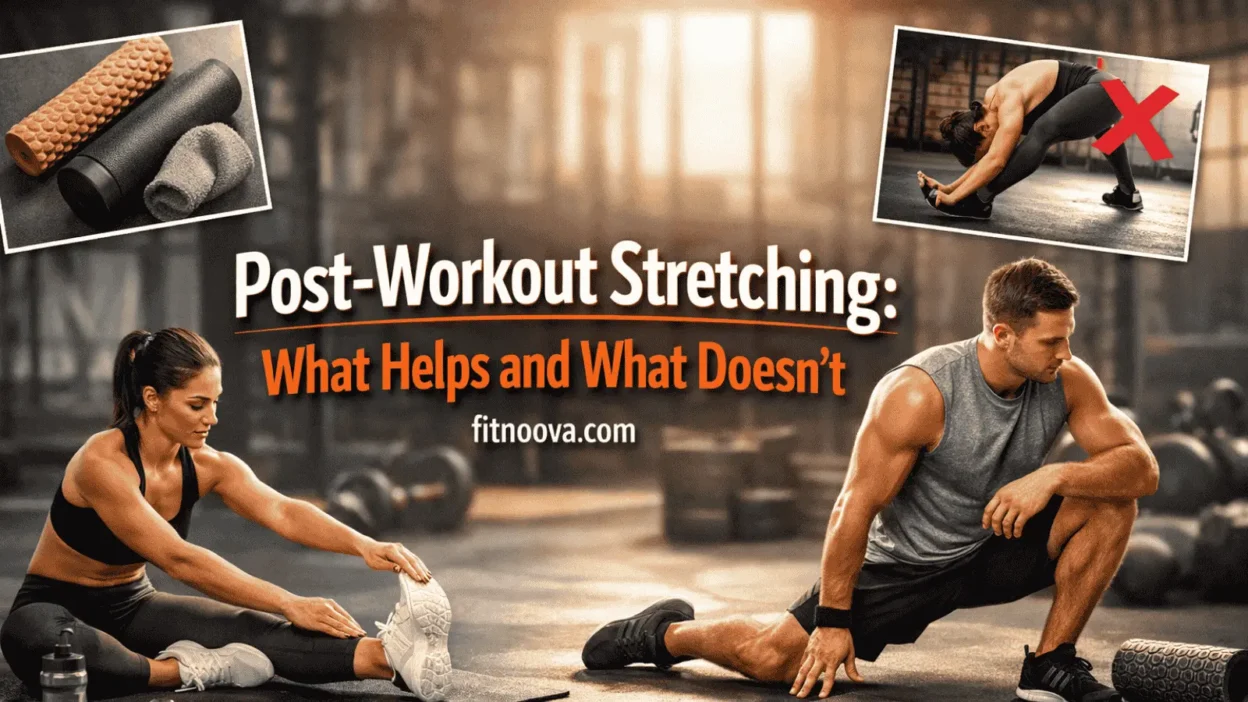
Post workout stretching can be a useful part of your cooldown, but it is not a magic fix for soreness, injury prevention, or faster results. For most people, the main benefits are that stretching feels good, helps maintain or improve flexibility over time, and gives the body a more gradual transition out of a hard session. Major health organizations also advise stretching when muscles are warm rather than cold.
Quick Answer
Post workout stretching is worth doing if it helps you feel better, maintain range of motion, or build flexibility. What it probably will not do is dramatically reduce next-day soreness or reliably prevent injuries on its own. A short cooldown followed by gentle static stretches is usually the best approach for beginners.
What Post-Workout Stretching Is Actually Good For
The clearest reason to stretch after exercise is that your muscles are already warm, which makes stretching more comfortable and generally safer than doing deep static stretches on cold tissue. That is why organizations such as Mayo Clinic and the American Heart Association recommend stretching after endurance or strength work, not before it.
Regular stretching can also help improve flexibility and range of motion over time. That matters if you sit a lot, feel stiff in certain positions, or want easier movement in daily life and training. It is especially useful when you repeatedly target the same muscle groups with lifting, running, cycling, or home workouts.
A cooldown has a separate job: it helps your heart rate and breathing come down more gradually instead of stopping abruptly. The American Heart Association notes that cooling down after exercise matters because your heart rate, body temperature, and blood vessels are still elevated right after activity.
What Post-Workout Stretching Probably Does Not Do
A lot of people stretch after training because they hope it will stop soreness the next day. The evidence does not really support that. A Cochrane review found little or no effect of stretching before or after exercise on delayed-onset muscle soreness in the days that follow a workout. Mayo Clinic makes a similar point: studies have not consistently shown that stretching prevents soreness or injury.
That does not mean stretching is useless. It means the benefit is often more modest and more specific than people expect. Stretching can be part of a recovery routine, but sleep, training load, hydration, nutrition, and sensible progression matter much more for how you feel after a workout. The CDC’s physical activity guidance also emphasizes gradual progression and choosing activity you can do safely.
Should You Stretch After Every Workout?
Not necessarily. If you are short on time, it is reasonable to keep post workout stretching brief and selective. You do not need a long full-body routine after every session. In many cases, two to five minutes of easy cooldown plus a few stretches for the muscles you just trained is enough.
For example:
- After a lower-body workout, focus on calves, quads, hamstrings, glutes, and hip flexors.
- After an upper-body session, focus on chest, shoulders, lats, and upper back.
- After cardio, focus on the areas that feel most worked or tight, not every muscle in your body.
That approach is usually more realistic than trying to force a long routine you will not stick with.
The Best Way To Do Post-Workout Stretching
For most beginners, post workout stretching should feel easy to moderate, never aggressive. A good target is a gentle pull, not pain. Mayo Clinic advises slow, controlled stretches without bouncing, with each stretch held around 30 seconds and repeated on both sides. The American Heart Association suggests roughly 10 to 30 seconds per stretch, repeated as needed.
A simple format looks like this:
- Spend 3 to 5 minutes easing out of the workout. Walk, pedal lightly, or move slowly until your breathing settles.
- Stretch the muscles you trained most.
- Hold each stretch for 15 to 30 seconds.
- Repeat 1 to 3 times per side if it still feels helpful.
- Stop short of pain, cramping, numbness, or joint pinching.
The NHS cooldown routine also supports a short, simple post-exercise stretch sequence rather than anything elaborate.
A Simple 5-Minute Post Workout Stretching Routine
This routine works well for beginners, home workout users, and general gym-goers. Move calmly, breathe normally, and do not force the range.
Calf Stretch
Stand facing a wall. Step one foot back, keep that heel down, and lean forward until you feel a stretch in the calf. Hold, then switch sides.
Time: 20 to 30 seconds per side
Quad Stretch
Stand tall and hold a wall or bench if needed. Bring one heel toward your glute and keep your knees close together. You should feel the stretch along the front of the thigh.
Time: 20 to 30 seconds per side
Hamstring Stretch
Place one heel slightly in front of you with the leg straight and hinge at the hips with a flat back. Do not round aggressively or yank on the leg.
Time: 20 to 30 seconds per side
Hip Flexor Stretch
Step into a split stance or half-kneeling position. Gently shift your hips forward while keeping your torso upright until you feel the stretch in the front of the hip.
Time: 20 to 30 seconds per side
Figure-4 Glute Stretch
Lie on your back or sit on a bench. Cross one ankle over the opposite knee and gently draw the legs toward you until you feel the stretch in the glute.
Time: 20 to 30 seconds per side
Chest And Front Shoulder Stretch
Stand in a doorway or clasp your hands lightly behind you and open the chest without arching hard through your lower back.
Time: 20 to 30 seconds
Lat Or Child’s Pose Stretch
Reach your arms forward on the floor or onto a bench and sink your hips back gently to stretch the sides of the torso and upper back.
Time: 20 to 30 seconds
How Hard Should Post-Workout Stretching Feel?
Easy to moderate is enough. You are not trying to “win” the stretch. If your muscles are shaking, your face is tense, or you are holding your breath, you are probably going too hard.
A useful rule: the stretch should feel clear but tolerable, and it should ease slightly as you breathe. Sharp pain, burning, numbness, or joint discomfort means back off right away.
When To Skip Or Modify It
Post workout stretching is usually fine for healthy adults, but it is smart to adjust when something feels off. Slow down or modify if:
- you have a fresh strain, sprain, or sudden pain
- a stretch causes tingling, numbness, or joint pain
- you are so fatigued that positions become sloppy
- you feel dizzy, faint, or unusually short of breath after training
The American Heart Association advises seeking medical evaluation if exercise brings on symptoms such as chest pain, pressure, marked shortness of breath, or lightheadedness.
If you are pregnant, have a current injury, or have a medical condition that affects movement, a clinician or physical therapist can help you choose safer positions. The NHS also notes that some people may need modified stretches after exercise.
Common Post-Workout Stretching Mistakes
Stretching Too Deep Because You Feel Warm
Warm muscles can move more comfortably, but that does not mean you should force range. Pushing hard usually creates guarding, not better mobility.
Bouncing Through Static Stretches
Fast bouncing raises injury risk and is not what most beginners need. Slow, steady holds are the safer default.
Using Stretching As A Substitute For Recovery Basics
If you are sleeping poorly, training too hard, or repeating max-effort sessions too often, stretching will not fix that. Recovery still comes down to total training load, rest, and consistency.
Doing A Long Routine You Will Never Repeat
A five-minute routine you actually do beats a 20-minute routine you skip. Keep it realistic.
Stretching Into Pain
A mild pull is fine. Pain is not.
FAQ
Should you do post workout stretching after lifting weights?
Yes, if it helps you cool down and maintain flexibility. It is generally better to do static stretching after lifting, when muscles are warm, rather than before the session.
How long should post workout stretching last?
For most people, about 5 to 10 minutes is enough. The NHS cooldown routine takes about 5 minutes, and the American Heart Association suggests a gradual cooldown of roughly 5 to 10 minutes after exercise.
Does post workout stretching reduce soreness?
Probably not by much. Research reviews have found little or no meaningful reduction in delayed-onset muscle soreness from stretching before or after exercise.
Is post workout stretching better than stretching before a workout?
For static stretching, usually yes. Major organizations generally recommend doing static stretches after strength or endurance exercise, while a warm-up before training should focus more on light movement and activity-specific prep.
Can you skip post workout stretching if you are short on time?
Yes. You can skip it sometimes without ruining your progress. A brief cooldown and a few targeted stretches for the tightest areas is often enough, especially for beginners.
What is the difference between normal tightness and a warning sign?
Normal post-exercise tightness usually feels like stiffness or mild soreness that improves as you move. Warning signs include sharp pain, swelling, tingling, numbness, joint instability, chest pain, unusual shortness of breath, or feeling faint. Those symptoms deserve caution and sometimes medical evaluation.
Conclusion
Post workout stretching is best viewed as a simple recovery habit, not a cure-all. It can help you cool down, feel less stiff in the moment, and improve flexibility over time, but it is unlikely to dramatically cut soreness or prevent injuries by itself. For most people, the smartest approach is short, gentle, and consistent: cool down for a few minutes, stretch the muscles you trained, and stop well before pain.