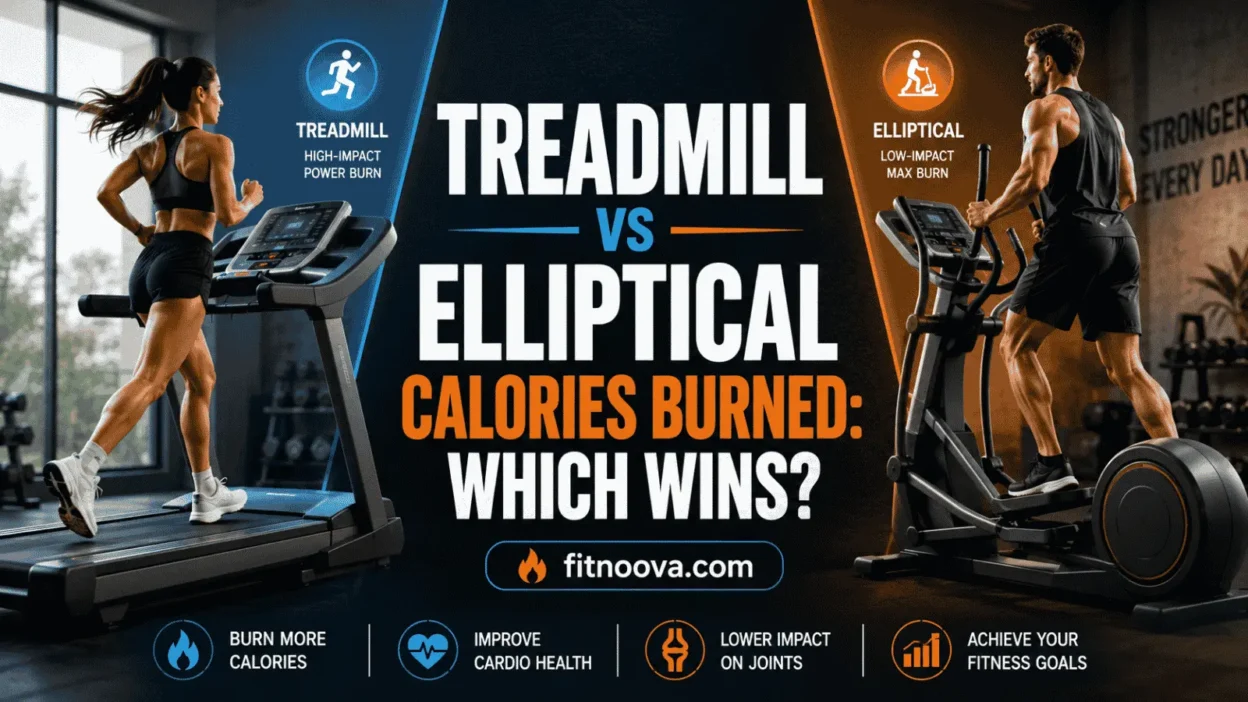
If you are comparing treadmill vs elliptical calories burned, the honest answer is this: the treadmill often burns more calories when you run, jog, or walk on an incline, but the elliptical can come very close when you use enough resistance, pace, and full-body effort.
The better machine is not always the one with the highest number on the screen. For beginners, home workout users, gym beginners, and people exercising for weight-loss support, the best choice is usually the machine you can use consistently, safely, and with enough intensity to make the workout count.
Quick Answer
A treadmill usually burns more calories than an elliptical when you run or use a challenging incline. An elliptical may burn a similar number of calories if you increase resistance, keep your cadence high, and actively push and pull the handles. Calorie burn depends most on body weight, workout duration, speed, incline, resistance, fitness level, and effort—not just the machine.
Why Calorie Burn Varies So Much
Cardio machines estimate calories, but those numbers are not exact. They usually use broad formulas based on weight, time, speed, resistance, and sometimes heart rate. They do not fully know your muscle mass, fitness level, stride mechanics, medication use, or how much effort you are actually putting into each movement.
A useful way to compare cardio activities is METs, or metabolic equivalents. One MET is roughly the energy cost of sitting quietly, and higher-MET activities require more energy. The 2024 Adult Compendium of Physical Activities is a major reference used to classify energy cost across activities, but it also notes that MET values are population estimates, not precise individual measurements.
That means a 30-minute workout on a treadmill and a 30-minute workout on an elliptical can look similar on paper but feel very different in real life.
The biggest calorie-burn factors are:
- Body weight: A larger body generally uses more energy to move.
- Workout duration: More minutes usually mean more total calories.
- Intensity: Speed, incline, resistance, and cadence matter.
- Fitness level: A beginner and a trained exerciser may experience the same setting differently.
- Technique: Holding the rails on a treadmill or coasting on an elliptical can reduce effort.
- Muscle involvement: Using legs only differs from using arms and legs together.
Treadmill Calories Burned: What To Expect
The treadmill has one major advantage: it lets you control speed and incline very clearly. Walking, incline walking, jogging, and running all change calorie burn in a direct and noticeable way.
According to the Adult Compendium, running at 6.0 to 6.3 mph is listed at 9.3 METs, while slower running and jogging ranges are lower. Uphill running can be higher still; for example, running uphill at 6.0 mph with a 5% incline is listed at 13.3 METs.
Walking can also become surprisingly demanding when incline is added. The Compendium lists hill climbing at moderate-to-brisk paces from 5.3 to 10.0 METs depending on grade and speed, which helps explain why incline treadmill walking can feel much harder than flat walking.
In plain terms, the treadmill tends to burn more calories when you:
- jog or run instead of walk
- add incline instead of staying flat
- avoid holding the handrails
- maintain a pace that raises breathing and heart rate
- use intervals rather than staying too easy for the full session
For beginners, incline walking is often the sweet spot. It can raise calorie burn without requiring running, although the calves, glutes, and lower back may need time to adapt.
Elliptical Calories Burned: What To Expect
The elliptical is often easier on the joints because your feet stay in contact with the pedals instead of repeatedly striking the belt. That lower-impact feel can make it easier for some people to train longer or more often.
The tradeoff is that elliptical calorie burn depends heavily on how you use the machine. A light resistance setting with slow, passive movement may not burn much. A strong resistance setting, steady cadence, and active upper-body work can make the elliptical a serious cardio workout.
The CDC explains that moderate-intensity activity generally feels like a 5 or 6 out of 10 effort, while vigorous activity begins around 7 or 8 out of 10. It also recommends the talk test: during moderate intensity, you can talk but not sing; during vigorous intensity, you can only say a few words before needing a breath.
That is especially useful on the elliptical because resistance numbers vary between brands. Level 8 on one machine may not feel like level 8 on another.
You will usually burn more calories on the elliptical when you:
- increase resistance enough to feel real pressure through the pedals
- keep your stride smooth but not lazy
- use the moving handles instead of resting your hands
- avoid bouncing or letting momentum carry you
- include short higher-effort intervals
Treadmill vs Elliptical Calories Burned: Side-By-Side Comparison
For calorie burn alone, the treadmill has the higher ceiling because running and steep incline work can become very demanding. The elliptical is still competitive when used with enough resistance and effort, but many people unintentionally underwork on it.
Here is the practical comparison:
| Goal | Better Choice For Most People |
|---|---|
| Highest possible calorie burn | Treadmill running or incline work |
| Lower-impact cardio | Elliptical |
| Beginner-friendly steady cardio | Either machine |
| Weight-loss support with less joint stress | Elliptical or incline walking |
| Improving running fitness | Treadmill |
| Longer cardio sessions with less pounding | Elliptical |
| Simple progression | Treadmill speed and incline |
| Full-body cardio feel | Elliptical with moving handles |
The treadmill may win for calorie burn per minute at higher intensities. The elliptical may win for consistency if it lets you train without knee, hip, or ankle discomfort.
Which Machine Is Better For Weight Loss?
For weight loss, neither machine is magic. A treadmill or elliptical can help increase energy expenditure, but fat loss still depends on your overall habits, including food intake, daily movement, sleep, strength training, stress, and consistency.
The CDC recommends adults get at least 150 minutes of moderate-intensity aerobic activity per week, or 75 minutes of vigorous-intensity aerobic activity, plus muscle-strengthening activity on at least 2 days per week.
That matters more than choosing the “perfect” cardio machine. A realistic weekly plan could include:
- 2 to 4 cardio workouts on the treadmill, elliptical, or both
- 2 strength-training sessions
- easier walking or mobility work on recovery days
- gradual increases in time, incline, speed, or resistance
For weight-loss support, the best machine is the one you can repeat without feeling beat up. If running leaves your knees sore for days, the treadmill may not be the best primary option right now. If the elliptical feels too easy and you never raise your effort, it may not be doing enough.
Which Machine Is Better For Beginners?
Beginners can use either machine well, but the elliptical is often more forgiving because it is lower impact and easier to control. The treadmill may feel more natural because walking is familiar, but speed changes and belt movement can feel intimidating at first.
Choose the treadmill if you:
- like walking
- want to build toward jogging or running
- prefer simple speed and incline settings
- want a workout that transfers well to outdoor walking or running
Choose the elliptical if you:
- want lower-impact cardio
- dislike running
- have mild joint sensitivity during impact exercise
- want to use arms and legs together
- feel more comfortable with a smooth, gliding motion
A beginner should not judge the workout only by calories burned. The better first goal is to finish sessions feeling challenged but not wrecked.
A Simple Calorie-Burning Treadmill Workout
This treadmill session is designed for beginners and busy adults who want an efficient cardio workout without sprinting.
25-Minute Incline Walking Workout
Warm-Up: 5 Minutes
Walk at an easy pace with little or no incline. Your breathing should stay comfortable.
Main Set: 15 Minutes
Alternate between:
- 2 minutes at a moderate incline and brisk pace
- 1 minute at a lower incline for recovery
Repeat 5 times.
Cool Down: 5 Minutes
Lower the incline and walk at an easy pace.
Keep the effort around a 5 to 7 out of 10. You should be breathing harder, but you should not feel out of control. Avoid holding the rails unless you need brief support for balance.
A Simple Calorie-Burning Elliptical Workout
This elliptical session works well when you want a low-impact workout that still feels purposeful.
25-Minute Resistance Interval Workout
Warm-Up: 5 Minutes
Use light resistance and settle into a smooth stride.
Main Set: 15 Minutes
Alternate between:
- 1 minute at higher resistance with strong handle use
- 2 minutes at moderate resistance while keeping movement steady
Repeat 5 times.
Cool Down: 5 Minutes
Lower the resistance and let your breathing return toward normal.
The key is to avoid coasting. Push through the pedals, keep your posture tall, and use the handles with control instead of letting your arms swing passively.
How To Choose Based On Your Body And Goals
The right choice depends on what your body tolerates and what your goal requires.
If your main goal is maximum calorie burn per minute, the treadmill has the edge when you run or use incline.
If your main goal is low-impact cardio, the elliptical is usually the better fit.
If your main goal is building running endurance, choose the treadmill.
If your main goal is staying consistent while reducing joint pounding, choose the elliptical or alternate both machines.
If your main goal is weight-loss support, use the machine that helps you train regularly at a moderate-to-vigorous effort while still recovering well.
The Mayo Clinic notes that heart-rate targets are general guides, and factors such as fitness level, health status, and certain medications can affect heart-rate response. People with medical conditions or medication concerns may need individualized guidance.
Common Mistakes That Lower Calorie Burn
Trusting The Machine Calories Too Much
The calorie number on the console is an estimate. Use it as a rough tracking tool, not a precise measurement.
Holding The Treadmill Rails
Holding the rails can reduce the amount of work your legs and trunk have to do. If you need to hold on for safety, lower the speed or incline.
Coasting On The Elliptical
The elliptical can feel easy when momentum takes over. Increase resistance until each stride requires steady effort.
Going Too Hard Too Soon
Beginners often jump into steep inclines, long runs, or high-resistance intervals before their body is ready. Progress gradually so your joints, muscles, and cardiovascular system can adapt.
Ignoring Recovery
More calorie burn is not always better. Persistent pain, unusual shortness of breath, dizziness, chest discomfort, or soreness that worsens instead of improving are signs to stop and seek appropriate medical guidance.
FAQ
Does the treadmill or elliptical burn more belly fat?
Neither machine targets belly fat specifically. Both can support fat loss by helping you burn calories and improve fitness, but where fat comes off first is influenced by genetics, hormones, age, training history, nutrition, and overall lifestyle.
Is 30 minutes on the elliptical better than 30 minutes on the treadmill?
It depends on intensity. A hard 30-minute elliptical workout can beat an easy treadmill walk, while a treadmill run or steep incline walk can burn more than a relaxed elliptical session. Compare effort, not just time.
Is the elliptical good for weight loss?
Yes, the elliptical can support weight loss when it is part of a consistent routine that also includes nutrition habits, strength training, daily movement, and recovery. It is especially useful for people who want cardio with less impact than running.
Is treadmill incline better than running?
Incline walking can be a strong option if you want a challenging workout without running impact. Running usually has a higher calorie-burn ceiling, but incline walking may be more sustainable for some beginners.
How accurate are treadmill and elliptical calorie counters?
They are estimates, not exact measurements. Accuracy improves when you enter your body weight and use a heart-rate monitor, but even then, the number should be treated as a useful approximation rather than a guaranteed total.
Can I use both the treadmill and elliptical in the same routine?
Yes. Using both can reduce boredom, spread stress across the body differently, and help you balance higher-impact and lower-impact cardio. For example, you might do treadmill incline walking twice per week and elliptical intervals once or twice per week.
Conclusion
When comparing treadmill vs elliptical calories burned, the treadmill usually wins at higher intensities, especially with running or incline walking. The elliptical can still burn plenty of calories when you use enough resistance, pace, and full-body effort, and it may be easier to repeat consistently because it is lower impact.
For most people, the smarter choice is not the machine with the biggest theoretical calorie burn. It is the machine that lets you train hard enough, often enough, and safely enough to keep going.