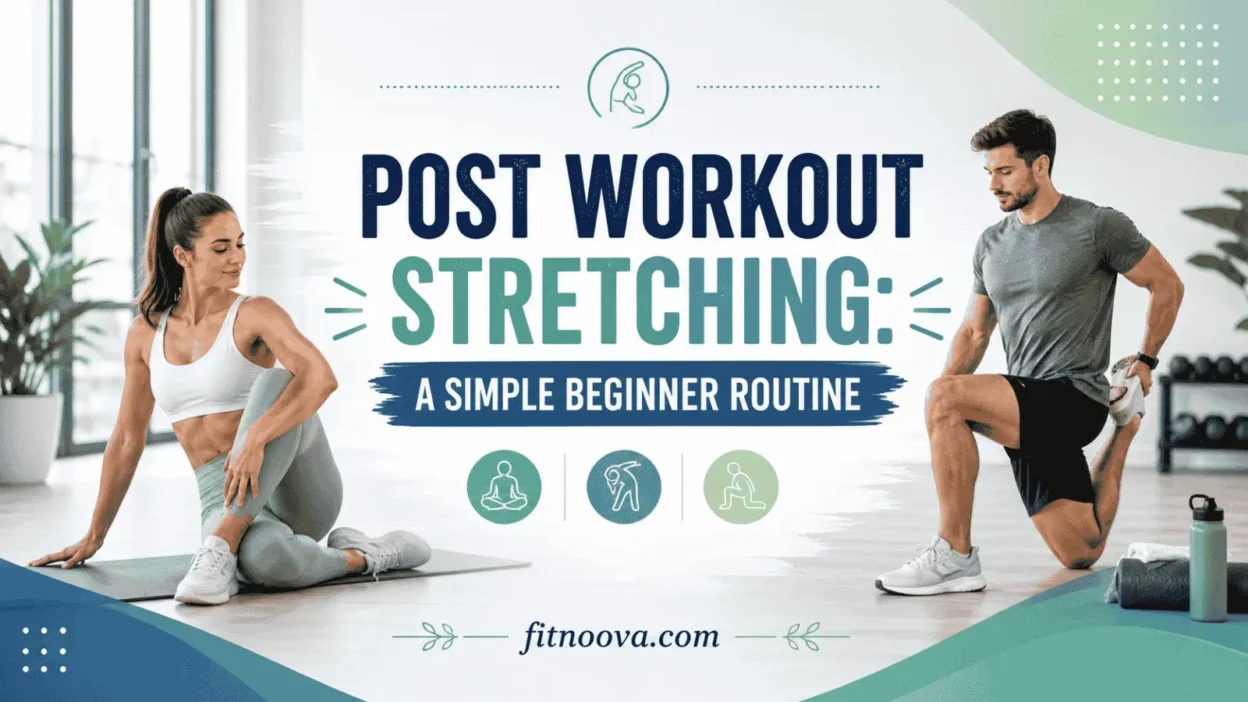
Post workout stretching is a simple way to help your body transition out of exercise, ease tension, and work on flexibility while your muscles are already warm. It does not need to be long or complicated. For most beginners, five to ten minutes of calm, controlled stretching after exercise is enough to feel more settled and build a useful habit.
Stretching after exercise is not a magic fix for soreness, and it should not be treated like injury prevention insurance. But done well, it can support range of motion, help you notice tight areas, and make your cool down feel more complete. The key is choosing the right stretches, holding them gently, and avoiding the urge to force your body into positions it is not ready for.
Quick Answer
Post workout stretching usually works best as a short cool down using gentle static stretches for the muscles you just trained. Hold each stretch for about 10 to 30 seconds, breathe normally, and stop before pain. A good beginner routine includes the calves, hamstrings, quads, hip flexors, glutes, chest, shoulders, and back.
Why Stretch After A Workout?
After a workout, your heart rate, breathing, body temperature, and muscle tension are still elevated. A cool down gives your body a calmer transition instead of stopping abruptly. The NHS describes post-exercise stretching as a way to gradually relax, improve flexibility, and slow the heart rate after activity.
Stretching after exercise can also be easier than stretching cold. Mayo Clinic advises warming up before stretching and notes that stretching after a workout is often a better choice because muscles are already warm.
The most realistic benefits are:
- helping you slow down after training
- maintaining or improving flexibility over time
- reducing a feeling of tightness after repeated movement
- improving awareness of how your body feels after exercise
- creating a simple recovery habit you can repeat consistently
What stretching does not reliably do is erase soreness. Delayed onset muscle soreness, or DOMS, often appears one to three days after a hard or unfamiliar workout, especially if you did more than your body is used to. Stretching may feel good, but soreness is more strongly affected by training load, sleep, nutrition, hydration, and gradual progression.
Post Workout Stretching Vs. Warm-Up Stretching
The biggest difference is timing and purpose.
Before a workout, your goal is to prepare your body to move. Dynamic movements such as leg swings, arm circles, hip circles, light squats, and walking lunges are usually more useful than long static holds. Mayo Clinic Press notes that dynamic stretching moves joints safely through range of motion and is commonly used to prepare for activity.
After a workout, your goal is different. You are not trying to prime your body for speed, power, or heavy lifting. You are trying to cool down, breathe easier, and gently lengthen areas that worked hard. That is where static stretching fits best.
Static stretching means you move into a comfortable position and hold it without bouncing. It should feel like mild to moderate tension, not sharpness, pinching, numbness, or joint pain.
How Long Should You Stretch After A Workout?
A practical target is five to ten minutes.
The NHS has a simple post-exercise stretching routine that takes about five minutes, with the option to spend more time if needed. Mayo Clinic recommends stretching major muscle groups at least two to three days per week, especially if flexibility is one of your goals.
For beginners, use this simple rule:
Hold each stretch for 10 to 30 seconds, repeat once if the area feels especially tight, and keep the intensity easy enough that you can breathe normally.
More is not always better. A short routine you actually do after most workouts is more useful than a perfect 25-minute routine you skip.
A Simple Full-Body Post Workout Stretching Routine
Use this routine after strength training, cardio, a home workout, or a beginner gym session. Move slowly, breathe through each stretch, and keep everything pain-free.
1. Standing Calf Stretch
Best for: walking, running, cycling, lower-body workouts, step-ups, and jump rope
Stand facing a wall. Step one foot back, press that heel toward the floor, and keep the back leg straight. Bend the front knee slightly until you feel a stretch in the calf of the back leg.
Hold for 20 to 30 seconds per side.
Keep your toes facing forward. If your back foot turns outward, the stretch often becomes less effective.
2. Hamstring Stretch
Best for: deadlifts, squats, running, cycling, and long periods of sitting
Place one heel on the floor slightly in front of you. Keep that leg mostly straight, soften the other knee, and hinge gently at your hips. Think about sending your hips back rather than rounding your spine.
Hold for 20 to 30 seconds per side.
You should feel this along the back of the thigh, not as a sharp pull behind the knee.
3. Quad Stretch
Best for: squats, lunges, cycling, stairs, and lower-body circuits
Stand tall and hold a wall or sturdy surface for balance. Bend one knee and bring your heel toward your glutes. Hold your ankle or pant leg, then gently draw the knee down toward the floor.
Hold for 20 to 30 seconds per side.
Avoid arching your lower back. If your knee feels irritated, reduce the bend or skip this stretch and use a gentler hip flexor stretch instead.
4. Half-Kneeling Hip Flexor Stretch
Best for: sitting-heavy days, running, cycling, lunges, squats, and core workouts
Start in a half-kneeling position with one knee down and the other foot forward. Keep your torso tall. Gently tuck your pelvis under, then shift slightly forward until you feel a stretch at the front of the hip on the kneeling side.
Hold for 20 to 30 seconds per side.
The movement should be small. Many people lean too far forward and arch their back, which takes the stretch away from the hip flexor.
5. Figure-Four Glute Stretch
Best for: squats, lunges, hip thrusts, running, and lower-body strength training
Lie on your back with both knees bent. Cross one ankle over the opposite thigh, making a “4” shape. If comfortable, pull the uncrossed leg toward your chest.
Hold for 20 to 30 seconds per side.
You should feel this in the glute or outer hip. If your knee feels uncomfortable, keep the bottom foot on the floor and make the stretch smaller.
6. Child’s Pose With Reach
Best for: back, lats, shoulders, core workouts, and upper-body training
Kneel on the floor, sit your hips back toward your heels, and reach your arms forward. Let your chest soften toward the floor while keeping the stretch relaxed.
Hold for 30 seconds.
To target one side more, walk both hands slightly to the right, hold, then walk them slightly to the left.
7. Doorway Chest Stretch
Best for: push-ups, bench press, desk posture, rowing, and upper-body workouts
Stand in a doorway with one forearm on the frame. Keep your elbow around shoulder height or slightly lower. Step forward gently until you feel a stretch across the chest.
Hold for 20 to 30 seconds per side.
Do not crank the shoulder back. Keep the stretch broad across the chest rather than sharp in the front of the shoulder.
8. Cross-Body Shoulder Stretch
Best for: upper-body workouts, swimming, rowing, boxing-style workouts, and general shoulder tension
Bring one arm across your chest. Use the other arm to gently support it above or below the elbow. Keep the shoulder relaxed instead of shrugging toward your ear.
Hold for 20 to 30 seconds per side.
This should feel mild and controlled. If you feel pinching in the shoulder joint, ease out.
How To Match Your Stretching To Your Workout
You do not need every stretch after every workout. The best post workout stretches are the ones that match what you trained.
After a lower-body workout, prioritize calves, hamstrings, quads, hip flexors, and glutes.
After an upper-body workout, focus on chest, shoulders, lats, upper back, and forearms.
After cardio, choose the muscles that did the most repeated work. Runners may need calves, hip flexors, hamstrings, and glutes. Cyclists may benefit from quads, hip flexors, calves, and chest-opening stretches.
After a full-body workout, use a shorter version of the full routine. Pick four to six stretches and keep the whole cool down under ten minutes.
How Intense Should Post Workout Stretching Feel?
Post workout stretching should feel calm, not aggressive.
Use a simple 1-to-10 effort scale. Aim for about a 3 or 4 out of 10. You should feel a clear stretch, but you should still be able to breathe, relax your face, and hold the position without bracing.
Back off if you feel:
- sharp pain
- burning nerve-like discomfort
- numbness or tingling
- joint pinching
- dizziness
- pain that worsens as you hold the stretch
Some muscle tension is normal. Pain is not the goal.
Can Stretching Help With Muscle Soreness?
Stretching may temporarily reduce stiffness or help you feel better after training, but it should not be sold as a guaranteed soreness cure.
Cleveland Clinic explains that DOMS typically starts one to three days after intense exercise and is common after new, harder, or unfamiliar workouts. Mayo Clinic also notes that research has not consistently shown stretching after exercise to reduce muscle soreness.
For soreness, the better strategy is to manage your overall recovery:
- increase workout difficulty gradually
- sleep enough
- eat enough protein and overall calories for your goals
- stay hydrated
- use light movement on sore days
- avoid repeating a very hard workout before you have recovered
Stretching can be part of that routine, but it should not carry the whole recovery plan.
Common Post Workout Stretching Mistakes
Stretching Too Hard
A deeper stretch is not automatically a better stretch. Forcing range of motion can irritate muscles, tendons, or joints, especially when you are tired after training.
Keep the stretch controlled and repeatable. You should finish feeling looser, not strained.
Bouncing Through Stretches
Bouncing can make a stretch harder to control. For beginners, steady holds are usually safer and easier to learn.
Move into the stretch slowly, pause, breathe, and come out of it with control.
Holding Your Breath
Breath-holding usually means you are pushing too hard. Breathe normally through each stretch. A slow exhale can help your body relax into the position without forcing it.
Stretching Through Pain
Discomfort and pain are not the same. Mild muscle tension is fine. Sharp, pinching, electrical, or worsening pain is a sign to stop.
If pain keeps coming back during certain stretches, that stretch may not be right for you right now.
Skipping The Cool Down After Hard Cardio
After intense cardio, do not drop straight to the floor for long stretches while your heart rate is still high. Walk slowly for a few minutes first, then stretch. This gives your body a smoother transition.
Using Stretching To Make Up For Poor Training Load
If you are constantly very sore, exhausted, or tight, the issue may not be your stretching routine. You may be doing too much too soon, training too hard too often, or not recovering well enough.
Stretching helps most when your workouts are already sensible.
When To Modify Or Skip Stretching
Modify your routine if you are pregnant, recovering from injury, managing a medical condition, or dealing with persistent pain. The NHS advises people with injuries, medical conditions, or pregnancy to check with a physiotherapist or healthcare professional about which stretches are appropriate.
You should also slow down and consider professional guidance if you have swelling, bruising, severe weakness, pain that changes your walking pattern, pain after a fall, or symptoms that do not improve with rest and easier activity.
For normal post-workout tightness, gentle stretching is usually reasonable. For injury-like pain, stretching harder is rarely the answer.
FAQ
Is post workout stretching necessary?
No, it is not mandatory, but it can be useful. Post workout stretching is a simple way to cool down, maintain flexibility, and check in with how your body feels after training. If you are short on time, even three to five minutes can be worthwhile.
Should I stretch immediately after lifting weights?
Usually, yes, as long as you feel steady and your breathing has settled. After heavy lifting or intense intervals, walk around for a few minutes first. Then use gentle static stretches for the muscles you trained.
How long should I hold each stretch after exercise?
Most beginners can hold each stretch for 10 to 30 seconds. If a muscle feels especially tight, repeat the stretch once rather than forcing a longer or deeper hold.
Is static stretching better after a workout?
Static stretching is often a good fit after a workout because your goal is to relax and restore range of motion, not prepare for explosive performance. Before a workout, dynamic movement is usually more useful.
Can I stretch every day?
Many people can stretch daily if the intensity is gentle and pain-free. Mayo Clinic recommends stretching major muscle groups at least two to three days per week, and consistency matters more than doing a long routine occasionally.
Should I stretch if I am very sore?
Gentle stretching is usually fine if it feels good, but do not force sore muscles. Light walking, easy movement, hydration, sleep, and reducing workout intensity may help more than aggressive stretching.
Conclusion
Post workout stretching works best when it is simple, calm, and consistent. You do not need a long routine or extreme flexibility goals. Start with five to ten minutes of gentle stretches for the muscles you trained, hold each position without pain, and use the time to bring your body back down after exercise.
The best routine is one you can repeat. Done regularly, post workout stretching can support flexibility, make your cool down feel more complete, and help you build a more sustainable relationship with training.