Last Updated: MAY 19 , 2026
cool down stretches help your body shift from hard effort to steady recovery without making your routine feel long or complex. After a workout, your muscles may feel tight, your heart rate stays high, and your joints need gentle movement before you stop fully. A smart finish can ease muscle tension, support flexibility, and help your breathing settle. Focus on slow, controlled positions that target the areas you used most, such as hamstrings, calves, hips, chest, and shoulders. Hold each move without bouncing, stay within a mild pull, and breathe evenly. This keeps the routine safe, simple, and useful after strength training, cardio, sports, or a quick home session.
Quick Answer
cool down stretches are gentle post-exercise positions that help your body relax after activity. Choose simple moves for the legs, hips, back, chest, and shoulders. Hold each position for 15 to 30 seconds, breathe slowly, and avoid pushing into pain. Keep the goal clear: calm your body and restore easy movement.
What Cool Down Stretches Are Actually For

A cooldown is the transition between exercise and rest. Instead of stopping abruptly, you taper the intensity down for a few minutes so your heart rate and breathing can settle more gradually. Then, if you want to stretch, you do it while your body is still warm. That is why post-workout stretching tends to feel easier than stretching “cold.”
What cool down stretches can do well:
- Help you shift out of workout mode more comfortably
- Give you a regular time to work on flexibility
- Ease feelings of tightness in the muscles you just trained
- Encourage slower breathing and a calmer finish to the session
What they do not reliably do:
- Guarantee less next-day soreness
- Prevent every injury
- Fix poor training load, bad sleep, or too much intensity
That distinction matters. Research and clinical guidance on stretching are mixed, especially when people expect it to eliminate soreness. Stretching still has a place, but it helps to be realistic about what it is and is not doing.
How Long Should A Cooldown Last?
For most workouts, 5 to 10 minutes of lower-intensity movement is a good starting point. After that, spend another 5 minutes or so on gentle stretches if they feel useful. If you finished a very light workout, your cooldown can be shorter. If you just did intervals, a hard run, or a demanding leg session, taking a little longer usually feels better.
You do not need a long ritual. A simple 8- to 12-minute cooldown is enough for most beginners.
When To Do Cool Down Stretches
The best time is right after your workout, once you have already reduced the intensity. That could mean:
- Walking slowly after a run
- Pedaling lightly after a cycling session
- Marching in place after a home workout
- Doing an easy bodyweight reset after strength training
Then move into stretches for the muscle groups you used most. Post-workout is a better fit for static stretching than the first few minutes before a workout, because warm muscles generally tolerate stretching more comfortably.
The Best Cool Down Stretches For Most People
You do not need dozens of moves. A small, repeatable lineup works better.
1. Standing Calf Stretch
Stand facing a wall. Put one foot behind you, keep that heel down, and bend the front knee until you feel a stretch in the back calf.
Why it helps: Useful after walking, running, jumping, sports, and lower-body workouts.
Hold: 20 to 30 seconds per side.
2. Standing Quad Stretch
Stand tall and hold onto a wall or chair if needed. Bend one knee and bring your heel toward your glute, holding your ankle or pant leg. Keep your knees close together and your torso upright.
Why it helps: Good after squats, lunges, cycling, stair workouts, and treadmill work.
Hold: 20 to 30 seconds per side.
3. Hamstring Stretch
Sit on the floor or the edge of a bench with one leg extended and the other bent. Hinge forward from your hips toward the straight leg, keeping your back long rather than rounding hard.
Why it helps: Useful after running, deadlifts, lower-body strength training, and long periods of sitting.
Hold: 20 to 30 seconds per side.
4. Hip Flexor Stretch
Step into a half-kneeling lunge or a split stance. Gently shift your weight forward while keeping your torso tall and your glutes lightly engaged.
Why it helps: A smart pick after cycling, running, core work, and any day that involves lots of sitting outside the gym.
Hold: 20 to 30 seconds per side.
5. Figure-Four Glute Stretch
Lie on your back and cross one ankle over the opposite knee. Pull the uncrossed leg toward you until you feel a stretch in the glute and outer hip.
Why it helps: Helpful after lower-body lifting, walking, hiking, or incline workouts.
Hold: 20 to 30 seconds per side.
6. Child’s Pose
Kneel, sit your hips back toward your heels, and reach your arms forward on the floor. If that position bothers your knees, widen your stance or skip it.
Why it helps: A gentle stretch for the back, hips, and shoulders after general training.
Hold: 20 to 30 seconds.
7. Chest Stretch
Stand tall and clasp your hands behind your back, or place your forearm against a wall and turn gently away. Keep the stretch mild.
Why it helps: Useful after push-ups, bench work, desk-heavy days, and upper-body training.
Hold: 20 to 30 seconds per side or both sides together.
8. Overhead Triceps And Lat Stretch
Reach one arm overhead, bend the elbow, and let the hand drop behind your head. Use the other hand for light pressure if needed. For more side-body stretch, lean slightly.
Why it helps: Good after upper-body lifting, swimming, circuits, and rowing.
Hold: 20 to 30 seconds per side.
9. Shoulder Stretch
Bring one arm across your chest and use the opposite hand to support it gently just above the elbow.
Why it helps: Helpful after pressing, pulling, and general upper-body sessions.
Hold: 20 to 30 seconds per side.
10. Seated Or Supine Spinal Twist
Sit tall or lie on your back and rotate gently through the upper and mid-back. Keep the twist easy, not aggressive.
Why it helps: Can feel good after full-body workouts, but it should stay light and controlled.
Hold: 15 to 20 seconds per side.
A Simple 10-Minute Cool Down Stretch Routine
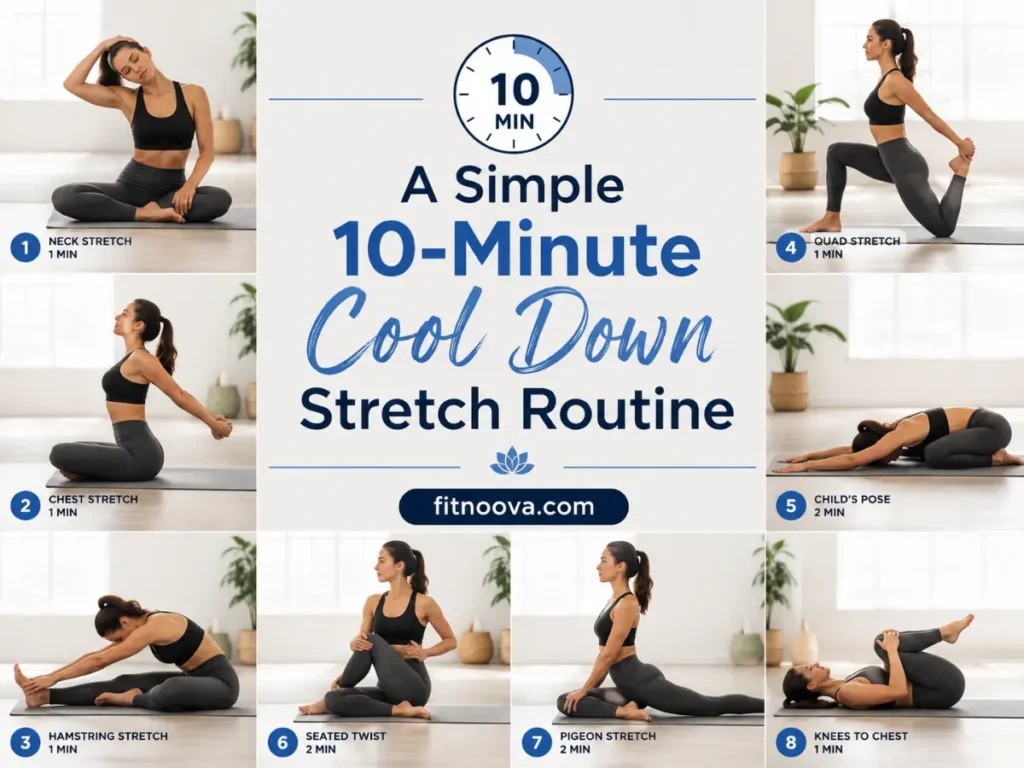
This routine works well after most beginner workouts.
Step 1: Lower The Intensity For 5 Minutes
Pick the version that matches your session:
- After a run: walk at an easy pace
- After cycling: pedal very lightly
- After strength training: walk slowly or march in place
- After a home workout: do easy steps and deep breathing
The point is to let your body come down gradually instead of going from hard effort to stillness in a few seconds.
Step 2: Do 5 Key Stretches
Try this sequence:
- Calf stretch — 20 to 30 seconds each side
- Quad stretch — 20 to 30 seconds each side
- Hamstring stretch — 20 to 30 seconds each side
- Hip flexor stretch — 20 to 30 seconds each side
- Chest or shoulder stretch — 20 to 30 seconds each side
That is enough for a basic cooldown. On upper-body days, add the triceps or shoulder stretch. On lower-body days, add the figure-four glute stretch.
How Hard Should Cool Down Stretches Feel?
Mild to moderate tension is fine. Sharp pain is not. A stretch should feel controlled, not forced. Major health organizations consistently advise gentle stretching, normal breathing, and no bouncing. If you feel stabbing pain, joint pain, or numbness, back off and change the position or stop.
A simple rule: if you have to grit your teeth, hold your breath, or yank yourself into the stretch, it is too much.
Which Muscles Should You Stretch After A Workout?
Match the stretch to the workout you just did.
After Running Or Walking
Focus on:
- Calves
- Quads
- Hamstrings
- Hip flexors
- Glutes
After Leg Day
Focus on:
- Quads
- Hamstrings
- Glutes
- Adductors
- Calves
After Upper-Body Training
Focus on:
- Chest
- Shoulders
- Triceps
- Lats
- Upper back
After A Full-Body Home Workout
Pick one stretch each for:
- Calves or hamstrings
- Quads or hip flexors
- Glutes
- Chest
- Shoulders
This approach keeps your cooldown efficient and relevant instead of turning it into a random collection of poses.
Cool Down Stretches For Beginners
If you are new to exercise, keep it very simple:
- Choose 4 to 6 stretches
- Hold each one for 15 to 30 seconds
- Do one round only
- Stretch the areas that feel worked, not every muscle in your body
- Use support from a wall, bench, or chair when balance is an issue
Beginners do not need to “earn” a hard stretch. Consistency matters more than intensity.
Common Mistakes To Avoid
Skipping The Slowdown Phase
Stretching immediately after an all-out effort without first easing down is not the best setup. Spend a few minutes lowering intensity first.
Bouncing Through The Stretch
Ballistic, jerky stretching is not what most people need in a cooldown. Controlled holds are the safer default.
Pushing Into Pain
A stretch is not supposed to feel sharp, pinchy, or unstable. Pain is a sign to reduce range, adjust position, or stop.
Holding Your Breath
Breathing helps you relax into a stretch. Breath-holding usually makes you tense up more.
Expecting Stretching To Fix Overtraining
If you ramped up volume too fast, slept poorly, or trained through exhaustion, a few stretches will not solve that. Recovery still depends on total training load, sleep, food, hydration, and rest days.
Doing The Same Routine No Matter What You Trained
Your cooldown should reflect the session you just finished. A short, targeted routine usually works better than a long generic one.
When To Back Off Or Get Medical Advice
A normal post-workout cooldown may include mild tightness, heavier breathing that settles, and the feeling that the worked muscles are tired. That is different from symptoms that should make you stop.
Back off and seek medical guidance promptly if exercise or stretching brings on chest pain, unusual shortness of breath, dizziness, faintness, or an irregular heartbeat. If you notice severe muscle pain along with dark urine or unusual weakness, get medical care right away.
If you are returning to exercise after surgery, an injury, pregnancy, a cardiac event, or a long break with medical issues, it is smart to follow advice from your clinician or physical therapist rather than a general routine.
FAQ
Are cool down stretches necessary after every workout?
Not always, but they are often useful. The most important part is the gradual drop in intensity after harder exercise. Stretching afterward is optional, but many people find it helps them feel less tight and gives them a regular chance to work on flexibility.
How long should I hold each cool down stretch?
About 10 to 30 seconds is a solid range for most people. You can repeat a stretch if needed, but longer is not automatically better.
Do cool down stretches prevent soreness?
Not reliably. Some people feel better after stretching, but research has not consistently shown that stretching prevents post-workout soreness. It is better to think of stretching as one part of recovery, not the whole plan.
Should I stretch even if I did strength training instead of cardio?
Yes, you can. Just tailor the stretches to the muscles you trained. After upper-body work, focus on the chest, shoulders, and triceps. After lower-body work, focus on the calves, quads, hamstrings, glutes, and hips.
Is it better to stretch before or after a workout?
For static stretching, after is often the better fit because your muscles are warm. Before a workout, most people benefit more from a dynamic warm-up that prepares them to move.
Can I do cool down stretches on rest days too?
Yes. You can use the same stretches on rest days or after a short walk, as long as you warm up a bit first and keep the intensity gentle. Warm muscles generally stretch more comfortably than cold ones.
Conclusion
cool down stretches work best when they match the workout you just finished and stay gentle from start to end. A short routine can support range of motion, reduce tightness, and make recovery feel more controlled. You do not need a long sequence or advanced poses. Choose a few steady moves, breathe well, and stop before discomfort turns sharp. Make it part of every workout.