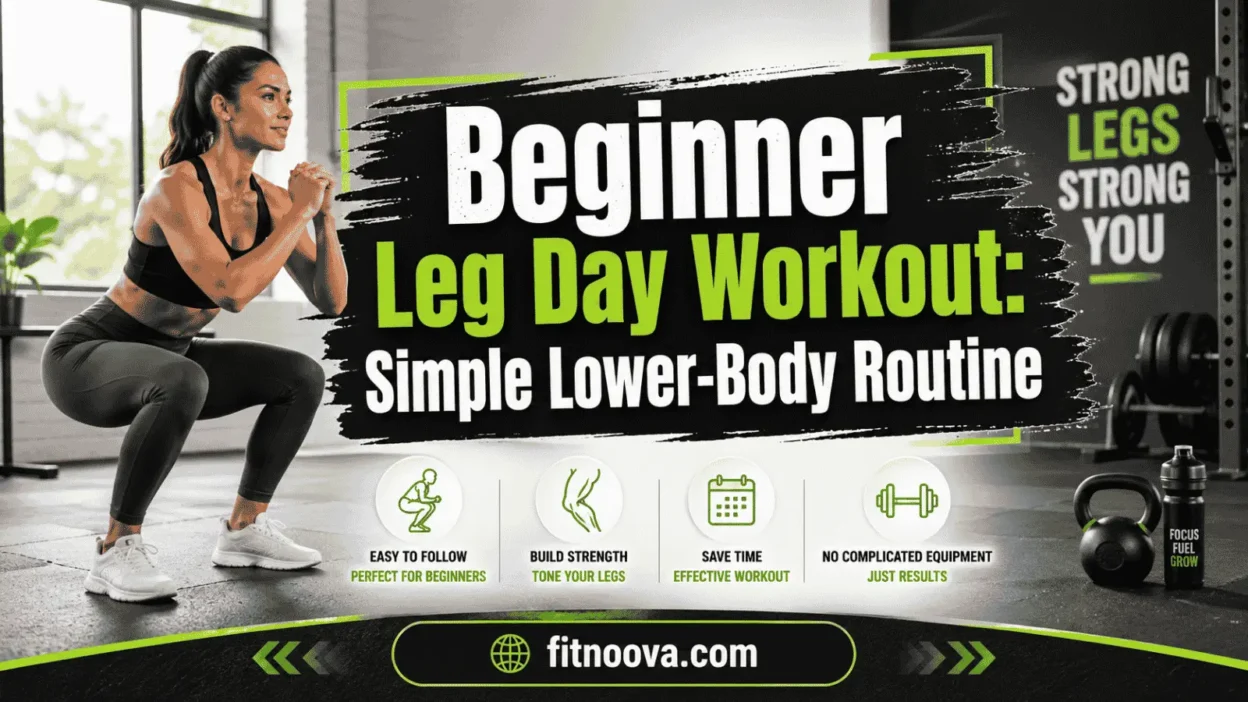
A good beginner leg day workout does not need to be brutal, complicated, or packed with exercises you are not ready for. It should teach you how to squat, hinge, step, and bridge with control while building strength in your quads, glutes, hamstrings, calves, and hips.
For most beginners, the best starting point is a short lower-body routine done one to two times per week, with moderate effort, clean form, and enough recovery between sessions. The goal is not to leave the gym barely able to walk. The goal is to practice the main movement patterns, build confidence, and gradually make the workout more challenging.
Quick Answer
A beginner leg day workout should include 4 to 6 simple lower-body exercises, such as squats, hip hinges, glute bridges, step-ups, calf raises, and core work. Start with 2 to 3 sets of 8 to 12 controlled reps per exercise, using a weight or variation that feels challenging but still lets you keep good form. Most beginners can train legs once or twice per week, with at least a day or two of recovery between hard lower-body sessions.
Current public-health guidance also supports muscle-strengthening activity at least 2 days per week for adults, ideally working all major muscle groups over the course of the week.
What Makes a Good Beginner Leg Day?
A beginner leg workout should do three things well.
First, it should train the major lower-body muscles without overwhelming you. Your legs include large muscle groups that do a lot of work in daily life, so beginners usually do better with a focused routine than a long list of advanced lifts.
Second, it should use exercises that teach useful movement patterns. Squatting helps with sitting, standing, and lifting. Hip hinging teaches you to use your glutes and hamstrings without rounding your back. Step-ups and lunges build single-leg strength and balance.
Third, it should leave room for progression. You do not need to chase soreness. You need a routine you can repeat, improve, and recover from.
For a true beginner, a good leg day should feel challenging by the end, but not chaotic. You should finish feeling like you worked, not like you survived something.
Beginner Leg Day Workout
This routine works for gym beginners and home workout users. Use the gym version if you have dumbbells, machines, or a barbell available. Use the home version if you are training with body weight, a chair, a step, or resistance bands.
Beginner Leg Day At A Glance
| Exercise | Sets | Reps | Rest |
|---|---|---|---|
| Bodyweight Squat Or Goblet Squat | 2–3 | 8–12 | 60–90 sec |
| Romanian Deadlift Or Hip Hinge | 2–3 | 8–12 | 60–90 sec |
| Step-Up Or Reverse Lunge | 2 | 8–10 each leg | 60–90 sec |
| Glute Bridge Or Hip Thrust | 2–3 | 10–15 | 45–75 sec |
| Standing Calf Raise | 2–3 | 10–15 | 45–60 sec |
| Dead Bug Or Side Plank | 2 | 6–10 each side or 20–30 sec | 30–60 sec |
Choose one version of each exercise. You do not need to do every possible variation.
Warm Up Before Leg Day
A warm-up should make your joints feel ready and help you move better during the workout. It does not need to be long.
Spend 5 to 8 minutes on easy movement, then do a few practice reps of the first exercise.
A simple beginner warm-up:
- 2 to 3 minutes of brisk walking, cycling, marching in place, or light stair climbing
- 10 bodyweight good mornings
- 10 glute bridges
- 8 slow bodyweight squats
- 5 controlled step-ups per side
Your first working set should not be your first time doing the movement that day. Practice the pattern first, then add difficulty.
Exercise 1: Squat
The squat is the main knee-bending movement in a beginner leg day workout. It trains your quads, glutes, hips, and core.
Best Beginner Options
Start with one of these:
- Bodyweight squat
- Box squat to a bench or chair
- Goblet squat with one dumbbell
- Assisted squat holding a stable support
How To Do It
Stand with your feet about hip- to shoulder-width apart. Brace your midsection gently, as if you are about to cough. Bend your knees and hips together, lower with control, then press through your feet to stand tall.
Your knees can move forward as long as your heels stay down and the movement feels controlled. Try to keep your chest from collapsing and your lower back from rounding at the bottom.
Beginner Form Tip
Use a box, bench, or chair if you are not sure how low to go. Touch it lightly, then stand back up. Do not relax completely onto the seat.
Exercise 2: Romanian Deadlift Or Hip Hinge
A hip hinge trains your glutes and hamstrings. It also teaches you how to bend forward without turning every lower-body lift into a rounded-back movement.
Best Beginner Options
- Bodyweight hip hinge
- Dumbbell Romanian deadlift
- Kettlebell deadlift from the floor
- Resistance band good morning
How To Do It
Stand tall with a soft bend in your knees. Push your hips back as if you are closing a car door behind you. Keep the weight close to your legs if you are using dumbbells. Stop when you feel a stretch in your hamstrings or when your torso cannot lower farther without your back rounding.
Then squeeze your glutes and stand tall again.
Beginner Form Tip
The hinge is not a squat. Your knees bend a little, but your hips do most of the moving.
Exercise 3: Step-Up Or Reverse Lunge
Single-leg exercises help build balance, coordination, and strength from side to side. They also make leg day more practical because walking, climbing stairs, and changing direction all happen one leg at a time.
Best Beginner Options
- Low step-up
- Assisted reverse lunge
- Split squat holding a wall or rail
- Supported stationary lunge
How To Do A Step-Up
Place one foot fully on a sturdy step or bench. Press through that foot to stand up. Step down with control and repeat on the same side or alternate sides.
Use a low step at first. If your hip shifts, your knee caves in, or you have to push hard off the floor with the back foot, the step may be too high.
How To Do A Reverse Lunge
Stand tall, step one foot back, and lower until both knees bend comfortably. Push through the front foot to return to standing.
Reverse lunges are often more beginner-friendly than forward lunges because they can feel easier to control.
Exercise 4: Glute Bridge Or Hip Thrust
Glute bridges are useful for beginners because they train hip extension without requiring much balance or equipment. They also help many people learn what it feels like to use the glutes rather than relying only on the lower back or quads.
Best Beginner Options
- Bodyweight glute bridge
- Dumbbell glute bridge
- Banded glute bridge
- Bench-supported hip thrust
How To Do It
Lie on your back with your knees bent and feet flat on the floor. Keep your ribs down, press through your heels and midfoot, and lift your hips until your body forms a straight line from shoulders to knees. Pause briefly, then lower with control.
Avoid arching your lower back at the top. Think “hips up,” not “ribs up.”
Exercise 5: Standing Calf Raise
Calves are easy to skip, but they matter for walking, running, balance, ankle strength, and lower-leg resilience.
How To Do It
Stand tall with your feet about hip-width apart. Rise onto the balls of your feet, pause briefly, then lower slowly. Hold a wall, rail, or machine for balance if needed.
For more range of motion, you can eventually do calf raises on a step, but beginners should master the floor version first.
Exercise 6: Dead Bug Or Side Plank
Core work belongs in a beginner leg workout because your trunk helps stabilize your hips, spine, and pelvis during lower-body exercises.
Dead Bug
Lie on your back with your arms up and knees bent. Gently press your lower back toward the floor. Slowly lower one arm and the opposite leg, then return and switch sides.
Side Plank
Lie on your side with your elbow under your shoulder. Lift your hips and hold a straight line from head to feet, or start from your knees if the full version is too hard.
Choose the version that lets you stay controlled. Shaking is fine. Losing position is the sign to stop the set.
How Hard Should Leg Day Feel For Beginners?
Use a simple effort scale.
Most working sets should feel like a 6 to 8 out of 10. That means the set is challenging, but you could still do about 2 to 4 more good reps if you had to.
Avoid taking beginner leg exercises to complete failure. Training to failure can break down form quickly, especially on squats, lunges, and hinge movements. You will make better progress by keeping reps clean and repeating the workout consistently.
A good rule: stop the set when your form changes, not when your body physically refuses to move.
How Often Should Beginners Train Legs?
Most beginners do well with one dedicated leg day per week at first, especially if they are also walking, doing cardio, playing sports, or training the upper body.
After a few weeks, many people can move to two lower-body sessions per week. This lines up well with broad adult fitness guidance that recommends muscle-strengthening activities at least 2 days weekly.
A simple weekly schedule could look like this:
- Monday: Full-body strength or upper body
- Wednesday: Beginner leg day
- Friday: Full-body strength or upper body
- Weekend: Walking, mobility, light cardio, or rest
If you want two leg days, separate them by at least 48 hours when possible:
- Monday: Leg day
- Thursday: Leg day
- Other days: Upper body, walking, light cardio, or rest
You can train more often later, but beginners usually progress faster when recovery is built into the plan.
How To Progress This Beginner Leg Day Workout
Progression should be gradual. You do not need to change the workout every week.
Use this order:
- Improve control and range of motion
- Add reps within the suggested range
- Add a set to one or two exercises
- Add light weight
- Move to a harder variation
For example, if you start with 2 sets of 8 goblet squats, work toward 2 sets of 12 with good form. Once that feels manageable, add a little weight or move to 3 sets.
Do not increase everything at once. Adding weight, reps, sets, and harder exercises in the same week is a common reason beginners feel beat up.
Gym Version Of The Workout
If you train at a gym, this version is simple and effective.
Beginner Gym Leg Day
| Exercise | Sets | Reps |
|---|---|---|
| Goblet Squat | 3 | 8–12 |
| Dumbbell Romanian Deadlift | 3 | 8–12 |
| Step-Up Or Leg Press | 2–3 | 8–12 |
| Dumbbell Glute Bridge Or Hip Thrust | 2–3 | 10–15 |
| Standing Or Seated Calf Raise | 2–3 | 10–15 |
| Dead Bug | 2 | 6–10 each side |
The leg press can be useful for beginners because it provides more support than free-weight squats. Still, do not use it as an excuse to load the machine heavily before you can control the movement. Lower the platform smoothly, keep your hips down, and avoid locking your knees aggressively at the top.
Home Version Of The Workout
You can do a beginner leg day workout at home without machines.
Beginner Home Leg Day
| Exercise | Sets | Reps |
|---|---|---|
| Bodyweight Squat To Chair | 3 | 8–12 |
| Backpack Romanian Deadlift | 3 | 8–12 |
| Low Step-Up | 2 | 8–10 each leg |
| Glute Bridge | 3 | 10–15 |
| Standing Calf Raise | 3 | 10–15 |
| Side Plank From Knees | 2 | 20–30 sec each side |
A loaded backpack can work well for squats, hinges, and glute bridges. Keep the load light enough that you can move smoothly and stop before your form falls apart.
What To Do If Your Legs Get Very Sore
Some soreness after a new leg workout is common, especially 24 to 48 hours later. Mild soreness, stiffness, or tenderness can happen when your muscles are adapting to unfamiliar work.
That said, soreness is not the goal. Severe soreness that changes how you walk, limits normal daily movement, or keeps getting worse is a sign that the workout was too much.
For your next session, reduce the number of sets, use easier variations, or keep more reps in reserve. Walking, gentle mobility, hydration, sleep, and time usually help normal soreness settle.
Back off and consider medical guidance if you have sharp pain, swelling, pain in a joint rather than a muscle, numbness, dizziness, chest pain, or pain that does not improve. Mayo Clinic Health System notes that overtraining can contribute to muscle and joint injuries, and persistent performance drops, sleep issues, unusual fatigue, and mood changes can be warning signs that recovery is not keeping up.
Common Beginner Leg Day Mistakes
Doing Too Much On Day One
The first leg day should not be a test of toughness. Beginners often do too many sets, too many lunges, or too much weight because the workout feels fine in the moment. The soreness arrives later.
Start with the lower end of the set range. You can always build.
Rushing Through Reps
Fast reps hide weak positions. Lower with control, pause when needed, and stand up smoothly. You should be able to feel which muscles are working.
Going Too Heavy Too Soon
Weight only helps if you can control it. If adding weight makes your squat shallower, your knees cave in, or your back round during hinges, the load is too heavy for now.
Skipping The Hinge Pattern
Many beginners squat and lunge but forget to train hip hinging. That leaves the hamstrings and glutes undertrained. Romanian deadlifts, good mornings, and hip hinges help balance the routine.
Ignoring Recovery
Leg muscles can handle hard work, but they still need time to recover. Poor sleep, very low calories, high stress, and constant intense workouts can make even a reasonable plan feel harder than it should.
Treating Pain Like Progress
Muscle effort is normal. Burning during a set can be normal. Mild soreness can be normal.
Sharp pain, joint pain, pinching, numbness, or pain that changes your movement is not something to push through.
FAQ
Is one leg day a week enough for beginners?
Yes, one leg day per week can be enough when you are just starting, especially if you are learning form and doing other activity during the week. Over time, many beginners benefit from two lower-body sessions per week, but you do not need to rush there.
Should beginners do squats or leg press?
Both can work. Squats teach balance, coordination, and full-body control, while the leg press provides more support and may feel easier to learn. Many gym beginners can use both, but start light and focus on controlled movement.
How long should a beginner leg day workout take?
Most beginner leg workouts should take about 30 to 45 minutes, including a warm-up. If it regularly takes much longer, you may be doing too many exercises, resting too long, or adding unnecessary volume.
Can I do this leg workout for weight loss?
You can include this workout in a weight-loss plan, but no single leg workout guarantees fat loss. Strength training helps build and maintain muscle, while nutrition, total activity, sleep, and consistency all matter. Keep the focus on sustainable habits rather than trying to burn as many calories as possible in one session.
Should my legs be sore after every workout?
No. Soreness is not required for progress. As your body adapts, you may feel less sore even when you are getting stronger. Good signs include better control, more reps, slightly heavier weights, and steadier energy after workouts.
What weight should I start with for leg day?
Start with body weight or a light weight that lets you complete every rep with control. By the end of each set, you should feel challenged but still able to do a few more clean reps. If your form changes quickly, reduce the weight.
Conclusion
A beginner leg day workout should be simple, repeatable, and focused on the basics: squat, hinge, step, bridge, raise, and stabilize. Start with a manageable routine, train with clean form, and progress one small step at a time.
You do not need an extreme workout to build stronger legs. You need a plan that fits your current ability, respects recovery, and gives you room to improve.