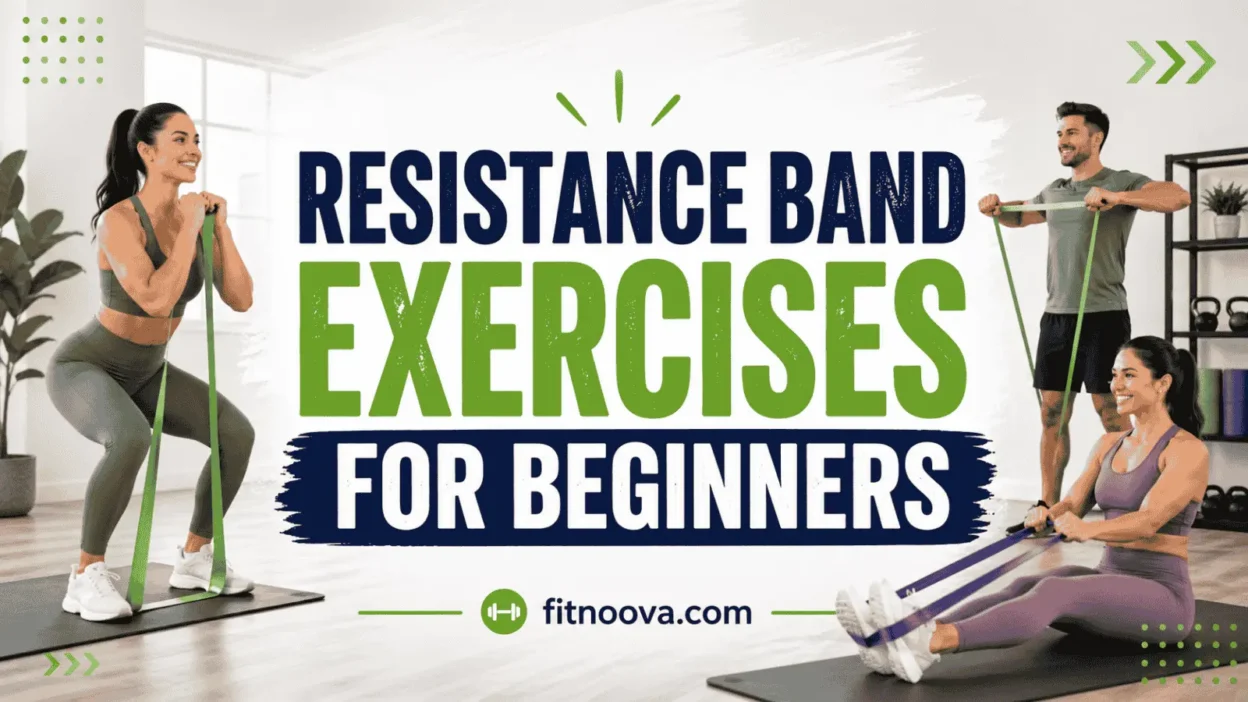
Resistance band exercises for beginners are one of the easiest ways to start strength training at home, at the gym, or while traveling. Bands are affordable, portable, joint-friendly for many people, and useful for training your legs, back, chest, shoulders, arms, and core without a rack of weights.
The goal is not to make the workout complicated. For your first few weeks, you need a small group of reliable exercises, clean form, moderate effort, and a simple way to progress when the moves start feeling easier.
Quick Answer
The best resistance band exercises for beginners are squats, rows, chest presses, glute bridges, lateral walks, shoulder presses, biceps curls, triceps presses, dead bugs, and pull-aparts. Start with 1 to 2 sets of 8 to 12 controlled reps per exercise, using a band that feels challenging but still lets you move with good form.
For general health, adults are encouraged to include muscle-strengthening activities for all major muscle groups at least two days per week, according to the Physical Activity Guidelines for Americans.
Why Resistance Bands Work Well For Beginners
Resistance bands make strength training less intimidating because they do not require much space, expensive equipment, or advanced technique. They also let you adjust difficulty quickly by changing your hand position, foot position, band thickness, or range of motion.
Unlike a dumbbell, which usually feels heaviest in the same direction because of gravity, a band creates more tension as it stretches. That teaches you to control both parts of the movement: the lifting phase and the return phase. For beginners, that control is often more important than chasing heavier resistance.
Bands can also be used for a full-body resistance band workout. You can train pushing, pulling, squatting, hinging, bracing, and hip stability with one or two bands. The British Heart Foundation describes resistance bands as elastic or fabric bands used for strength training, balance, flexibility, and mobility, and notes that they can be used for exercises across the back, shoulders, chest, arms, and legs.
What Kind Of Resistance Band Should Beginners Use?
Most beginners do best with two types of bands:
A long loop band or tube band with handles for rows, chest presses, deadlifts, curls, and shoulder presses.
A small loop band for glute bridges, lateral walks, clamshells, and hip stability work.
Choose a light or medium band first. The right band should make the last few reps feel like work without forcing you to jerk, shrug, twist, hold your breath, or shorten the movement. If your form changes dramatically halfway through the set, the band is too heavy.
Bands vary in tension, so color alone is not a universal guide. One brand’s “medium” can feel like another brand’s “heavy.” The Royal Marsden notes that resistance bands can vary in strength and that tension can often be adjusted by changing hand position.
How To Use Resistance Bands Safely
Before each workout, check the band for small tears, cracks, thinning, or weak spots. Do not use a damaged band. Keep the band away from your face when it is stretched, and make sure it is secure under your feet, around a sturdy anchor, or in your hands before starting a movement.
Use smooth reps. A band should not snap you back into position. Move through a comfortable range, pause briefly where you feel the muscles working, and return with control.
A simple beginner effort level is about a 6 or 7 out of 10. You should feel challenged, but you should still have 2 to 3 good reps left at the end of most sets.
Stop or modify the exercise if you feel sharp pain, chest pain, dizziness, unusual shortness of breath, numbness, or joint pain that gets worse as you continue. Mild muscle fatigue and normal next-day soreness can happen, but pain that changes your movement is a reason to back off. Mayo Clinic notes that overuse injuries often come from repetitive stress, training errors, or technique errors.
The Best Resistance Band Exercises For Beginners
Use these exercises as your foundation. You do not need to do all of them every session. Pick 5 to 8 moves that match your ability and available time.
Band Squat
Best For: Quads, glutes, hips, and beginner lower-body strength
Stand with your feet about shoulder-width apart. Place a long band under both feet and hold the other end at shoulder height, or use a small loop band above your knees. Sit your hips back and down as if lowering into a chair. Keep your chest tall, knees tracking in the same direction as your toes, and feet flat.
Press through your whole foot to stand back up. Avoid bouncing at the bottom.
Beginner Dose: 1 to 2 sets of 8 to 12 reps
Make It Easier: Use bodyweight only or reduce the depth.
Make It Harder: Use a stronger band or slow the lowering phase.
Band Row
Best For: Upper back, posture muscles, and pulling strength
Sit on the floor with your legs extended, or stand with the band anchored around a sturdy object at chest height. Hold one end in each hand. Start with your arms long, then pull your elbows back toward your ribs. Squeeze your shoulder blades gently without shrugging.
Return slowly until your arms are straight again.
Beginner Dose: 1 to 2 sets of 8 to 12 reps
Form Tip: Think “elbows back,” not “hands to chest.”
Band Chest Press
Best For: Chest, shoulders, and triceps
Anchor the band behind you at chest height, or wrap it around your upper back while holding the ends. Stand tall with one foot slightly forward. Press your hands forward until your arms are almost straight, then return with control.
Keep your ribs down and avoid arching your lower back.
Beginner Dose: 1 to 2 sets of 8 to 12 reps
Make It Easier: Use a lighter band or step closer to the anchor.
Band Glute Bridge
Best For: Glutes, hips, and lower-body control
Lie on your back with knees bent and feet flat. Place a small loop band above your knees. Keep gentle outward pressure on the band as you lift your hips. Pause at the top, then lower slowly.
Your lower back should not do all the work. If you feel this mostly in your back, reduce the height and focus on squeezing your glutes.
Beginner Dose: 1 to 2 sets of 10 to 15 reps
Band Lateral Walk
Best For: Side glutes, hip stability, knees, and balance
Place a small loop band above your knees or around your ankles. Bend your knees slightly and sit your hips back. Step sideways with control, then bring the other foot in without letting the band go slack.
Take small steps. Bigger is not better if your knees collapse inward or your torso rocks side to side.
Beginner Dose: 8 to 12 steps each direction
Band Shoulder Press
Best For: Shoulders, upper arms, and overhead strength
Stand on the center of a long band with one or both feet. Hold the ends near shoulder height. Press your hands overhead until your arms are almost straight, then lower slowly.
Keep your ribs stacked over your hips. If your back arches or your neck tightens, use a lighter band or press one arm at a time.
Beginner Dose: 1 to 2 sets of 8 to 10 reps
Band Pull-Apart
Best For: Upper back, rear shoulders, and posture support
Hold a light band in front of your chest with both hands. Keep your arms straight but not locked. Pull the band apart until your hands move wider than your shoulders, then return slowly.
This should feel controlled, not aggressive. Keep your shoulders down and your neck relaxed.
Beginner Dose: 1 to 2 sets of 10 to 15 reps
Band Biceps Curl
Best For: Front of the upper arms
Stand on the band and hold one end in each hand. Keep your elbows close to your sides. Curl your hands toward your shoulders, then lower slowly.
Do not swing your torso to lift the band.
Beginner Dose: 1 to 2 sets of 10 to 12 reps
Band Triceps Pressdown
Best For: Back of the upper arms
Anchor the band above you, or hold one end overhead and press the other end down with the working arm. Keep your elbow close to your side. Straighten the arm, pause briefly, then return with control.
Beginner Dose: 1 to 2 sets of 10 to 12 reps per side
Band Dead Bug
Best For: Core control and lower-back-friendly bracing
Lie on your back with knees bent over hips. Hold a light band with both hands, arms reaching toward the ceiling. Create light tension in the band. Slowly lower one heel toward the floor while keeping your ribs down and lower back steady. Return and switch sides.
This is not about speed. It is about keeping your trunk quiet while your limbs move.
Beginner Dose: 6 to 10 reps per side
A Simple Beginner Resistance Band Workout Routine
Do this beginner resistance band workout 2 to 3 days per week on nonconsecutive days. Rest about 30 to 60 seconds between exercises, or longer if your form starts to slip.
Full-Body Beginner Band Workout
- Band Squat — 8 to 12 reps
- Band Row — 8 to 12 reps
- Band Chest Press — 8 to 12 reps
- Band Glute Bridge — 10 to 15 reps
- Band Pull-Apart — 10 to 15 reps
- Band Lateral Walk — 8 to 12 steps each way
- Band Biceps Curl — 10 to 12 reps
- Band Dead Bug — 6 to 10 reps per side
Start with one round if you are new to exercise or returning after time away. Move to two rounds when the workout feels manageable and your form stays consistent.
ACSM’s 2026 resistance training guidance emphasizes consistency over complicated programming and notes that bands, bodyweight, and home-based routines can be effective options for healthy adults.
How Often Should Beginners Do Resistance Band Workouts?
For most beginners, 2 to 3 resistance band sessions per week is enough. Leave at least one day between harder full-body sessions so your muscles and joints have time to recover.
A realistic week might look like this:
Monday: Full-body resistance band workout
Wednesday: Full-body resistance band workout
Friday or Saturday: Optional lighter band workout, walk, mobility, or stretching
You can still walk, stretch, or do easy cardio on the days between band workouts. Strength training does not need to leave you exhausted to be useful.
How To Progress Without Overdoing It
Progression should feel gradual. You are ready to make an exercise harder when you can complete all reps with steady form, controlled breathing, and no joint discomfort.
Use one progression at a time:
- Add 1 to 2 reps per set.
- Add a second set.
- Slow down the lowering phase.
- Use a slightly stronger band.
- Step farther from the anchor.
- Hold the hardest part of the movement for 1 to 2 seconds.
- Reduce rest time slightly.
Do not change everything at once. A stronger band, more sets, shorter rest, and slower reps in the same week can turn a reasonable workout into too much too soon.
How Hard Should Resistance Band Exercises Feel?
Most beginner sets should feel moderately challenging. The final reps should require focus, but they should not look messy.
A useful rule: stop the set when you could still do about 2 good reps. This keeps the workout productive while reducing the chance that fatigue ruins your form.
You do not need to train to failure as a beginner. ACSM’s 2026 summary notes that advanced techniques, including training to fatigue or momentary muscle failure, are not consistently necessary for the average healthy adult.
Common Mistakes To Avoid
Using A Band That Is Too Heavy
A heavy band is not better if it shortens your range of motion or makes you compensate. Choose the band that lets you control the full movement.
Letting The Band Snap Back
The return phase builds control. If the band pulls you back quickly, slow down and use less tension.
Holding Your Breath
Breathe steadily. Exhale during the harder part of the movement and inhale as you return.
Rushing Through Reps
Fast reps often hide poor form. Use a pace that lets you feel the target muscles working.
Training The Same Muscles Hard Every Day
Beginners usually improve better with recovery days. More frequent training is not automatically better if soreness, joint irritation, or fatigue keeps building.
Ignoring Pain
Muscle effort is normal. Sharp pain, worsening joint pain, tingling, dizziness, chest discomfort, or pain that changes your movement is not something to push through.
Who Should Modify Or Get Guidance First?
Resistance band training is suitable for many beginners, but some people should start more carefully. Consider getting guidance from a qualified health or fitness professional if you:
- Have a recent injury or surgery
- Have chest pain, fainting episodes, or unexplained shortness of breath
- Have a medical condition that affects exercise tolerance
- Are pregnant or recently postpartum and unsure what is appropriate
- Have significant balance concerns
- Feel pain during basic bodyweight movements
- Have been inactive for a long time and are unsure where to start
This does not mean you cannot exercise. It means your starting point may need to be more personalized.
FAQ
Can beginners build muscle with resistance bands?
Yes, beginners can build strength and muscle with resistance bands, especially if they train consistently, use enough tension, and gradually make exercises harder over time. Bands are not just for warm-ups; they can be a useful strength-training tool when the sets are challenging and controlled.
Are resistance bands better than dumbbells for beginners?
Resistance bands are not automatically better, but they are often easier to start with because they are affordable, portable, and simple to store. Dumbbells are easier to measure and progress in exact weight jumps. Many beginners do well with bands first, then add dumbbells later if they want more variety.
How long should a beginner resistance band workout be?
A good beginner workout can take 20 to 30 minutes. Shorter sessions can still be useful if you focus on major movement patterns such as squats, rows, presses, bridges, and core control.
Can I do resistance band exercises every day?
You can do light mobility or easy activation work most days, but hard full-body resistance band workouts are usually better 2 to 3 times per week for beginners. Your muscles and joints need time to recover and adapt.
What resistance band should I start with?
Start with a light or medium band that lets you complete 8 to 12 controlled reps without straining. If you are unsure, choose the lighter option first. You can always add tension by shortening the band, stepping farther away, or moving to a stronger band later.
Do resistance bands help with weight loss?
Resistance bands can support weight-loss efforts by helping you build strength, maintain muscle, and stay active, but they do not guarantee fat loss on their own. Sustainable weight management usually depends on a combination of strength training, regular movement, nutrition habits, sleep, stress management, and consistency.
Conclusion
Resistance band exercises for beginners work best when they are simple, consistent, and easy to repeat. Start with a few full-body movements, use a band you can control, train 2 to 3 times per week, and progress gradually as your form improves.
You do not need a complicated plan to get stronger. A steady routine built around squats, rows, presses, bridges, pull-aparts, curls, and core work is enough to build a strong foundation.