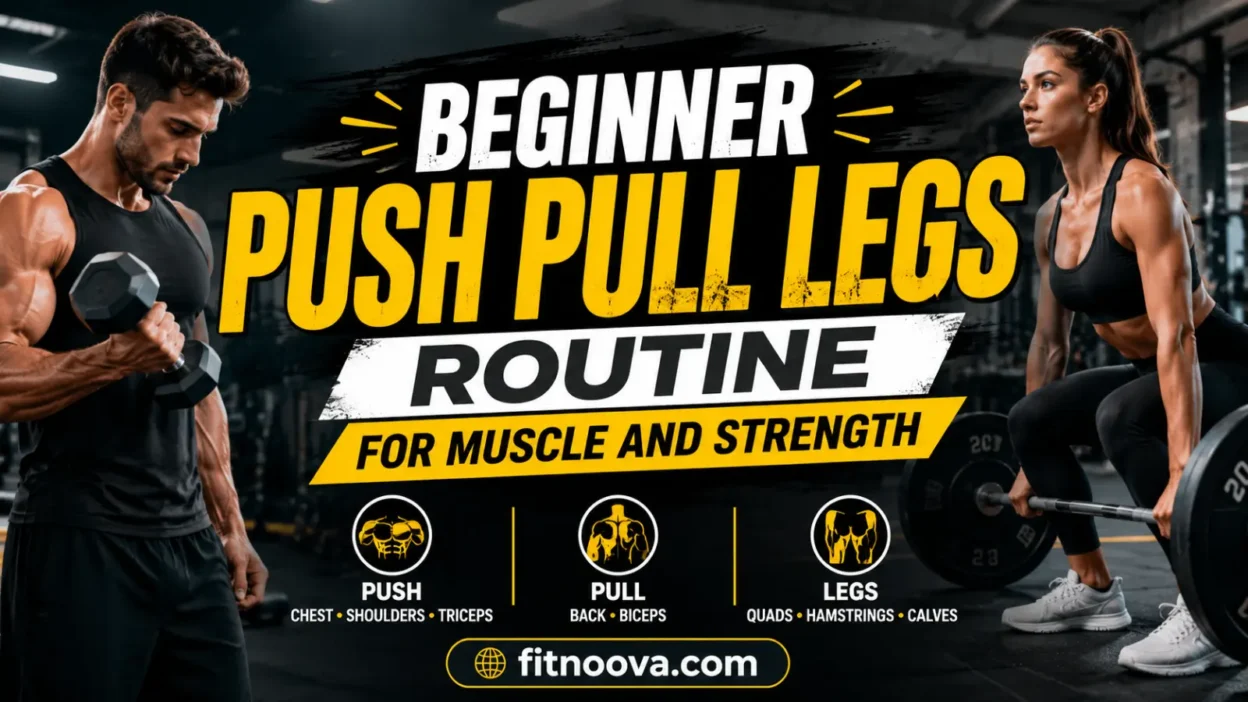
A beginner push pull legs routine is one of the simplest ways to organize strength training without feeling overwhelmed. Instead of training random body parts each day, you split workouts by movement patterns: pushing exercises, pulling exercises, and lower-body training.
For beginners, this structure works well because it balances training volume, recovery, and exercise variety while helping you build consistency in the gym.
Quick Answer
A beginner push pull legs routine divides training into three workout types:
- Push day trains the chest, shoulders, and triceps
- Pull day trains the back and biceps
- Leg day trains the lower body and core
Most beginners do best with 3 workouts per week, using basic compound exercises, moderate effort, and steady progression over time.
What Is a Push Pull Legs Split?
Push pull legs (often shortened to PPL) is a workout split that groups exercises based on how your body moves.
Push Workouts
Push exercises involve pressing weight away from your body. These workouts mainly train:
- Chest
- Shoulders
- Triceps
Common exercises include bench presses, push-ups, shoulder presses, and machine presses.
Pull Workouts
Pull exercises involve pulling weight toward your body. These workouts target:
- Upper back
- Lats
- Rear shoulders
- Biceps
Rows, pulldowns, pull-ups, and curls are common choices.
Leg Workouts
Leg day focuses on lower-body strength and stability, including:
- Quads
- Hamstrings
- Glutes
- Calves
- Core support muscles
Squats, deadlift variations, lunges, and leg presses are typical exercises.
Why Push Pull Legs Works Well for Beginners
Many beginners struggle with one of two problems:
- Doing too much too soon
- Following a random plan without progression
A beginner push pull legs routine helps solve both.
Balanced Recovery
Since muscle groups are separated logically, you usually get enough recovery between sessions. For example, your chest and shoulders recover while you train legs or back.
Easier Exercise Selection
Instead of memorizing complicated bodybuilding splits, beginners can focus on a smaller group of movements each session.
Strong Foundation for Progress
A PPL split naturally emphasizes compound lifts like:
- Squats
- Rows
- Presses
- Pulldowns
- Deadlift variations
These exercises help beginners build strength, coordination, and training confidence.
Flexible Scheduling
You can run a push pull legs routine 3, 4, 5, or 6 days per week. Beginners usually respond best to a simpler version with fewer total sessions.
Best Beginner Push Pull Legs Schedule
For most new lifters, this schedule works well:
| Day | Workout |
|---|---|
| Monday | Push |
| Wednesday | Pull |
| Friday | Legs |
| Weekend | Rest or light activity |
This setup provides recovery days between sessions, which matters when you’re still adapting to resistance training.
If your schedule changes week to week, you can simply rotate through the workouts in order rather than forcing specific calendar days.
Beginner Push Pull Legs Workout Plan
The goal is not to destroy yourself every session. The goal is to practice movements, build consistency, and gradually improve.
Each workout should take roughly 45 to 70 minutes.
Push Day
Barbell or Dumbbell Bench Press
- 3 sets of 6 to 10 reps
Incline Dumbbell Press
- 3 sets of 8 to 12 reps
Seated Shoulder Press
- 3 sets of 8 to 10 reps
Dumbbell Lateral Raise
- 2 to 3 sets of 12 to 15 reps
Triceps Pushdown
- 2 to 3 sets of 10 to 15 reps
Optional: Push-Ups
- 1 to 2 sets close to technical failure
Pull Day
Lat Pulldown or Assisted Pull-Up
- 3 sets of 8 to 12 reps
Seated Cable Row
- 3 sets of 8 to 12 reps
Chest-Supported Dumbbell Row
- 3 sets of 10 reps
Face Pull
- 2 to 3 sets of 12 to 15 reps
Dumbbell Curl
- 2 to 3 sets of 10 to 15 reps
Hammer Curl
- 2 sets of 10 to 12 reps
Leg Day
Goblet Squat or Barbell Squat
- 3 sets of 6 to 10 reps
Romanian Deadlift
- 3 sets of 8 to 10 reps
Leg Press
- 3 sets of 10 to 12 reps
Walking Lunge
- 2 sets per leg
Standing Calf Raise
- 3 sets of 12 to 15 reps
Plank
- 2 to 3 rounds of 20 to 45 seconds
How Hard Should Beginners Train?
Beginners do not need maximal effort on every set.
A good rule:
- Finish most sets with 1 to 3 reps left in reserve
- Focus on controlled technique
- Stop if form breaks down significantly
Training to complete exhaustion every workout often hurts recovery and consistency more than it helps.
How To Progress on a Push Pull Legs Routine
Progressive overload matters, but beginners often overcomplicate it.
You can make progress by:
- Adding a small amount of weight
- Performing more reps with the same weight
- Improving technique
- Controlling tempo better
- Reducing rest times slightly
For example:
- Week 1: 3 sets of 8 with 20-pound dumbbells
- Week 3: 3 sets of 10 with the same weight
- Week 4: Increase to 25 pounds and repeat
Small improvements add up over months.
How Long Should You Follow a Beginner PPL Routine?
Most beginners can use the same push pull legs structure for several months before needing major changes.
You do not need a new routine every few weeks.
Consider adjusting your program if:
- Progress completely stalls for several weeks
- Recovery becomes difficult
- Motivation drops from excessive volume
- Your goals change significantly
Otherwise, consistency usually matters more than constant variation.
Home Gym vs Commercial Gym Options
A push pull legs routine works in almost any setup.
If You Train at Home
You can build a beginner-friendly PPL routine using:
- Adjustable dumbbells
- Resistance bands
- A bench
- Bodyweight exercises
Substitutions work well:
- Push-ups instead of bench press
- Band rows instead of cable rows
- Bulgarian split squats instead of leg press
If You Train in a Gym
Machines can help beginners learn movement patterns safely while building confidence.
You do not need to avoid machines completely. A combination of machines and free weights is often realistic and effective for newer lifters.
Common Beginner Push Pull Legs Mistakes
Doing Too Many Exercises
More volume is not always better.
A beginner usually does not need:
- 10 chest exercises
- 25 total sets
- Two-hour workouts
Focus on quality over quantity.
Adding Weight Too Fast
Progress should feel gradual.
Large jumps in weight often lead to:
- Poor technique
- Joint irritation
- Stalled progress
Ignoring Recovery
Muscle growth and strength gains happen during recovery, not only during workouts.
Pay attention to:
- Sleep
- Nutrition
- Stress
- Rest days
Training With Constant Soreness
Mild soreness can happen, especially early on. Sharp pain, worsening joint discomfort, or lingering fatigue are different.
If recovery consistently feels poor:
- Reduce volume slightly
- Improve sleep
- Add rest days
- Reassess exercise technique
Persistent pain should be evaluated by a qualified medical professional.
Changing Programs Too Often
Beginners frequently switch routines before giving them time to work.
A simple plan followed consistently usually outperforms a “perfect” plan followed inconsistently.
Should Beginners Do Push Pull Legs 6 Days Per Week?
Usually not at first.
While advanced lifters sometimes run high-frequency PPL schedules, most beginners recover better with:
- 3 days per week
- Or occasionally 4 days with extra recovery
More training is not automatically better if sleep, recovery, or technique suffer.
Nutrition Tips That Support a Beginner PPL Routine
Training is only part of the equation.
For better recovery and performance:
- Eat enough protein consistently
- Stay hydrated
- Include carbohydrates around workouts if helpful for energy
- Avoid aggressive crash dieting while starting resistance training
If fat loss is your goal, a moderate calorie deficit tends to be more sustainable than extreme restriction.
FAQ
Is push pull legs good for complete beginners?
Yes. A beginner push pull legs routine is simple to follow, easy to recover from when programmed properly, and flexible enough for most fitness goals.
How many days per week should beginners do push pull legs?
Most beginners do best with 3 workouts per week. This provides enough training stimulus while allowing recovery between sessions.
Can you build muscle with a beginner push pull legs routine?
Yes. Beginners can build muscle and strength effectively with a balanced PPL program, especially when they train consistently and gradually increase workload over time.
What if I miss a workout day?
Simply continue the rotation from where you left off. Missing one workout occasionally is not a major problem.
Should beginners train to failure?
Usually not on every set. Beginners often progress better by stopping slightly before failure while focusing on form and consistency.
Can women follow a push pull legs routine?
Absolutely. Push pull legs training can be adjusted for any experience level, body size, or goal regardless of gender.
Conclusion
A beginner push pull legs routine gives new lifters a clear structure without unnecessary complexity. It organizes training logically, supports recovery, and helps build strength through repeatable movement patterns.
The best version is not the most advanced or exhausting one. It is the routine you can perform consistently, recover from properly, and improve gradually over time.