Last Updated: MAY 19, 2026
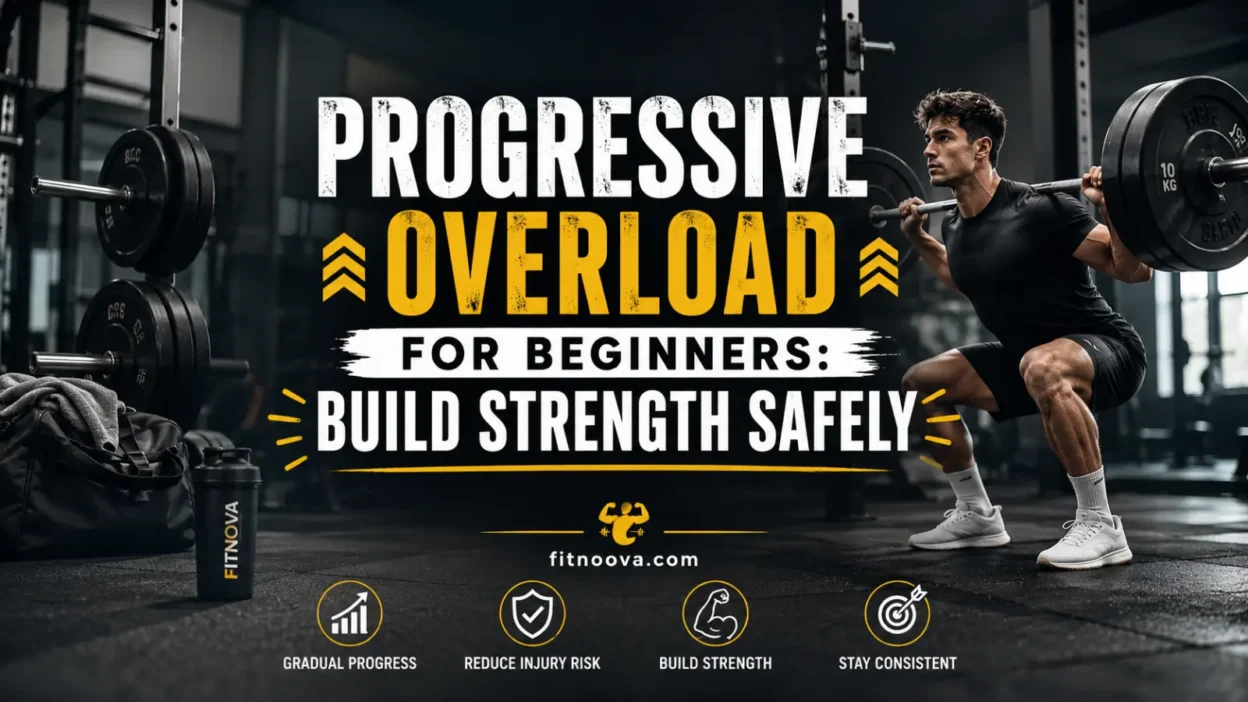
progressive overload for beginners means making small, planned increases to your workouts so your body has a clear reason to get stronger. The goal is not to lift heavier every session or push until form breaks. Start with a simple strength training routine, choose weights you can control, and track reps, sets, and rest. When an exercise feels steady for all planned reps, add a small change next time. That change could be more weight, one extra rep, another set, or better range of motion. A basic workout plan helps you avoid random jumps, sore joints, and stalled progress. Keep recovery, form, and consistency at the center, because steady progress beats rushed effort.
Quick Answer
progressive overload for beginners is the practice of slowly increasing training stress so muscles adapt safely. Start with good form, use a weight you can control, and change only one variable at a time. Add small increases in reps, sets, weight, or range of motion when your current work feels stable.
What Progressive Overload Actually Means
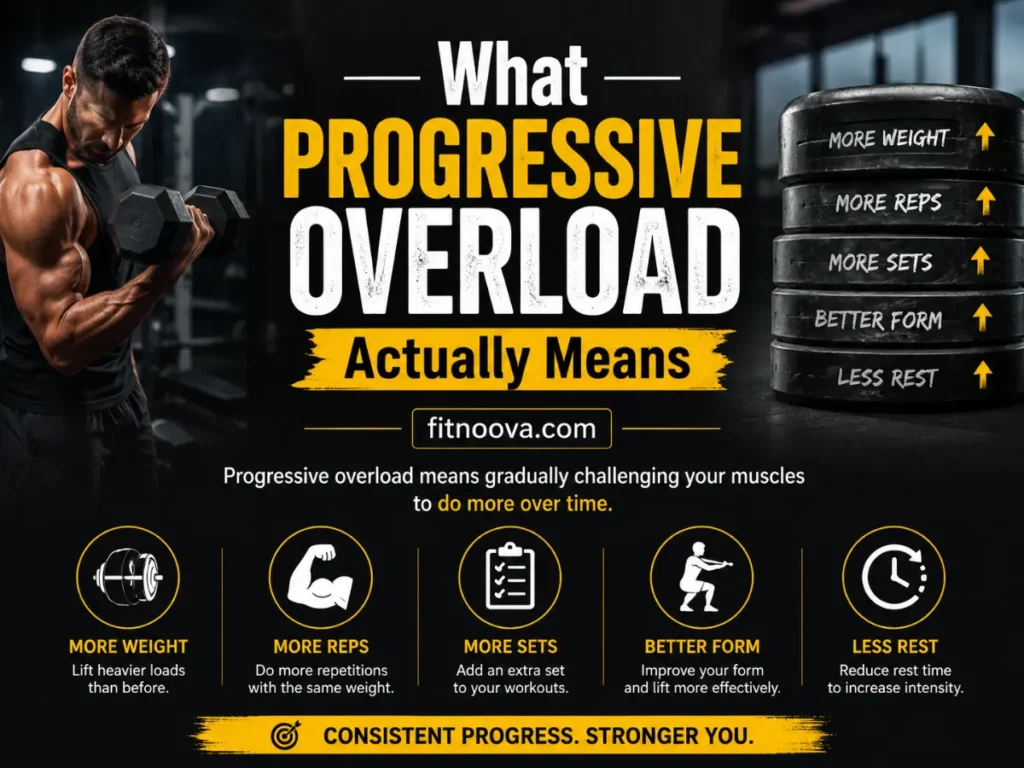
Your body adapts to the demands you place on it. If your workouts never change, results usually stall. If your workouts jump ahead too fast, you are more likely to run into poor form, nagging pain, or inconsistent recovery. Progressive overload sits in the middle: enough challenge to move forward, not so much that training becomes chaotic.
In practical terms, that challenge can come from several places:
- lifting a little more weight
- doing more reps with the same weight
- adding another set
- improving range of motion
- moving with better control
- shortening rest periods slightly when appropriate
- training the same movement pattern more consistently
For beginners, the biggest mistake is thinking overload only means heavier dumbbells or barbells. Often, the first and smartest form of progression is doing the same movement better. A squat to a cleaner depth, a push-up with better body position, or a row with more control is real progress.
Why Beginners Benefit So Much From It
Beginners usually do not need advanced programming. Early progress often comes from showing up consistently, practicing basic movement patterns, and applying gradual progression instead of constant variety.
That matters because beginner bodies are still adapting to the basics of resistance training. ACSM’s 2026 update notes that resistance training remains a key part of fitness and general health, and its guidance continues to frame training using variables such as frequency, intensity, volume, and progression rather than one magic formula.
For most healthy adults, general physical activity guidance still includes at least 150 to 300 minutes of moderate aerobic activity per week plus muscle-strengthening activity at least two days per week.
That means a beginner does not need an extreme split or six-day lifting schedule to benefit. In fact, a simple full-body program done two to three times per week is often the most sustainable place to start.
The Best Ways To Apply Progressive Overload As A Beginner
Add Reps Before You Add Much Weight
This is often the easiest method for people learning technique.
Say you are doing goblet squats with 15 pounds for 8 reps. Rather than jumping to 25 pounds next week, try building from 8 reps to 10, then 12 with the same load. Once you can hit the top of your planned rep range with solid form, move up to the next small jump in weight and start again at the lower end of the range.
This approach works especially well for:
- goblet squats
- dumbbell presses
- rows
- split squats
- Romanian deadlifts
- machine exercises
Mayo Clinic guidance for general strength training also reflects this beginner-friendly idea: use a load that fatigues the target muscles within roughly 12 to 15 reps, and when that becomes easy, increase resistance gradually.
Add Weight In Small Increments
You do not need dramatic jumps. For beginners, smaller increases are usually better because they let your technique keep up with your ambition.
Examples:
- upper-body lifts: add 2.5 to 5 pounds total when possible
- lower-body lifts: add 5 to 10 pounds total when appropriate
- bodyweight exercises: make the movement harder before rushing to weighted versions
If the jump available is too large, stay with the same weight and progress another way first.
Add A Set Only When Recovery Is Good
More volume can drive progress, but more is not always better. If you are already struggling to recover, another set may create more fatigue than benefit.
A simple beginner setup might look like this:
- Week 1 to 2: 2 sets per exercise
- Week 3 to 6: 2 to 3 sets per exercise as tolerated
- Later: only add more volume if performance and recovery stay steady
This matters because progression is not just about what happens during the workout. It is also about whether you can come back and train well again.
Improve Form, Tempo, And Range Of Motion
This is one of the most overlooked ways to overload a movement.
A few examples:
- lowering the weight with control instead of dropping it
- pausing briefly at the bottom of a squat
- using a full pain-free range of motion
- keeping your trunk stable during presses and rows
- doing a push-up to a lower surface as you get stronger
These changes increase the training demand without forcing weight increases that your technique is not ready for.
Increase Training Frequency Carefully
A beginner doing one full-body workout per week will usually benefit from moving to two sessions. Someone training two days per week may progress well with three. Beyond that, more is not automatically better.
For most beginners, two to three weekly strength sessions is enough to improve strength, skill, and confidence while leaving time to recover. Public-health guidance supports at least two weekly muscle-strengthening sessions, not daily all-out lifting.
How Hard Should Beginner Workouts Feel?
A beginner workout should feel challenging, but not frantic.
A useful rule of thumb is to finish most sets feeling like you could still do 1 to 3 more reps with good form. That keeps effort high enough to drive adaptation without turning every set into a grind.
In plain English:
- too easy: you finish the set and barely feel like you trained
- about right: the last few reps feel hard, but still clean
- too hard: your form breaks down, you rush, hold your breath, or need help to finish reps
Training this way is more sustainable than constantly chasing soreness or exhaustion.
A Simple Progressive Overload Plan For Beginners
Here is a practical way to use progressive overload in a basic full-body routine.
Train 2 to 3 times per week on nonconsecutive days.
Choose 4 to 6 exercises that cover major movement patterns:
- squat pattern: goblet squat or bodyweight squat
- hinge pattern: Romanian deadlift or hip hinge
- push pattern: dumbbell press or incline push-up
- pull pattern: dumbbell row or cable row
- core: dead bug, plank, or carry
- optional lower-body single-leg move: split squat or step-up
Use this framework:
Weeks 1 To 2
Do 2 sets of 8 to 10 reps for each exercise. Focus on learning setup, control, breathing, and range of motion.
Weeks 3 To 4
Keep the same weight and try to add 1 to 2 reps per set where form stays solid.
Weeks 5 To 6
When you can complete all planned sets at the top of your rep range, increase the load slightly and drop back toward the lower end of the range.
Weeks 7 And Beyond
Repeat the cycle. Only add sets if you are recovering well and technique remains consistent.
Example with dumbbell row:
- Week 1: 15 pounds, 2 sets of 8
- Week 2: 15 pounds, 2 sets of 10
- Week 3: 15 pounds, 2 sets of 12
- Week 4: 20 pounds, 2 sets of 8
- Week 5: 20 pounds, 2 sets of 9 or 10
That is progressive overload. It is simple, repeatable, and realistic.
How To Know If You Are Progressing
Beginners often look for progress in the wrong places. Better signs include:
- you are using slightly more weight than before
- you can do more reps with the same load
- your form looks more stable
- your rest periods feel more manageable
- movements that used to feel awkward now feel familiar
- you recover well enough to train again on schedule
Soreness can happen, especially after new exercises or a jump in intensity, but it is not the goal. Cleveland Clinic notes that delayed onset muscle soreness usually shows up one to three days after exercise, often after unfamiliar or harder training, and that a workout can still be productive even if you do not feel DOMS.
Common Mistakes That Slow Beginner Progress
Changing Too Many Variables At Once
If you add weight, reps, sets, and extra workouts all in the same week, it becomes hard to tell what is helping and what is burying you. Progress one variable at a time whenever possible.
Ignoring Form To Chase Numbers
A sloppier rep is not a better rep. If technique breaks down every time you increase the load, the weight is probably too heavy right now.
Training Hard Every Session
Beginners often assume every workout should feel extreme. It should not. Consistent, repeatable training beats occasional heroic sessions.
Skipping Recovery
Muscles and connective tissue need time to adapt. General strength-training guidance supports resting at least a full day before training the same muscle group hard again.
Using Soreness As Your Scorecard
DOMS is common, especially with new training, but it is not proof of an effective workout and it is not required for progress. DOMS that follows a typical pattern usually fades within a few days; pain that is severe, worsening, or lasting a week or more may point to something else.
When To Back Off Or Modify
A little training discomfort is normal. Sharp pain is not. General beginner guidance should stay practical here:
Back off, modify, or stop the exercise if:
- you feel sharp or sudden pain
- joint pain gets worse as the set goes on
- your technique falls apart repeatedly
- fatigue is so high that you cannot recover between sessions
- soreness is severe enough to limit normal movement for days
Mayo Clinic advises stopping an exercise if it causes pain and returning with less load or after more recovery, and Cleveland Clinic notes that DOMS is usually manageable at home but severe or concerning pain deserves medical attention.
If you have been inactive for a long time, are older and just returning to exercise, or have a chronic condition, it is sensible to get medical guidance before starting a new program.
FAQ
How fast should beginners increase weight?
As fast as your form allows and no faster. For many lifts, that means adding a small amount only after you can complete your target reps with clean technique. Some exercises may progress weekly at first, while others take longer.
Is progressive overload only for lifting weights?
No. You can apply it to bodyweight training, machines, resistance bands, and even cardio. The principle is the same: gradually increase the challenge in a controlled way.
Can I use progressive overload at home?
Yes. At home, overload can come from extra reps, slower tempo, longer range of motion, harder exercise variations, shorter rest periods, or added resistance from bands, dumbbells, kettlebells, or weighted backpacks.
Do I need to increase something every workout?
No. Beginners often progress quickly, but not every session needs a measurable jump. Sometimes maintaining performance with better form is progress. Sometimes recovery is the right call.
Should beginners train to failure?
Usually not on most sets. Beginners tend to do better leaving a little room in the tank while they learn technique and recover consistently. Near-max effort has a place, but it does not need to define the whole program.
What if I stop progressing?
First, check the basics: sleep, food intake, consistency, exercise technique, and whether you are making jumps that are too big. Many plateaus come from trying to progress too aggressively, not too slowly.
Conclusion
progressive overload for beginners works best when progress feels clear, controlled, and repeatable. You do not need complex methods to build muscle, improve training volume, or gain strength. You need a steady routine, honest tracking, good form, and enough recovery to handle the next step. Small increases help your body adapt without turning every workout into a test. Start with one simple change this week.