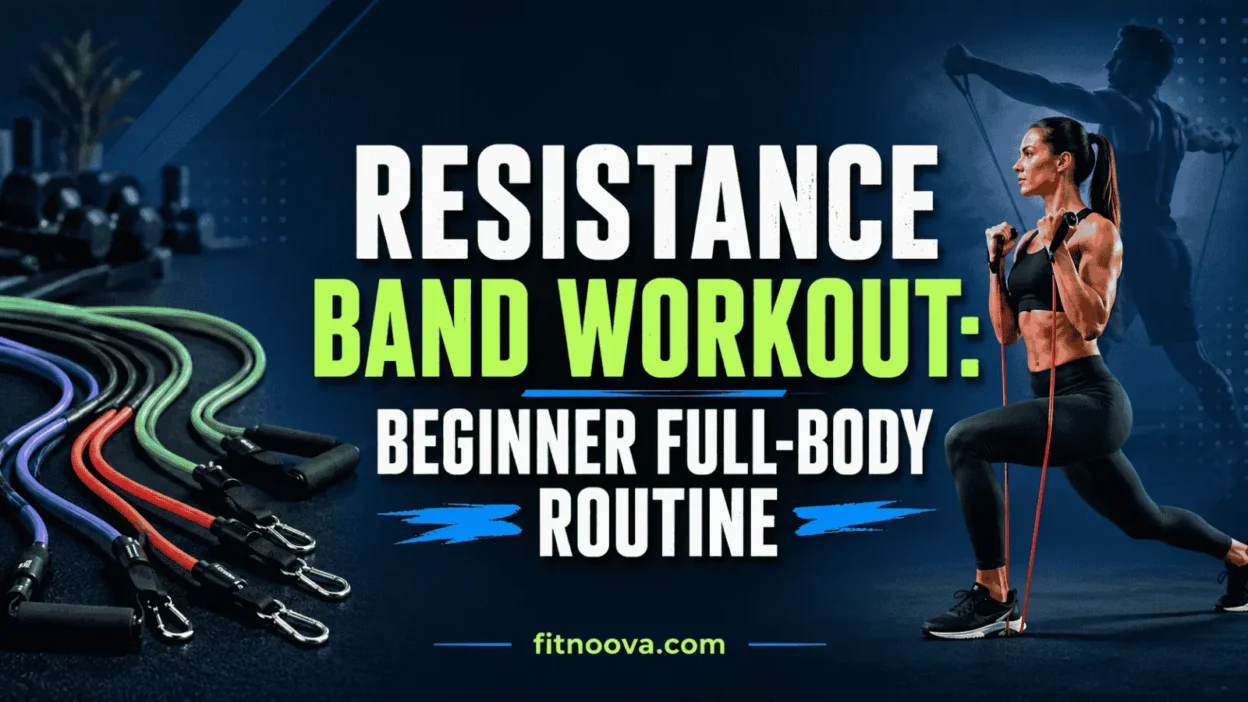
A resistance band workout is one of the simplest ways to build strength at home, at the gym, or while traveling. Bands are affordable, easy to store, and useful for training your legs, glutes, back, chest, shoulders, arms, and core without needing a full rack of weights.
They are also beginner-friendly because the resistance is adjustable. You can make an exercise easier by using a lighter band or shortening your range of motion, or make it harder by using a thicker band, adding more tension, or slowing down each rep.
This guide gives you a complete full-body resistance band routine, plus form tips, progression advice, common mistakes, and safety notes so you can train with confidence.
Quick Answer
A good resistance band workout should train all major muscle groups with controlled, steady movements. Beginners can start with 2 to 3 full-body sessions per week, using 1 to 3 sets of 8 to 15 reps per exercise and resting at least a day between harder strength sessions.
Resistance bands can be used for squats, rows, presses, deadlifts, curls, lateral walks, core work, and mobility drills. Choose a band that makes the last few reps challenging while still allowing clean form.
Why Resistance Bands Work
Resistance bands create tension your muscles have to work against. Unlike dumbbells, which are usually hardest at certain points because of gravity, bands get more challenging as they stretch. That makes them useful for learning control, improving muscle engagement, and adding resistance to movements that might otherwise feel too easy.
Mayo Clinic notes that resistance bands are a valid strength-training option alongside free weights, machines, and body-weight exercises, and emphasizes using proper form to reduce injury risk.
Bands are especially practical for beginners because they let you adjust the difficulty quickly. If a move feels too hard, you can loosen the band, use a lighter one, or reduce the range of motion. If it feels too easy, you can step farther away, use a thicker band, slow the tempo, or add another set.
Who This Resistance Band Workout Is Best For
This routine is designed for beginners, home workout users, busy adults, and anyone who wants a low-equipment strength plan. It can also work well for people returning to exercise after time off, as long as they start conservatively and respect their current fitness level.
This workout may be a good fit if you want to:
- Build basic full-body strength
- Exercise at home with minimal equipment
- Learn movement patterns before using heavier weights
- Add strength training to a walking, cycling, or cardio routine
- Train while traveling
- Reduce reliance on machines or crowded gym spaces
If you have a current injury, recent surgery, chest pain, unexplained dizziness, or a medical condition that affects exercise safety, get guidance from a qualified healthcare professional before starting or progressing the routine.
What You Need
You do not need much equipment for this workout. A small set of bands gives you more options, but one medium resistance band is enough to begin.
Useful options include:
- A long loop band for squats, rows, deadlifts, and presses
- A mini band for glute bridges, lateral walks, and hip work
- A tube band with handles for rows, curls, presses, and pulldowns
- A sturdy anchor point, if you are doing anchored rows or presses
Before every session, inspect the band for cracks, thinning, tears, or weak spots. Do not use a damaged band. If you anchor a band in a door, make sure the door closes securely away from you and that the anchor is designed for exercise use.
How Often To Do A Resistance Band Workout
For general health, adults are encouraged to do muscle-strengthening activity at least 2 days per week, working all major muscle groups. The CDC also recommends at least 150 minutes of moderate-intensity aerobic activity weekly for adults.
For beginners, a realistic starting point is:
- 2 full-body resistance band workouts per week for the first 2 to 3 weeks
- 3 full-body workouts per week once the routine feels manageable
- At least 24 to 48 hours between harder strength sessions for the same muscle groups
You do not need to train to exhaustion. A good beginner effort level is finishing most sets with 2 to 3 reps “left in the tank.” The last few reps should feel challenging, but your form should not fall apart.
Beginner Resistance Band Workout
This full-body routine trains your lower body, upper body, and core. Move slowly, control the band in both directions, and rest 45 to 90 seconds between exercises as needed.
Warm-Up: 4 To 6 Minutes
Start with easy movement to raise your body temperature and prepare your joints.
Do 30 to 45 seconds each:
- March in place
- Arm circles
- Body-weight squats
- Hip hinges
- Shoulder blade squeezes
- Easy band pull-aparts with a light band
The goal is not to tire yourself out. You should feel warmer, looser, and ready to move.
1. Banded Squat
Works: Quads, glutes, hamstrings, core
Stand with your feet about shoulder-width apart. Place a long loop band under both feet and hold the other end at shoulder height, or use a mini band above your knees. Sit your hips back and down as if lowering into a chair. Press through your feet to stand.
Do 2 to 3 sets of 8 to 12 reps.
Keep your chest lifted, ribs stacked over your pelvis, and knees tracking in the same direction as your toes. If your knees cave inward, use a lighter band or reduce your depth.
2. Resistance Band Row
Works: Upper back, lats, rear shoulders, biceps
Anchor the band at chest height or loop it around a sturdy post. Hold one end in each hand and step back until the band has light tension. Pull your elbows back, squeeze your shoulder blades gently, then return with control.
Do 2 to 3 sets of 10 to 15 reps.
Avoid shrugging your shoulders toward your ears. Think about pulling your elbows toward your back pockets rather than yanking with your hands.
3. Banded Glute Bridge
Works: Glutes, hamstrings, hips, core
Lie on your back with your knees bent and feet flat. Place a mini band above your knees. Brace your core lightly, press through your heels, and lift your hips until your body forms a straight line from shoulders to knees. Lower slowly.
Do 2 to 3 sets of 10 to 15 reps.
Keep your ribs down and avoid arching your lower back at the top. If you feel this mostly in your lower back, reduce the range of motion and focus on squeezing your glutes.
4. Standing Band Chest Press
Works: Chest, shoulders, triceps, core
Anchor the band behind you at chest height, or wrap a long band behind your upper back. Hold the ends near your chest. Press your hands forward until your arms are almost straight, then return slowly.
Do 2 to 3 sets of 8 to 12 reps.
Keep your wrists straight and avoid locking your elbows hard at the end. Mayo Clinic’s resistance band guidance also recommends avoiding locked elbows during pressing movements.
5. Banded Romanian Deadlift
Works: Hamstrings, glutes, lower back, core
Stand on the middle of a long band with your feet hip-width apart. Hold the ends in your hands. Soften your knees, push your hips back, and lower your hands along the front of your legs. Stand tall by driving your hips forward.
Do 2 to 3 sets of 8 to 12 reps.
This is a hip hinge, not a squat. Your back should stay neutral, and you should feel a stretch in your hamstrings rather than strain in your lower back.
6. Band Pull-Apart
Works: Upper back, rear shoulders, posture muscles
Hold a light band in front of your chest with both hands. Keep your arms mostly straight and pull the band apart until your hands move toward your sides. Pause briefly, then return slowly.
Do 1 to 3 sets of 10 to 15 reps.
Use a light band. This exercise works best when it is smooth and controlled, not forced.
7. Banded Lateral Walk
Works: Glutes, hips, outer thighs
Place a mini band above your knees or around your ankles. Slightly bend your knees and hips. Step to one side, then bring the other foot in without letting the band go slack. Take several steps one way, then return.
Do 2 sets of 8 to 12 steps per side.
Keep your toes pointing forward and your upper body steady. You should feel the sides of your hips working.
8. Pallof Press
Works: Core, obliques, deep trunk stabilizers
Anchor a band at chest height. Stand sideways to the anchor and hold the band at your chest with both hands. Step away until there is tension. Press your hands straight forward without letting your body rotate, then bring them back.
Do 2 sets of 8 to 12 reps per side.
This is an anti-rotation core exercise. Move slowly and keep your hips and shoulders square.
Simple Weekly Plan
For most beginners, this plan is enough to start:
Monday: Full-body resistance band workout
Tuesday: Walk, easy cardio, or mobility
Wednesday: Rest or light activity
Thursday: Full-body resistance band workout
Friday: Walk, easy cardio, or mobility
Saturday: Optional third band workout or active recovery
Sunday: Rest
This schedule supports consistency without overloading the same muscles every day. You can shift the days based on your routine, but try not to do hard full-body strength sessions on back-to-back days when you are just getting started.
How To Choose The Right Band Resistance
The right band should make the last few reps challenging without forcing you to twist, jerk, shorten the movement too much, or lose control.
Use this simple test:
- If you cannot complete 8 clean reps, the band is probably too heavy.
- If you can easily do more than 15 to 20 reps, the band is probably too light.
- If the last 2 to 3 reps feel challenging but controlled, you are in a good range.
For some exercises, you may need different bands. A band that feels right for squats may be too heavy for pull-aparts or curls. That is normal.
How To Progress Your Resistance Band Workout
Progress slowly. The goal is to make the workout a little more challenging over time without rushing into sloppy reps.
Good progression options include:
- Add 1 to 2 reps per set
- Add one extra set to one or two exercises
- Use a slightly stronger band
- Slow the lowering phase of each rep
- Pause for 1 second at the hardest part of the movement
- Reduce rest slightly if your form stays solid
Do not change everything at once. Pick one progression method and keep the workout repeatable. Strength training works best when you can track what you are doing and build gradually.
Form Tips That Make Bands More Effective
Bands reward control. If you rush through the movement, the band can snap back, pull you out of position, or make the exercise less useful.
Focus on these basics:
Start With Light Tension
The band should not be completely loose at the beginning of the exercise. A small amount of tension helps keep the movement smooth.
Control The Return
Do not let the band pull you back quickly. The return phase is still part of the rep.
Keep Your Joints Stacked
During squats and deadlifts, keep your feet grounded and knees tracking naturally. During presses and rows, keep your wrists straight and shoulders away from your ears.
Breathe Normally
Exhale during the harder part of the rep and inhale as you return. Avoid holding your breath for long sets.
Stop Before Pain Changes Your Form
Muscle effort is expected. Sharp pain, joint pain, numbness, tingling, or pain that changes how you move is a reason to stop and reassess.
Common Resistance Band Workout Mistakes
Using A Band That Is Too Heavy
A heavy band is not automatically better. If you have to jerk, lean, twist, or shorten every rep, the resistance is too high. Use a lighter band and make the movement clean.
Letting The Band Snap Back
The band should return slowly. Snapping back reduces control and can irritate joints or increase the chance of the band slipping.
Skipping Pulling Exercises
Many people do more presses, squats, and curls than rows or pull-aparts. Include upper-back work to balance your routine and support better shoulder mechanics.
Training The Same Muscles Hard Every Day
Resistance bands may feel less intimidating than weights, but they still create training stress. Give your muscles time to recover, especially when you are sore or increasing volume.
Ignoring Band Condition
Bands wear down. Check them regularly, especially near handles, anchor points, or areas that rub against shoes or doors. Replace bands that look cracked, stretched out, or damaged.
When To Modify Or Back Off
Normal exercise discomfort usually feels like muscle effort, mild burning during a set, or general soreness 24 to 48 hours later. That can be part of adapting to a new routine.
Back off or stop if you notice:
- Sharp, sudden, or worsening pain
- Joint pain that persists after the exercise
- Numbness, tingling, or radiating pain
- Dizziness, chest pain, or unusual shortness of breath
- Swelling or pain that changes your normal movement
If symptoms are concerning, do not push through. Modify the exercise, rest, or seek medical guidance.
FAQ
Can you build muscle with resistance bands?
Yes, resistance bands can support muscle growth when the exercises are challenging enough and progressed over time. The key is using enough resistance, training close enough to fatigue, controlling each rep, and staying consistent. Cleveland Clinic notes that resistance bands can provide strength-building benefits and may be used as an alternative to traditional gym equipment.
Is a resistance band workout good for beginners?
Yes. Resistance bands are beginner-friendly because they are adjustable, portable, and easier to scale than many machines or free-weight exercises. Start with basic movements, use light to moderate resistance, and focus on form before adding intensity.
How long should a resistance band workout be?
Most beginner resistance band workouts can be effective in 20 to 35 minutes. A shorter 10- to 15-minute session can still be useful if you focus on a few major movements and train with good control.
Should I do resistance bands every day?
You can do light mobility or activation work often, but hard full-body resistance band workouts are usually best done 2 to 3 days per week when you are starting. Give your muscles time to recover between tougher sessions.
Are resistance bands better than dumbbells?
They are not better in every way; they are different. Bands are portable, affordable, and easy to use at home. Dumbbells are easier to load precisely and may be better for certain strength goals. Many people benefit from using both.
What resistance band should a beginner start with?
Most beginners should start with a light to medium band. The band should let you complete 8 to 15 clean reps with the last few reps feeling challenging but controlled.
Conclusion
A resistance band workout can be simple, effective, and easy to fit into real life. Start with a full-body routine 2 to 3 times per week, choose a band that lets you move with control, and progress gradually as the exercises become easier.
The best routine is not the hardest one you can survive. It is the one you can repeat, recover from, and improve over time.