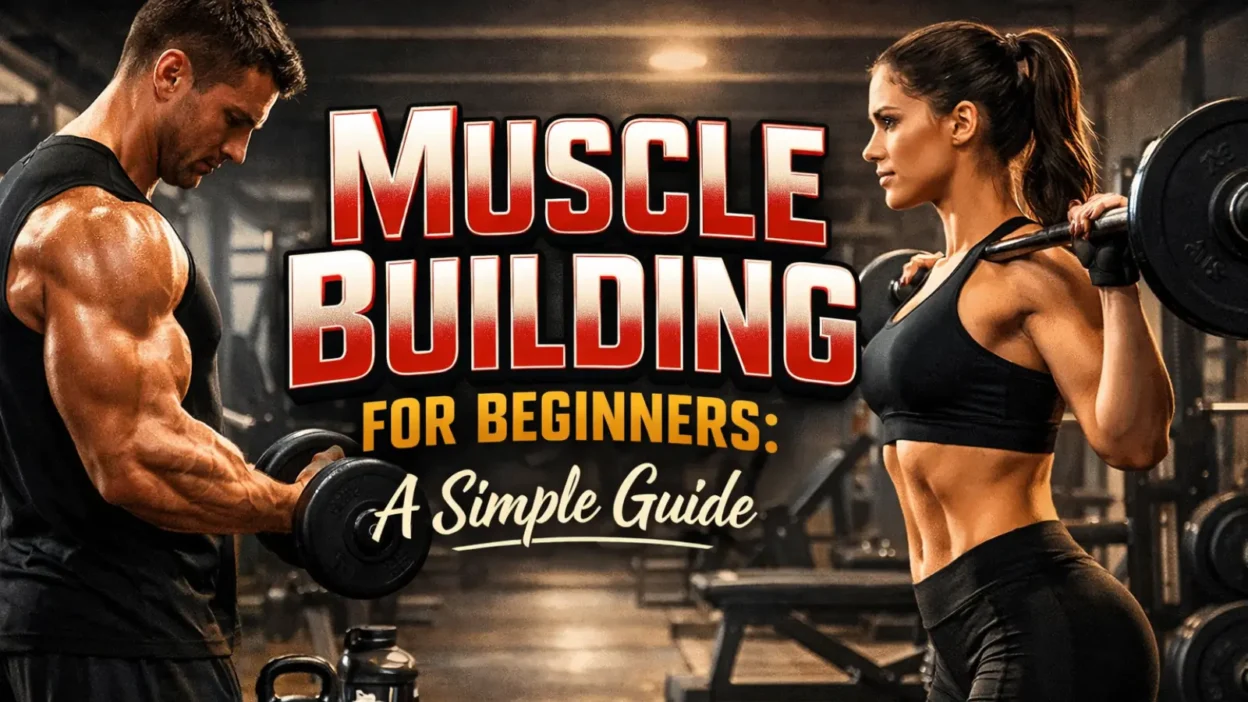
Muscle building for beginners does not require extreme workouts, complicated splits, or a shelf full of supplements. For most people, it starts with a few basic movement patterns, consistent strength training, enough recovery, and a diet that regularly includes protein-rich foods. Adults are generally advised to do muscle-strengthening work for all major muscle groups at least 2 days per week, which is a practical starting point for beginners.
Quick Answer
The best way to approach muscle building for beginners is to train your whole body two to three times per week, focus on good form, and slowly make your workouts more challenging over time. You do not need to train to exhaustion every session. Consistent effort, sensible progression, rest days, and a balanced diet matter more than fancy programming.
How Muscle Building Works
Your body builds muscle by adapting to training. When you challenge your muscles with resistance, then give them food and time to recover, they gradually get stronger and better at handling that workload.
For beginners, this process is usually more straightforward than people expect. You do not need to “shock” your muscles. You need to give them a reason to adapt, then repeat that process week after week.
That usually means:
- training the major muscle groups regularly
- using exercises you can perform with control
- adding difficulty gradually
- eating enough overall
- getting enough recovery between sessions
Beginners often make fast early progress because almost any well-structured resistance training is a new stimulus. That does not mean progress stays fast forever, but it does mean the basics work well in the beginning.
What Beginners Should Focus On First
A lot of new lifters jump straight to advanced methods. That is usually a mistake.
At the start, your priorities should be much simpler:
Learn The Main Movement Patterns
You do not need dozens of exercises. You need a handful you can repeat and improve. Most beginner muscle-building plans should include some version of:
- squat or sit-to-stand
- hinge
- push
- pull
- carry
- core bracing
These patterns train multiple muscle groups and teach coordination at the same time.
Build A Consistent Weekly Schedule
A decent plan done for three months beats a perfect plan abandoned after ten days. A beginner usually does better with a simple weekly rhythm than with a complicated split.
Use Good Technique Before Chasing Load
The goal is not to lift as heavy as possible on day one. The goal is to train the target muscles safely and consistently. Controlled reps, stable positions, and a manageable range of motion matter.
Leave A Little In The Tank
You do not need every set to feel like a test. A beginner often grows just fine by stopping with one to three reps left before form breaks down. That helps you practice better technique and recover well enough to train again.
The Best Training Frequency for Muscle Building for Beginners
For most beginners, full-body training two to three times per week is the most practical place to start. That matches public-health guidance to perform muscle-strengthening activity on at least 2 days per week, and it gives new lifters enough practice with the main lifts without overwhelming recovery.
A good beginner schedule might look like this:
- Monday: full-body workout
- Wednesday: full-body workout
- Friday: full-body workout
Or, if life is busy:
- Tuesday: full-body workout
- Saturday: full-body workout
Both can work.
Three days per week usually gives you more practice and more total work. Two days per week can still work very well if you train consistently and use enough effort.
A Simple Beginner Muscle-Building Routine
This kind of plan works well for many beginners in a gym or at home with dumbbells, bands, or body weight.
Full-Body Workout A
1. Squat Variation
Examples: goblet squat, bodyweight squat, leg press
Do 2 to 3 sets of 6 to 12 reps.
2. Horizontal Push
Examples: push-up, incline push-up, dumbbell bench press, machine chest press
Do 2 to 3 sets of 6 to 12 reps.
3. Horizontal Pull
Examples: seated row, one-arm dumbbell row, resistance-band row
Do 2 to 3 sets of 8 to 12 reps.
4. Hip Hinge
Examples: Romanian deadlift with dumbbells, kettlebell deadlift, hip hinge drill
Do 2 to 3 sets of 8 to 12 reps.
5. Overhead Press
Examples: dumbbell shoulder press, machine shoulder press
Do 2 sets of 8 to 12 reps.
6. Core Stability
Examples: dead bug, plank, Pallof press
Do 2 to 3 sets.
Full-Body Workout B
1. Single-Leg Lower-Body Exercise
Examples: split squat, reverse lunge, step-up
Do 2 to 3 sets of 6 to 10 reps per side.
2. Vertical Pull
Examples: lat pulldown, assisted pull-up, band pulldown
Do 2 to 3 sets of 8 to 12 reps.
3. Incline Or Alternate Push
Examples: incline dumbbell press, machine press, push-up variation
Do 2 to 3 sets of 8 to 12 reps.
4. Glute-Focused Exercise
Examples: hip thrust, glute bridge, cable pull-through
Do 2 to 3 sets of 8 to 15 reps.
5. Arm Accessory Work
Examples: dumbbell curls, triceps pressdowns
Do 1 to 2 sets of 10 to 15 reps.
6. Core Or Carry
Examples: side plank, suitcase carry, farmer carry
Do 2 to 3 sets.
Alternate Workout A and Workout B across the week. Keep rest periods long enough that you can perform the next set with control. For most compound lifts, that means about 1 to 2 minutes, and sometimes a little longer.
How Hard Should Your Workouts Feel?
A beginner muscle-building plan should feel challenging, but not chaotic.
A useful rule is this: the last few reps of a set should feel hard, but your form should still look solid. If the weight is so light that you could do far more reps than prescribed, it is probably too easy. If your form falls apart halfway through the set, it is too heavy.
A lot of beginners benefit from this approach:
- start with a weight you can control
- stay in a moderate rep range
- finish most sets with 1 to 3 reps still available
- increase the challenge slowly
This lets you learn technique and build confidence without turning every workout into a grind.
How To Progress Without Overcomplicating It
The principle behind muscle growth is simple: over time, your muscles need a slightly bigger challenge.
That does not mean adding weight every workout forever. It means using gradual progression. You can progress by:
- adding a small amount of weight
- doing one more rep with the same weight
- adding an extra set
- improving control, depth, or range of motion
- shortening excessive rest without rushing good sets
Here is one easy example. If your plan calls for 3 sets of 8 to 10 reps and you hit 10, 10, and 10 with clean form, increase the load a little next time. If you get 8, 8, and 7, keep the same load until you can do more.
That kind of steady progression is boring in the best possible way. It works.
Nutrition Basics That Support Muscle Growth
Training gives your body a reason to build muscle. Nutrition helps support that process.
You do not need a perfect diet. You do need a pattern you can stick to.
Prioritize Protein-Rich Meals
Protein helps build and maintain muscle tissue. Healthy adults need enough protein overall, and many people can meet their needs through regular meals built around foods such as dairy, eggs, fish, poultry, beans, lentils, soy foods, meat, nuts, and seeds. General adult protein intake guidance is often expressed as a share of calories, and individual needs vary.
A practical beginner approach is to include a meaningful protein source at each meal instead of saving all of it for dinner.
Eat Enough Overall
If you are constantly under-eating, muscle gain becomes harder. Some beginners trying to “get lean first” end up training hard while eating too little to recover well.
You do not need to bulk aggressively. You do need enough food to support training, recovery, and daily life.
Do Not Ignore Carbohydrates And Fats
Carbs help fuel training. Fats support overall health. A muscle-building diet is not just protein plus protein shakes.
A balanced eating pattern with protein foods, whole grains, fruits, vegetables, and healthy fat sources is a much better foundation than chasing one macro while neglecting everything else.
Supplements Are Optional
Beginners often think supplements are the missing piece. Usually they are not.
If your training, sleep, and daily diet are inconsistent, supplements will not fix that. Start with food, routine, and recovery first. The NIH notes that many performance supplements are marketed with bold claims, but evidence varies, and supplements should not replace sound training and nutrition habits.
Recovery Is Part Of Muscle Building
Muscle is not built only during the workout. Recovery matters.
That includes:
- sleep
- rest days
- nutrition
- managing training volume
- not pushing hard through significant pain
Adults are encouraged to spread activity across the week, and beginner strength training usually works best when the same muscle groups are not hammered hard every day. Public guidance also supports rest and practical pacing.
Normal Soreness vs A Problem
Some soreness after starting a program is common. Mild stiffness the next day is not unusual, especially when training is new. But severe pain, swelling, or soreness so intense that normal movement becomes difficult is a sign you likely overdid it and should back off.
Slow down and reassess if you notice:
- sharp or stabbing pain during a lift
- swelling
- limping or altered movement
- pain that keeps getting worse
- soreness so strong that daily movement is difficult
- persistent exhaustion or loss of performance
If that happens, rest, modify, and get medical guidance when needed.
Common Mistakes Beginners Make
Doing Too Much Too Soon
The fastest way to stall is to start with an advanced workload you cannot recover from. More is not automatically better.
Changing Exercises Constantly
A beginner does not need endless variety. You need enough repetition to improve technique and track progress.
Training With Sloppy Form
Heavier weights do not count for much if every rep is uncontrolled. Better reps usually beat ego lifting.
Ignoring Lower-Body Training
Some beginners overfocus on chest and arms. A better plan trains the whole body. Squats, hinges, split squats, and glute work matter.
Underestimating Recovery
Poor sleep, too little food, and no rest days can make a reasonable program feel impossible.
Expecting Visible Changes Immediately
Strength often improves before the mirror changes. Early progress may show up first as better technique, more reps, better posture, or weights that feel easier.
Who Should Modify Or Get Medical Clearance First?
A simple beginner strength plan is appropriate for many adults, but some people should be more careful at the start.
Talk with a qualified clinician before jumping in if you have:
- a major heart, lung, or metabolic condition
- recent surgery
- uncontrolled blood pressure
- significant joint pain
- a recent injury
- dizziness with exertion
- pregnancy-related exercise questions
- any condition that makes exercise feel unpredictable or unsafe
Public-health sources also note that people with chronic conditions may need help choosing the right type and amount of activity for their situation.
Home vs Gym: Which Is Better for Beginners?
Both can work.
A gym makes progression easier because you usually have more load options and machines that help you learn movement patterns. Home training can still build muscle if you have enough resistance and a good plan.
Home may suit you better if:
- you want privacy
- travel time is a barrier
- you have dumbbells or bands
- you are more likely to stick with it
A gym may suit you better if:
- you want more equipment
- you like a structured training environment
- you want easy load progression
- you benefit from seeing other people train
The best option is the one you will actually use for months, not just for one motivated week.
For readers building a routine outside the gym, our Beginner Home Workout Plan can help. If you are just getting comfortable in a gym setting, see Gym Mistakes Beginners Make for practical ways to avoid common setbacks.
How Long Does It Take To See Results?
That depends on your training history, sleep, nutrition, consistency, age, and starting point.
Most beginners notice some kind of progress fairly early, but not always in the form they expect. In the first several weeks, it is common to notice:
- better exercise control
- improved confidence
- more reps with the same weight
- less fatigue from the same workout
- better awareness of posture and bracing
Visible muscle gain takes longer and varies from person to person. The better mindset is to look for signs of real progress that are within your control: consistency, stronger lifts, better movement, and good recovery habits.
FAQ
Can beginners build muscle with just bodyweight training?
Yes, especially in the beginning. Push-ups, split squats, glute bridges, rows with bands, and well-progressed bodyweight exercises can build muscle if they become challenging enough over time.
Is two days a week enough to build muscle?
Yes. Two full-body strength sessions per week can work well for beginners, especially if the exercises are challenging, the routine is consistent, and you gradually progress. Public guidance recommends muscle-strengthening work at least 2 days per week.
Should beginners do cardio while trying to build muscle?
Yes. Cardio supports general health and does not automatically cancel muscle gain. The key is balancing it with your recovery and making sure strength training remains a priority if muscle gain is your main goal. Adults are also advised to get regular aerobic activity alongside strength work.
Do I need to train to failure to gain muscle?
No. Beginners usually do not need to take every set to failure. Training hard with good form and leaving a little room before breakdown is often more sustainable and easier to recover from.
What should I do on rest days?
Rest days can include normal movement like walking, light mobility, or easy daily activity. They are there to help you recover, not to make you feel guilty. Our Rest Day Explained article covers how to use them well.
What if I feel pain instead of normal soreness?
Mild soreness can be normal when you start. Sharp pain, swelling, and pain that changes how you move are different. If you have severe pain or swelling, stop the exercise and rest.
Conclusion
Muscle building for beginners is usually much simpler than the fitness world makes it sound. Train your whole body two to three times per week, focus on basic lifts, use good form, progress gradually, and recover well. You do not need a perfect plan. You need a realistic one you can follow long enough for it to work.