Last Updated: MAY 19, 2026
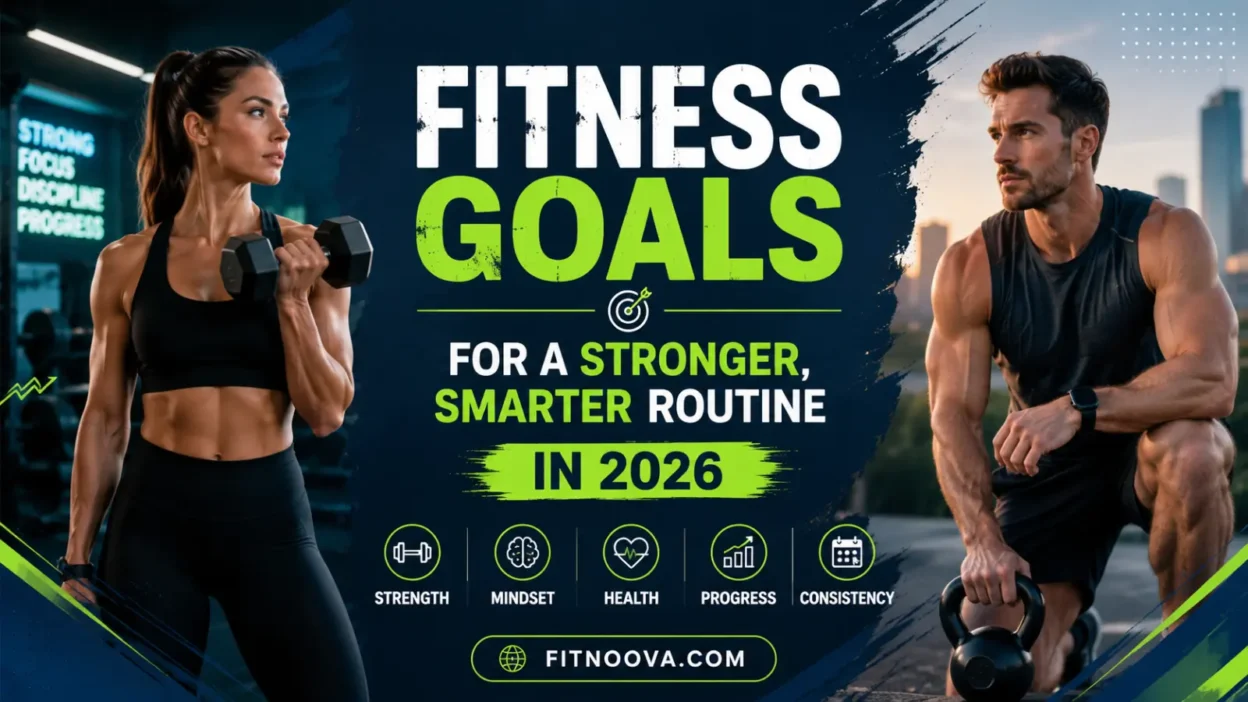
fitness goals work best when they turn a broad wish into a clear plan you can repeat. Start with one main outcome, then break it into small actions you can track each week. A stronger routine may include a workout plan, better sleep, steady meals, and simple progress tracking. Keep the plan realistic, so it fits your schedule instead of fighting it. Pick steps you can measure, such as training days, daily movement, or recovery time. This helps you see what works without guessing. The best approach feels clear, doable, and flexible enough to adjust as your body, time, and energy change.
Quick Answer
fitness goals are clear health targets that help you plan, measure, and improve your routine. Good ones focus on actions you can control, such as weekly training, daily steps, balanced meals, or sleep. Keep each target specific, realistic, and easy to review so progress feels steady instead of random.
What Fitness Goals Should Actually Look Like
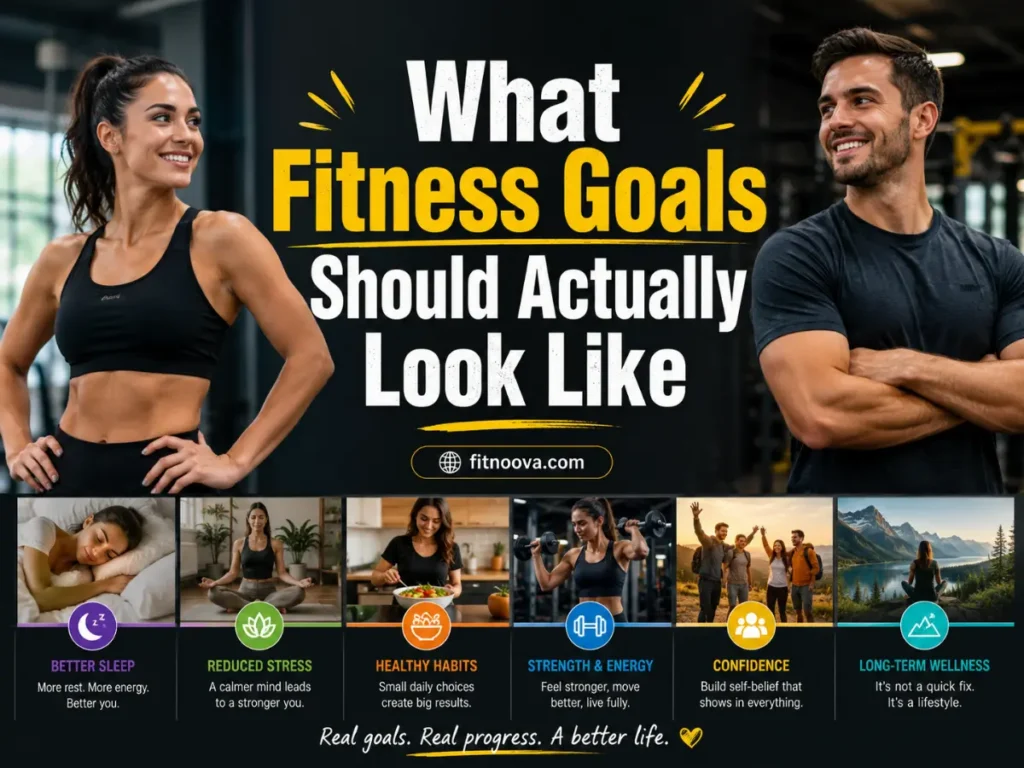
A useful fitness goal has three parts:
First, it defines the outcome you want. That might be improving stamina, building strength, exercising more regularly, or feeling less winded during daily life.
Second, it turns that outcome into a behavior. “Walk 30 minutes after work on Monday, Wednesday, and Friday” is more useful than “do more cardio.”
Third, it has a timeline and a way to measure progress. That does not mean obsessing over numbers. It just means you need a way to tell whether the plan is working.
Many people fail here because the goal is either too broad or too aggressive. The American Heart Association notes that goals that are vague or unrealistic are harder to sustain, while clear goals and tracking can make follow-through easier.
Start With The Right Type Of Goal
Most fitness goals fall into one of four buckets. Knowing which one you want helps you avoid mixing too many priorities at once.
Performance Goals
These focus on what your body can do. Examples include:
- Walk 2 miles without stopping
- Do 10 full push-ups
- Run a 5K
- Deadlift your bodyweight
Performance goals are often easier to measure than appearance goals, and they usually keep training more productive.
Habit Goals
These focus on consistency. Examples include:
- Exercise 3 days per week for the next 8 weeks
- Hit 7,000 to 8,000 steps per day
- Strength train every Tuesday and Saturday
Habit goals are especially useful for beginners because they build the routine that later supports bigger results.
Body-Composition Goals
These may involve fat loss, muscle gain, or changes in waist measurement or clothing fit. These goals are common, but they should still be anchored to behaviors you control, such as training frequency, meal planning, sleep, and activity.
Health Goals
These focus on energy, blood pressure support, blood sugar management, mobility, sleep, or general wellbeing. Physical activity supports broad health benefits, including better sleep, improved mood, and lower risk of several chronic conditions.
How To Set Fitness Goals That Are Realistic
A strong goal should stretch you a little without asking you to live like a different person overnight.
Match The Goal To Your Real Starting Point
If you currently do nothing, your first goal should not be six hard workouts a week. It might be two strength sessions and three 20-minute walks. That is not “aiming low.” It is building a base.
Public-health guidance also supports this approach: some activity is better than none, and benefits begin even before you hit the full weekly target.
Focus On Behaviors Before Outcomes
You cannot fully control the scale, how fast you gain muscle, or how quickly your endurance improves. You can control what you do this week.
A better framing looks like this:
- Less useful goal: lose 20 pounds fast
- Better goal: strength train twice a week, walk 30 minutes five days a week, and prepare lunches at home on weekdays for the next 6 weeks
Give Yourself A Time Frame
A deadline creates structure, but it should be reasonable. Four to twelve weeks is a useful range for most beginner or intermediate goals because it is long enough to build momentum and short enough to stay focused.
Keep The Goal Specific
If you need to guess whether you did it, the goal is too vague.
Compare these:
- “Get fitter”
- “Complete 8 weeks of three weekly workouts”
- “Increase my squat from 65 pounds to 95 pounds in 10 weeks”
- “Walk briskly for 150 minutes per week by the end of next month”
A Simple Formula For Better Fitness Goals
A practical fitness goal usually answers five questions:
- What exactly am I trying to improve?
- How often will I train?
- What will each session look like?
- How hard should it feel?
- How will I know I am progressing?
Here is a beginner-friendly example:
Goal: Improve general fitness and energy over the next 8 weeks.
Plan: Walk 30 minutes on Monday, Wednesday, and Friday, and do full-body strength training on Tuesday and Saturday.
Effort: Walks should feel brisk but conversational. Strength work should feel challenging by the last few reps, without wrecking form.
Progress Marker: Complete at least 4 out of 5 planned sessions each week for 8 weeks.
That lines up well with current guidance recommending aerobic activity plus muscle-strengthening work each week.
The Best Fitness Goals For Beginners
Beginners usually do better with goals that improve consistency, confidence, and basic work capacity.
1. Build A Weekly Exercise Habit
For many people, this is the best starting point.
Example: “Exercise 3 times per week for the next 6 weeks.”
That could mean two strength workouts and one cardio session, or three walks, depending on your current level.
2. Reach The Basic Activity Guidelines
A strong beginner goal is to work toward at least 150 minutes of moderate-intensity activity each week plus 2 days of strength training. You do not need to hit that on day one, but it is a solid long-term benchmark.
3. Improve Strength In A Few Key Movements
Choose 4 to 6 basic patterns:
- Squat or sit-to-stand
- Hinge
- Push
- Pull
- Carry
- Core stability
A good goal might be: “Complete two full-body strength workouts per week for 8 weeks and add reps or load gradually.”
4. Train For A Simple Event
Some people stay more engaged when the goal is concrete. A beginner 5K plan, for example, gives structure and built-in progression. NHS beginner guidance for Couch to 5K uses three sessions per week with rest days between runs, which is a useful reminder that improvement does not require daily hard training.
How Hard Your Training Should Feel
This is where many fitness goals go off course. People either go too easy to create change or too hard to recover well.
For beginners, a good rule is that most sessions should feel moderate. You should finish feeling worked, not destroyed. During moderate-intensity cardio, you should usually be able to talk but not sing. That “talk test” is commonly used in public-health guidance to judge effort.
For strength training, the last few reps of a set should feel challenging while your form stays under control. If technique falls apart early, the load is probably too heavy. If every set feels effortless, it may be too light to drive progress.
How To Progress Without Burning Out
Progression should be gradual. That can mean a little more time, a little more weight, an extra set, or better control and range of motion.
Good progression might look like this:
- Add 5 minutes to one walk each week
- Add 1 to 2 reps per set before increasing weight
- Add a second set before adding more exercises
- Increase training volume only after your current workload feels manageable
This slow-build approach also helps reduce excessive soreness. Delayed onset muscle soreness often shows up 24 to 72 hours after unfamiliar or intense exercise and usually settles within a few days; pain that lasts longer, feels sharp, or worries you deserves more attention.
A Practical 8-Week Fitness Goal Plan
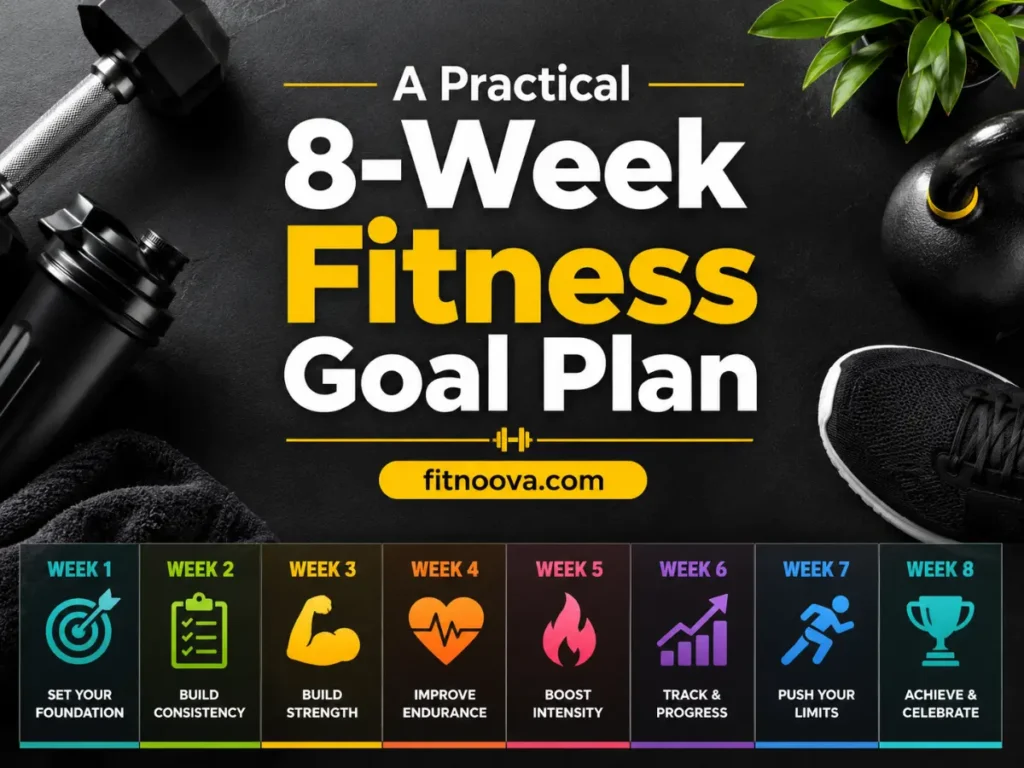
If you want a simple starting template, use this.
Weeks 1 To 2: Build The Routine
- Walk 20 to 30 minutes, 3 days per week
- Full-body strength training, 2 days per week
- Keep 1 to 2 rest or lighter days between harder sessions
Weeks 3 To 4: Add A Little More Volume
- Increase one walk by 5 to 10 minutes
- Add one set to 1 or 2 strength exercises
- Keep effort moderate
Weeks 5 To 6: Improve Quality
- Walk faster or choose a hill once per week
- Add small weight increases where form stays solid
- Track your sessions and recovery
Weeks 7 To 8: Reassess
- Are you more consistent?
- Are daily tasks easier?
- Are you lifting more, walking farther, or recovering better?
- Do you need a new goal, or another cycle of the same one?
This is often enough time to build momentum without making the plan feel endless.
Common Mistakes That Ruin Fitness Goals
Choosing Too Many Goals At Once
Trying to lose fat, gain a lot of muscle, train for a race, fix sleep, and work out every day usually leads to scattered effort. Pick one primary goal and let the rest support it.
Setting Outcome Goals Without A Weekly Plan
A goal is not a plan. “Get stronger” means very little until you decide how many days you will train, what lifts you will do, and how you will progress.
Making The Plan Too Strict
If your goal only works under perfect conditions, it is fragile. Good plans have a version for busy weeks, travel, poor sleep, and low motivation.
Ignoring Recovery
Rest days are not a sign of weak commitment. They are part of training. Beginner running guidance commonly spaces sessions out with rest days, and the same logic applies to strength work.
Treating Pain Like Progress
Hard effort is normal. Sharp pain is not. Stop or scale back if you have chest pain, severe dizziness, trouble breathing, or pain that feels wrong rather than merely challenging. Those symptoms deserve prompt medical attention.
What To Do When Progress Slows Down
Plateaus are normal. They do not always mean your plan has failed.
Start by checking the basics:
- Are you actually following the plan most weeks?
- Are you sleeping enough to recover?
- Are you trying to progress too quickly?
- Is your goal still specific enough?
- Have you been repeating the same routine without adding challenge?
Often, the fix is not a more extreme program. It is a cleaner version of the one you already have.
FAQ
How many fitness goals should I have at one time?
One primary goal is usually enough. You can have a few supporting habits, but your training should revolve around one clear priority so your effort is not split in too many directions.
What are realistic fitness goals for beginners?
Realistic fitness goals for beginners include exercising 3 times per week, walking more consistently, reaching the basic activity guidelines, completing a first 5K, or building strength with two weekly full-body sessions. These are practical, measurable, and easier to sustain than dramatic short-term targets.
How long does it take to reach fitness goals?
It depends on the goal, your starting point, and how consistent you are. Habit and routine goals may improve within a few weeks, while strength, endurance, and body-composition changes usually take longer. A 6- to 12-week time frame is often realistic for a first phase.
Should fitness goals focus on weight loss?
They can, but behavior-based goals usually work better. Weight can change slowly and unevenly. A stronger approach is to focus on training frequency, activity levels, food habits, sleep, and recovery while using weight or waist measurement as just one marker.
What if I miss workouts?
Do not treat one missed week like a failed goal. Adjust and continue. A plan you can return to quickly is better than one that collapses after a minor disruption.
When should I talk to a doctor before starting?
Get medical guidance before starting or progressing exercise if you have a chronic condition, are pregnant or postpartum, have been told to limit activity, or develop warning signs such as chest pain, severe shortness of breath, fainting, or dizziness with exercise. Public-health guidance also notes that adults with chronic conditions or disabilities should aim to be active as they are able, with modifications as needed.
Conclusion
fitness goals give your routine direction when they stay simple, honest, and tied to daily behavior. Focus on consistency, recovery, strength training, cardio, and nutrition habits you can maintain. Avoid chasing too many changes at once, because a crowded plan often breaks down fast. Review your progress each week, adjust what feels too hard, and keep the next step small enough to finish. Choose one action today.