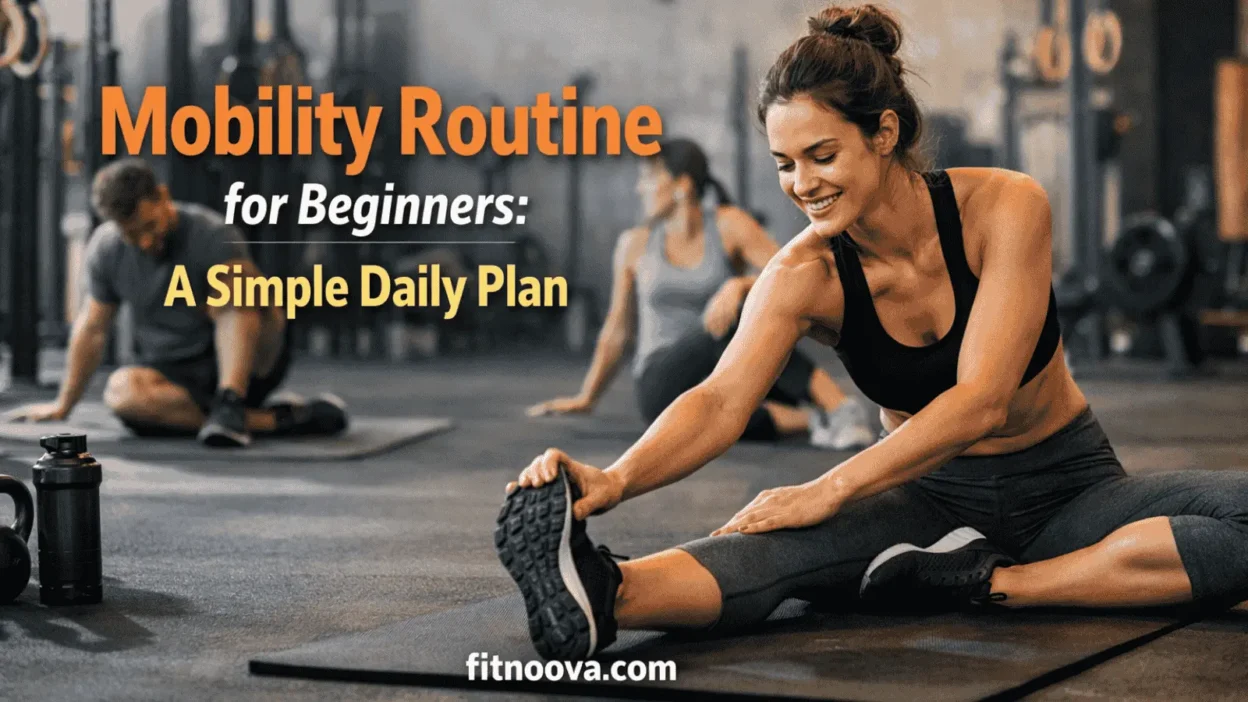
A good mobility routine is a short series of controlled movements that helps your joints move more comfortably, prepares your body for exercise, and makes everyday movement feel less stiff. For most beginners, the best routine is not long or extreme. It is consistent, gentle enough to repeat, and focused on the areas that commonly feel tight from sitting and training: ankles, hips, thoracic spine, and shoulders. Guidance from Mayo Clinic, HSS, and federal physical activity resources supports a practical approach: warm up first, use controlled dynamic movements before activity, and keep intensity low enough that you feel motion and muscular effort, not pain.
Quick Answer
A beginner-friendly mobility routine should take about 8 to 12 minutes and use slow, controlled movements for the ankles, hips, spine, and shoulders. Do it before workouts as a dynamic warm-up, or on its own once a day to reduce stiffness and improve how you move. Mobility work should feel smooth and manageable, not painful, and it works best when paired with regular walking, strength training, and general physical activity.
What a Mobility Routine Is Actually For
Mobility is not exactly the same as flexibility. Flexibility is about how much a muscle or soft tissue can lengthen. Mobility is about how well you can actively move a joint through a useful range of motion with control. In real life, that matters when you squat down, reach overhead, rotate to look behind you, or walk up stairs without feeling stiff and restricted.
That is why a mobility routine earns its place even if you already lift, run, or walk regularly. It can help you move better in training, make warm-ups more effective, and make daily tasks feel easier. It is not a substitute for strength training or aerobic exercise, but it complements both. Public health guidance still centers the basics: adults should aim for at least 150 minutes of moderate physical activity each week plus muscle-strengthening work at least 2 days per week. Mobility work fits around that foundation rather than replacing it.
Who This Routine Suits Best
This routine is a strong fit for:
- beginners who feel generally stiff
- busy adults who sit for long stretches
- people who want a better warm-up before strength training or cardio
- home exercisers who want a low-barrier daily habit
- older adults who want to keep moving comfortably, with appropriate modifications
It is not meant to push through significant pain, rehab an injury on your own, or force extra range where a joint already feels unstable. If you have a recent injury, recurring joint swelling, numbness, chest symptoms with exertion, or a medical condition that affects exercise tolerance, it is smart to get individual guidance before starting.
How Often to Do a Mobility Routine
The best schedule is the one you will actually keep.
For most people, one of these works well:
- Daily for 8 to 10 minutes if stiffness is your main issue
- Before each workout for 5 to 10 minutes as part of your warm-up
- Two to three times per week if you are already active and just want maintenance
Mayo Clinic notes that even 5 to 10 minutes at a time can be helpful, and regular practice matters more than occasional long sessions. HSS also recommends dynamic stretching after 5 to 10 minutes of light activity as part of a warm-up.
How Hard It Should Feel
A mobility routine should feel like controlled movement, gentle muscular effort, and mild tension at end range. It should not feel sharp, pinching, electric, or unstable.
Use these simple rules:
- move slowly enough to stay in control
- stop a rep or two before pain
- breathe normally
- aim for smooth reps, not max range
- keep the session around a 3 to 5 out of 10 for effort
That matters because forcing range can backfire. Mayo Clinic advises gentle, slow movement and backing off if a stretch causes pain.
A Simple 10-Minute Full-Body Mobility Routine
Do 30 to 45 seconds per move, or 6 to 10 reps per side. If you are using this before a workout, start with 3 to 5 minutes of easy walking, cycling, or marching in place first.
1. Cat-Cow
Start on hands and knees. Round your upper back gently, then reverse the motion and lift your chest slightly.
Why it helps: wakes up spinal movement without loading it heavily
Tip: think smooth motion, not big motion
2. Thread-the-Needle Rotation
From all fours, slide one arm under your body, then open that arm up toward the ceiling.
Why it helps: improves thoracic rotation, which many desk-bound adults lack
Tip: let the movement come from your mid-back, not your lower back
3. 90/90 Hip Switch
Sit on the floor with both knees bent, one leg in front and one to the side. Rotate slowly to switch sides.
Why it helps: trains hip internal and external rotation
Tip: put your hands behind you for support if needed
4. Half-Kneeling Hip Flexor Rock
Kneel with one foot forward. Tuck your pelvis slightly and glide your body forward until you feel the front of the hip open.
Why it helps: targets hips that feel tight after long periods of sitting
Tip: do not arch your lower back to fake more range
5. Deep Squat Hold With Support
Hold onto a door frame, rack, or sturdy countertop and sink into a comfortable squat.
Why it helps: works ankles, hips, and the lower body together
Tip: keep heels down as much as you can, but use support freely
6. Ankle Knee-to-Wall Drill
Stand facing a wall in a split stance. Drive the front knee toward the wall while keeping the heel down.
Why it helps: improves ankle mobility, which affects walking, squatting, and lunging
Tip: keep the movement small and honest
7. Walking Lunge With Reach
Step into a controlled lunge and reach both arms overhead or slightly across the front leg.
Why it helps: opens the hips while adding balance and coordination
Tip: front knee should stay roughly in line with your foot, not collapsing inward
8. Leg Swings
Hold onto a wall and swing one leg forward and back in a controlled way. Then do a smaller side-to-side version.
Why it helps: dynamic prep for hips and hamstrings
Tip: this is a swing, not a kick
9. Wall Slides
Stand with your back against a wall if possible. Move your arms up and down in a goalpost shape.
Why it helps: improves shoulder movement and upper-back control
Tip: move only through the range you can keep smooth
10. Torso Twists
Stand tall and rotate side to side with relaxed arms.
Why it helps: a simple dynamic drill for trunk rotation
Tip: keep it controlled rather than flinging yourself around
HSS specifically recommends dynamic movements such as torso twists, walking lunges, and leg swings as part of a warm-up because they prepare the muscles and joints for activity.
How to Use This Routine in Real Life
Before a Workout
Use the full routine or pick 4 to 6 moves that match the session ahead.
Examples:
- Before lower body training: ankle drill, deep squat hold, hip flexor rock, leg swings, walking lunges
- Before upper body training: cat-cow, thread-the-needle, wall slides, torso twists
- Before walking or jogging: ankle drill, leg swings, walking lunges, torso twists
This is where mobility work tends to be most useful for beginners. It helps you arrive at the workout feeling ready rather than stiff and rushed. Dynamic movement is the better fit here than long static holds.
On Rest Days
Keep it easy and treat it like movement practice. Ten minutes is enough. Pair it with a short walk if you want an even better payoff for general health and stiffness. Public health guidance consistently emphasizes moving more and sitting less, even when sessions are short.
In the Morning or After Sitting
You do not need to force a long session first thing in the morning. A shorter sequence often feels better:
- cat-cow
- 90/90 hip switch
- ankle drill
- wall slides
- torso twists
This works especially well for people who feel stiff after sleep or after a full workday at a desk.
How to Progress Without Overdoing It
Mobility improves best when you earn range gradually.
Progress by changing only one variable at a time:
- add a few reps
- slow the tempo
- pause briefly in the end position
- reduce external support
- use a slightly deeper range only if it still feels controlled
A useful benchmark is not how extreme the movement looks. It is whether daily tasks and training positions feel smoother over time. Can you squat more comfortably? Reach overhead without compensating? Rotate your trunk without feeling locked up? Those are better signs of progress than chasing a dramatic stretch sensation.
Common Mistakes That Make Mobility Work Less Useful
Treating Mobility Like a Pain Test
You do not need to force a joint to prove the routine is working. Pain is a sign to back off, not push harder. Mayo Clinic’s stretching guidance is clear on this point: expect tension, not pain.
Doing Static Stretching as Your Only Warm-Up
Long held stretches have a place, especially after training or as separate flexibility work, but they are not the best standalone warm-up for most workouts. Dynamic movement is a better pre-exercise fit.
Ignoring Strength
Better mobility without enough strength and control does not usually stick. If you can access a position but cannot own it, the improvement tends to be less useful. That is one reason mobility routines work best alongside regular strength training. Public health guidelines still recommend strengthening all major muscle groups at least twice per week.
Changing Too Many Things at Once
If you add a long mobility routine, new lifting exercises, more cardio, and less recovery all in the same week, it becomes hard to tell what is helping and what is irritating a joint. Keep the habit simple first.
Skipping the Areas That Actually Need Attention
Many people default to hamstring stretching only. In practice, beginners often get more benefit from ankles, hips, upper back, and shoulders.
When to Back Off and Get Medical Advice
General stiffness, mild muscle effort, and a light stretch sensation are normal. Stop and get medical guidance if you notice symptoms like:
- chest pain or chest pressure
- sudden dizziness or faintness
- numbness or tingling that does not settle
- joint swelling or a joint that feels unstable
- pain that is sharp, worsening, or lingers beyond normal post-exercise soreness
- shortness of breath that feels out of proportion to effort
Chest pain during exertion deserves prompt medical attention rather than self-diagnosis. MedlinePlus notes that chest pain can reflect conditions such as angina and should be evaluated by a healthcare professional. NHS activity guidance also advises speaking to a clinician first if you have not exercised for some time and have medical conditions or concerns.
FAQ
How long should a mobility routine be?
For most beginners, 8 to 12 minutes is enough. A shorter routine done consistently is usually more useful than a long session you avoid.
Can I do a mobility routine every day?
Yes, if the intensity stays low and the movements feel controlled. Daily mobility work is reasonable for stiffness, especially if you sit a lot.
Is mobility the same as stretching?
Not quite. Stretching usually focuses on tissue length and flexibility. Mobility includes active control of a joint through range, which is why many mobility drills look more like movement than passive stretching.
Should I do mobility before or after a workout?
Dynamic mobility is usually best before a workout after a brief general warm-up. Longer static stretching fits better after training or as separate flexibility work.
Will a mobility routine fix pain?
Not necessarily. A routine may help with normal stiffness and restricted movement, but persistent pain, swelling, instability, or nerve-like symptoms need proper assessment.
What if I cannot get into the positions shown?
Use support, reduce range, slow the tempo, or shorten the hold. Mobility work should meet your current level, not punish you for it.
Conclusion
A solid mobility routine does not need to be elaborate to work. For beginners, the best plan is a short, repeatable sequence of controlled movements that targets the hips, ankles, spine, and shoulders, fits easily into the week, and never turns into a pain contest. Done regularly, it can make workouts feel smoother and everyday movement feel less stiff, especially when it sits alongside walking, strength training, and the broader physical activity habits that health guidelines continue to recommend.