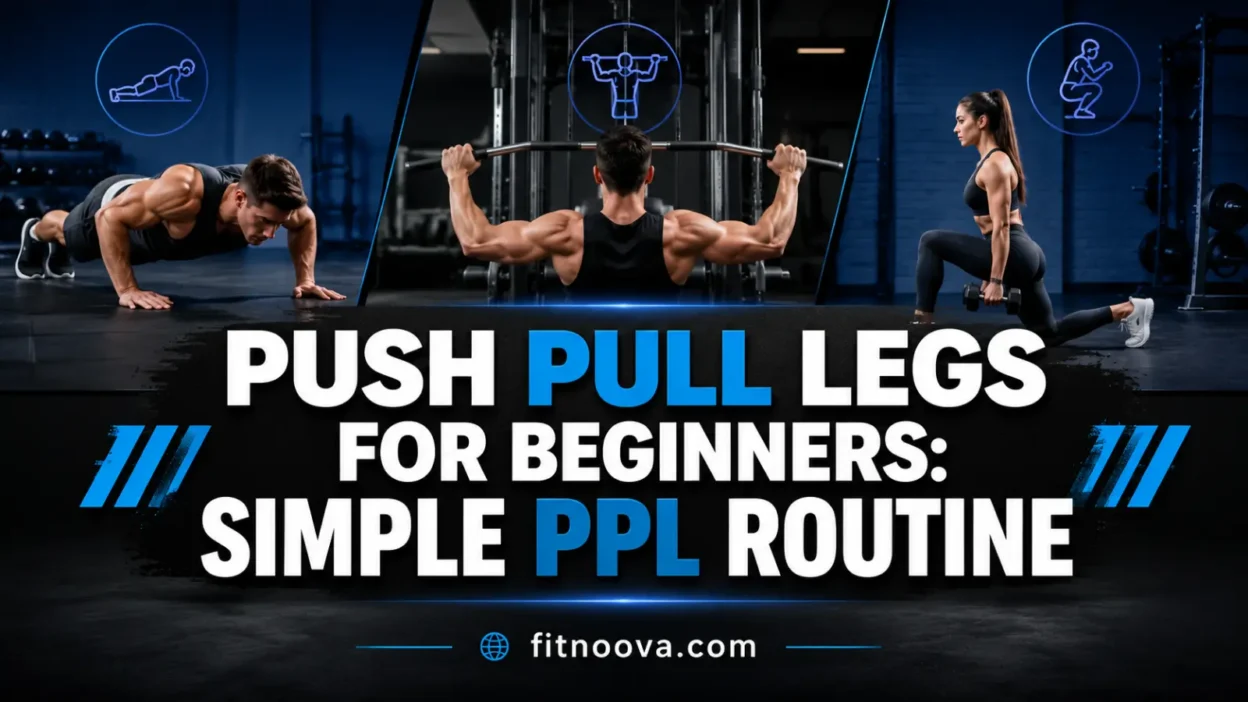
Push pull legs for beginners can be a smart way to start strength training because it organizes workouts by movement pattern: pushing muscles, pulling muscles, and lower-body muscles. Instead of trying to train everything at once with no clear plan, a push pull legs routine gives each workout a specific focus while still helping you build strength, muscle, coordination, and confidence in the gym.
The key is not to copy an advanced 6-day bodybuilding split right away. Beginners usually do better with fewer exercises, moderate effort, clean technique, and enough recovery between sessions. A good beginner PPL split should feel structured, not overwhelming.
Quick Answer
Push pull legs is a workout split where you train pushing muscles on one day, pulling muscles on another day, and legs on a third day. For beginners, the best starting point is usually a 3-day push pull legs routine done once per week, or a 4-day rotation if recovery is good. Most new lifters should focus on basic exercises, controlled reps, and gradual progression rather than heavy max-effort training.
What Is Push Pull Legs?
Push pull legs, often shortened to PPL, divides strength training into three workout types:
- Push Day: Chest, shoulders, and triceps
- Pull Day: Back, rear shoulders, and biceps
- Leg Day: Quads, hamstrings, glutes, calves, and core
The idea is simple: muscles that work together get trained together. When you do a bench press or push-up, your chest, shoulders, and triceps all help press the weight away from your body. When you row or pull down, your back and biceps work together. When you squat, hinge, lunge, or step, your lower body does most of the work.
That structure makes PPL easy to understand, which is one reason it is popular with gym beginners. You are not randomly picking exercises. Each session has a clear purpose.
Is Push Pull Legs Good For Beginners?
Yes, push pull legs can work well for beginners when the routine is simple and recovery-friendly. It gives you enough practice with major movement patterns without forcing you to train six days per week.
The mistake many beginners make is assuming that PPL only works as a high-volume 6-day split. That version can be useful for experienced lifters, but it is often too much for someone who is still learning form, building joint tolerance, and figuring out recovery.
For a beginner, the better version is usually:
- 3 workouts per week
- 4 to 6 exercises per workout
- 2 to 3 sets per exercise
- Mostly moderate weights
- At least one rest day between hard sessions when possible
This fits well with general physical activity guidance that adults include muscle-strengthening work for all major muscle groups at least two days per week. Newer resistance-training guidance also supports a flexible, consistent approach rather than chasing one perfect program. The 2026 ACSM position stand found that resistance training improves strength, muscle size, power, endurance, balance, and several physical function outcomes in healthy adults, with consistency and progressive training mattering more than unnecessary complexity.
Who Should Use A Beginner PPL Split?
A beginner push pull legs routine is a good fit if you want a clear gym plan and can train three days per week. It works especially well for people who want to learn basic strength exercises without doing a full-body workout every session.
It may suit you if:
- You are new to lifting or returning after a long break
- You want a simple beginner workout split
- You like knowing exactly what each day is for
- You can recover well between sessions
- You want a routine that can grow with you over time
It may not be the best first choice if you can only train one or two days per week. In that case, a full-body routine usually gives you better weekly coverage because each workout trains most major muscle groups.
If you have a medical condition, are recovering from an injury, are pregnant or postpartum, or have been told to limit certain movements, use this as general education and get individualized guidance from a qualified healthcare or fitness professional.
The Best Push Pull Legs Schedule For Beginners
The best beginner schedule is the one you can repeat consistently without feeling beat up. You do not need to train six days per week to make progress.
Option 1: 3-Day PPL Routine
This is the best starting point for most beginners.
Monday: Push
Wednesday: Pull
Friday: Legs
Tuesday, Thursday, Saturday, Sunday: Rest, walking, mobility, or light activity
This schedule gives you a full rest day between workouts and keeps soreness manageable. It also makes each session easier to focus on because you are not rushing through too many body parts.
Option 2: 4-Day Rolling PPL Routine
This works if you recover well and want slightly more training frequency.
Monday: Push
Tuesday: Rest
Wednesday: Pull
Thursday: Rest
Friday: Legs
Saturday: Rest
Sunday: Push again
Then continue the rotation.
This approach does not lock each workout to the same weekday. Over time, each muscle group gets trained a little more often than once per week.
Option 3: 6-Day PPL Split
A 6-day PPL split usually looks like this:
Monday: Push
Tuesday: Pull
Wednesday: Legs
Thursday: Push
Friday: Pull
Saturday: Legs
Sunday: Rest
This is popular online, but it is not the best starting point for most beginners. Six lifting days can create too much fatigue before your form, recovery habits, and training tolerance are ready. Save this version for later, after you have several months of consistent training behind you.
Beginner Push Pull Legs Routine
Use this routine for 8 to 12 weeks before making major changes. Start lighter than you think you need to. The first goal is to learn the exercises and build repeatable form.
Push Day: Chest, Shoulders, And Triceps
- Machine Chest Press Or Dumbbell Bench Press
2 to 3 sets of 8 to 12 reps - Seated Dumbbell Shoulder Press Or Machine Shoulder Press
2 to 3 sets of 8 to 12 reps - Incline Dumbbell Press Or Push-Up
2 sets of 8 to 12 reps - Cable Triceps Pressdown Or Bench Dip Modification
2 sets of 10 to 15 reps - Lateral Raise
2 sets of 12 to 15 reps
Keep the first push workout conservative. Pressing movements can irritate shoulders if you rush the weight, flare the elbows aggressively, or lower the weight without control.
Pull Day: Back, Rear Shoulders, And Biceps
- Lat Pulldown Or Assisted Pull-Up
2 to 3 sets of 8 to 12 reps - Seated Cable Row Or Chest-Supported Dumbbell Row
2 to 3 sets of 8 to 12 reps - One-Arm Dumbbell Row Or Machine Row
2 sets of 10 to 12 reps per side - Face Pull Or Rear Delt Fly
2 sets of 12 to 15 reps - Dumbbell Curl Or Cable Curl
2 sets of 10 to 15 reps
On pull day, think about moving your elbows rather than yanking with your hands. Pulling with control helps you feel your back muscles and reduces the chance of turning every rep into a shrug.
Leg Day: Quads, Hamstrings, Glutes, Calves, And Core
- Goblet Squat Or Leg Press
2 to 3 sets of 8 to 12 reps - Romanian Deadlift With Dumbbells
2 to 3 sets of 8 to 12 reps - Reverse Lunge Or Split Squat
2 sets of 8 to 10 reps per side - Leg Curl Machine Or Stability Ball Leg Curl
2 sets of 10 to 15 reps - Standing Calf Raise
2 sets of 12 to 15 reps - Plank Or Dead Bug
2 sets of 20 to 40 seconds, or 8 to 12 controlled reps per side
Leg day should feel challenging, but it should not leave you limping for days. Beginners often get very sore from too many squats, lunges, or Romanian deadlifts too soon. Start with fewer hard sets and build from there.
How Hard Should Each Set Feel?
Most beginner sets should finish with about 1 to 3 good reps left in reserve. That means you could do a few more reps if you had to, but your form would still be clean.
You do not need to train to failure on every set. Going all-out too often can make your form worse, increase soreness, and make the next workout harder to recover from. The better goal is steady practice with enough effort to make the muscles work.
A useful beginner rule:
- Too easy: You finish the set and feel like you could do 6 or more extra reps.
- About right: You finish with 1 to 3 solid reps left.
- Too hard: Your form breaks down, you hold your breath excessively, or you need momentum to finish.
How To Progress A Push Pull Legs Routine
Progression should be gradual. You do not need to add weight every workout, and you should not force heavier loads if your form is slipping.
Use this simple progression method:
- Pick a rep range, such as 8 to 12 reps.
- Start with a weight you can lift for 8 clean reps.
- Over time, work toward 12 clean reps on all sets.
- Once you can do that with control, increase the weight slightly.
- Repeat the process.
For example, if you dumbbell bench press 25 pounds for 8, 8, and 7 reps, stay with that weight. When you can press it for 12, 12, and 12 with good form, move up to the next available weight and begin again.
This approach keeps progress measurable without turning every workout into a test. Resistance training research supports progressive training, and the updated ACSM position stand notes that strength can be enhanced by factors such as heavier loading, full range of motion, 2 to 3 sets, and training at least twice per week when appropriate for the person and goal. For beginners, the practical takeaway is not to chase advanced numbers immediately. It is to build a routine you can repeat and progress safely.
Warm-Up For Push Pull Legs Workouts
A warm-up does not need to be long. It should prepare your body for the first few exercises and help you move better.
Use this simple structure:
- 5 minutes of light cardio, such as walking, cycling, or rowing
- 1 to 2 easy mobility drills for the area you are training
- 1 to 3 lighter warm-up sets before your first main lift
For example, before a push workout, you might do a few minutes on a bike, some shoulder circles, then two light sets of chest press before your working sets.
Do not turn the warm-up into a second workout. You should feel more prepared after warming up, not tired.
Rest Times Between Sets
Most beginners do well with 60 to 120 seconds of rest between sets. Use the shorter end for smaller exercises like curls, triceps pressdowns, lateral raises, and calf raises. Use the longer end for squats, rows, presses, Romanian deadlifts, and leg press.
If your breathing is still heavy or your next set would clearly suffer, rest a little longer. Rest is not laziness. It helps you perform better reps, especially when learning new movements.
Can You Do Push Pull Legs At Home?
Yes, but home PPL works best if you have at least some equipment, such as adjustable dumbbells, resistance bands, or a pull-up bar. Push and leg days are usually easier to train at home than pull day because back exercises require something to pull against.
Home substitutions can include:
- Push-ups instead of bench press
- Pike push-ups instead of shoulder press
- Band rows instead of cable rows
- One-arm dumbbell rows instead of machine rows
- Goblet squats instead of barbell squats
- Dumbbell Romanian deadlifts instead of barbell deadlifts
- Split squats instead of leg press
If you only have body weight, you can still use the push pull legs structure, but your pull day may be limited unless you have bands, a suspension trainer, or a safe pulling setup.
How Much Soreness Is Normal?
Some soreness is normal when you are new to lifting, especially 1 to 3 days after a workout. This is often called delayed onset muscle soreness, or DOMS, and it commonly happens after a new activity, a new exercise, or a harder workout than your body is used to.
Mild soreness that improves as you move is usually not a problem. Sharp pain, joint pain, swelling, numbness, pain that changes your normal movement, or pain that gets worse instead of better is different. Back off the exercise and get appropriate medical guidance if symptoms feel unusual or concerning.
For beginners, soreness should not be the goal. A workout can be effective without making you painfully sore.
Common Mistakes Beginners Should Avoid
Doing The Advanced 6-Day Split Too Soon
A 6-day PPL routine looks productive, but more training is not automatically better. If your sleep, nutrition, form, and recovery are not ready, six days can quickly become too much.
Start with three days. Earn more volume later.
Changing Exercises Every Week
Exercise variety can be useful, but beginners need repetition. You learn faster when you practice the same core movements for several weeks.
Keep your main exercises stable for at least 8 to 12 weeks. Change an exercise only if it causes discomfort, does not fit your equipment, or clearly is not working for your body.
Lifting Too Heavy Before Form Is Consistent
Heavy weights expose weak technique. They do not fix it.
A beginner should be able to control the lowering phase, use a comfortable range of motion, and keep the target muscles involved before adding more load.
Skipping Legs
Push pull legs only works if leg day actually happens. Lower-body training supports strength, balance, daily movement, and a more complete routine. If leg day feels intimidating, reduce the number of exercises, not the habit.
Treating Every Set Like A Max Test
You do not need to prove your strength every workout. Most of your progress will come from consistent, repeatable training that you can recover from.
Save true max-effort lifting for later, when you have better technique and a reason to test.
Ignoring Recovery
Recovery includes sleep, food, hydration, rest days, and managing stress. If your performance drops for several workouts in a row, soreness stays unusually high, or motivation crashes, your body may need less training for a short period.
A Simple Weekly Plan For Gym Beginners
Here is a clean 3-day push pull legs plan you can follow:
Monday: Push
- Machine Chest Press: 3 sets of 8 to 12
- Seated Dumbbell Shoulder Press: 2 sets of 8 to 12
- Incline Dumbbell Press: 2 sets of 8 to 12
- Triceps Pressdown: 2 sets of 10 to 15
- Lateral Raise: 2 sets of 12 to 15
Wednesday: Pull
- Lat Pulldown: 3 sets of 8 to 12
- Seated Cable Row: 3 sets of 8 to 12
- Dumbbell Row: 2 sets of 10 to 12 per side
- Face Pull: 2 sets of 12 to 15
- Dumbbell Curl: 2 sets of 10 to 15
Friday: Legs
- Goblet Squat Or Leg Press: 3 sets of 8 to 12
- Dumbbell Romanian Deadlift: 3 sets of 8 to 12
- Reverse Lunge: 2 sets of 8 to 10 per side
- Leg Curl: 2 sets of 10 to 15
- Calf Raise: 2 sets of 12 to 15
- Plank: 2 sets of 20 to 40 seconds
Use light warm-up sets before the first big movement of each workout. Keep the work sets controlled and stop before your form breaks down.
When To Make The Routine Harder
Stay with the beginner version until it starts to feel predictable in a good way. That usually means your form is cleaner, soreness is manageable, and you are slowly adding reps or weight.
You can make the routine harder by:
- Adding one set to your first exercise of the day
- Adding a fourth workout in a rolling PPL schedule
- Choosing slightly harder exercise variations
- Increasing weight once you hit the top of your rep range
- Slowing down the lowering phase if you need more control
Only change one or two things at a time. If you add more sets, more weight, and more training days all at once, you will not know what helped or what caused problems.
FAQs
Can beginners do push pull legs?
Yes. Beginners can do push pull legs as long as the plan is simple, recovery-friendly, and not copied from an advanced lifter. A 3-day PPL routine is usually the best starting point.
Is push pull legs better than full-body training for beginners?
Neither is always better. Full-body training is often better if you can train only two or three days per week and want frequent practice with the same lifts. Push pull legs is useful if you prefer focused workouts and like separating upper-body pushing, upper-body pulling, and legs.
How many days per week should beginners do PPL?
Most beginners should start with three days per week. After a few months of consistent training, some people can move to a 4-day rolling schedule. A 6-day PPL split is usually better for intermediate or advanced lifters.
Should beginners use machines or free weights?
Both can work. Machines are helpful because they are stable and easier to learn. Free weights help build coordination and control. A beginner routine can use both, especially for exercises like machine chest press, cable rows, dumbbell presses, and goblet squats.
How long should a beginner PPL workout take?
Most beginner PPL workouts should take about 45 to 70 minutes, including warm-up time. If your workouts are much longer, you may be doing too many exercises, resting without purpose, or adding unnecessary volume.
Can push pull legs help with fat loss?
Push pull legs can support fat loss by helping you build or maintain muscle and stay active, but fat loss also depends heavily on nutrition, daily movement, sleep, and consistency. Do not rely on the workout split alone.
What should I do if I miss a workout?
Do the missed workout next and continue the rotation. If you miss pull day, do pull day next. You do not need to cram multiple missed workouts into one session.
Conclusion
Push pull legs for beginners works best when it is simple, consistent, and easy to recover from. Start with a 3-day routine, focus on clean reps, use moderate effort, and progress gradually when your form is ready. You do not need a complicated 6-day split to build a strong foundation; you need a plan you can repeat safely and improve over time.