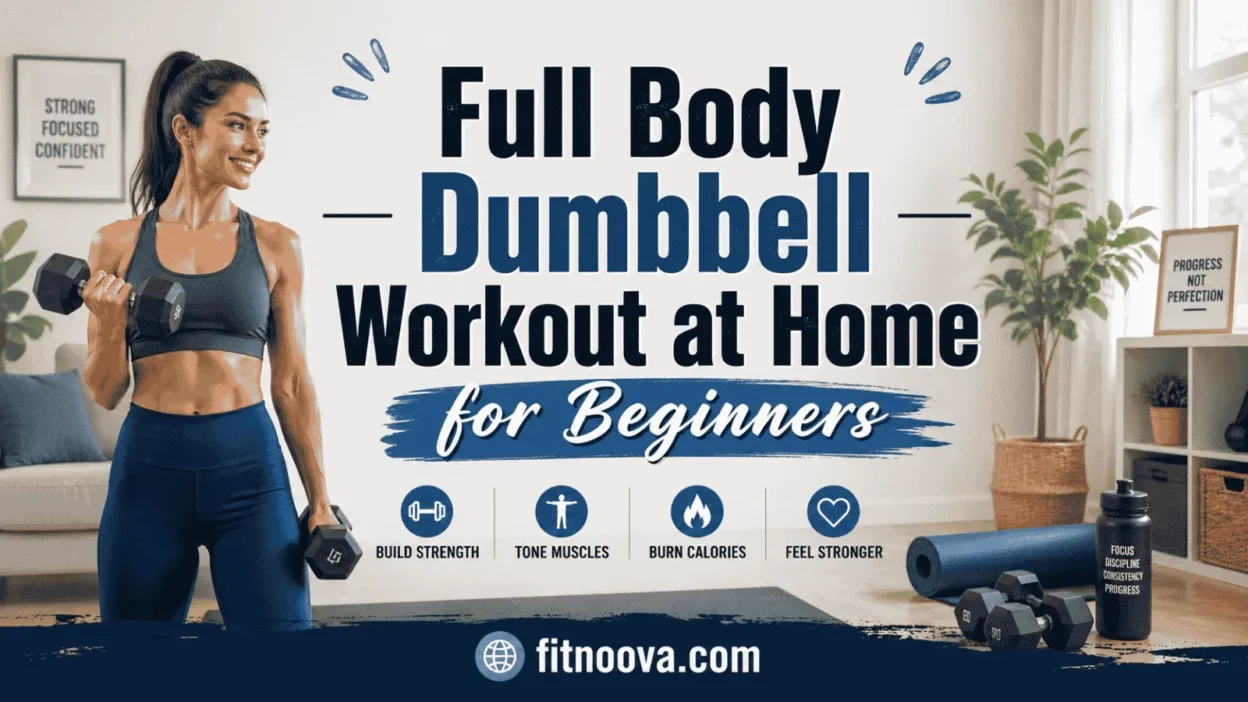
A full body dumbbell workout at home is one of the simplest ways to build strength without a gym, bulky equipment, or a complicated plan. With one or two pairs of dumbbells, you can train your legs, hips, back, chest, shoulders, arms, and core in a single session.
This routine is designed for beginners and busy adults who want a practical home strength workout they can repeat consistently. It is not a “destroy yourself” workout. The goal is to move well, train the major muscle groups, build confidence, and progress at a pace your body can handle.
Quick Answer
A good full body dumbbell workout at home should include a squat or lunge, a hip-hinge movement, a push, a pull, a shoulder exercise, and a core move. Beginners can do this routine 2 to 3 days per week, leaving at least one rest or lighter day between strength sessions. That lines up well with public-health guidance recommending muscle-strengthening activity at least 2 days per week for adults.
The At-Home Dumbbell Workout
This workout takes about 30 to 40 minutes, depending on your pace and rest time.
Workout Overview
Best For: Beginners, home workout users, busy adults, and anyone rebuilding a consistent strength routine
Equipment: One or two pairs of dumbbells
Frequency: 2 to 3 times per week
Rest Between Sets: 45 to 90 seconds
Effort Level: Moderate; you should finish most sets with 1 to 3 good reps left in reserve
Goal: Build total-body strength, coordination, and training consistency
Warm-Up: 5 Minutes
Do not skip the warm-up, especially if you are training first thing in the morning or after sitting for hours. The point is not to tire yourself out. It is to get your joints moving and make the first working set feel smoother.
Do 30 to 45 seconds of each:
- March in place or step jacks
- Bodyweight squats
- Arm circles
- Hip hinges without weight
- Glute bridges
- Dead bugs or bird dogs
After that, do one lighter practice set of the first two exercises before using your working weight.
Full Body Dumbbell Workout Routine
1. Dumbbell Goblet Squat
Sets/Reps: 3 sets of 8 to 12 reps
Muscles Worked: Quads, glutes, core, upper back
Hold one dumbbell vertically at chest height. Stand with your feet about shoulder-width apart. Sit your hips down and back, keep your chest tall, and lower until you can maintain control. Press through your feet to stand.
Form Tip: Your knees can move forward as long as your heels stay down and your knees track in the same direction as your toes.
Make It Easier: Squat to a chair or bench.
Make It Harder: Slow the lowering phase to 3 seconds.
2. Dumbbell Romanian Deadlift
Sets/Reps: 3 sets of 8 to 12 reps
Muscles Worked: Hamstrings, glutes, lower back, upper back
Hold a dumbbell in each hand in front of your thighs. Soften your knees, push your hips back, and let the dumbbells travel down the front of your legs. Stop when you feel a stretch in your hamstrings or when your back wants to round. Stand by driving your hips forward.
Form Tip: Think “hips back,” not “dumbbells down.” The dumbbells lower because your hips move.
Make It Easier: Use lighter weights and stop at knee level.
Make It Harder: Pause for 1 second at the bottom while keeping your back neutral.
3. Dumbbell Floor Press
Sets/Reps: 3 sets of 8 to 12 reps
Muscles Worked: Chest, shoulders, triceps
Lie on your back with your knees bent and feet flat. Hold a dumbbell in each hand. Start with your upper arms on the floor and elbows around 45 degrees from your body. Press the dumbbells over your chest, then lower with control until your upper arms lightly touch the floor.
Form Tip: Keep your wrists stacked over your elbows. Do not let the dumbbells drift too far toward your face.
Make It Easier: Use one dumbbell at a time.
Make It Harder: Add a slow 2-second lower.
4. One-Arm Dumbbell Row
Sets/Reps: 3 sets of 8 to 12 reps per side
Muscles Worked: Back, lats, rear shoulders, biceps
Place one hand on a sturdy chair, bench, or couch. Step back into a supported hinge position. Hold a dumbbell in the opposite hand and row it toward your ribs. Lower slowly.
Form Tip: Pull with your elbow, not your hand. Keep your shoulders away from your ears.
Make It Easier: Use a lighter dumbbell and brace your free hand on a higher surface.
Make It Harder: Pause at the top of each rep.
5. Dumbbell Reverse Lunge
Sets/Reps: 2 to 3 sets of 6 to 10 reps per side
Muscles Worked: Glutes, quads, hamstrings, calves, core
Hold dumbbells at your sides. Step one foot back, lower with control, then press through your front foot to stand. Alternate sides or complete all reps on one side before switching.
Form Tip: Keep most of your weight in the front leg. The back leg helps with balance.
Make It Easier: Do bodyweight reverse lunges or hold one dumbbell at your chest.
Make It Harder: Use heavier dumbbells or slow the lowering phase.
6. Dumbbell Shoulder Press
Sets/Reps: 2 to 3 sets of 8 to 10 reps
Muscles Worked: Shoulders, triceps, upper chest, core
Stand tall or sit on a chair. Hold dumbbells at shoulder height. Press them overhead until your arms are straight but not aggressively locked. Lower with control.
Form Tip: Keep your ribs down. If your lower back arches hard, use lighter weights or press one arm at a time.
Make It Easier: Do a seated shoulder press.
Make It Harder: Use a half-kneeling position to challenge your core.
7. Dumbbell Dead Bug
Sets/Reps: 2 sets of 6 to 10 reps per side
Muscles Worked: Core, deep abdominal muscles, hip control
Lie on your back holding one light dumbbell over your chest. Bring your knees above your hips. Slowly extend one leg while keeping your lower back gently connected to the floor. Return and switch sides.
Form Tip: Move slowly. If your back arches, shorten the range of motion.
Make It Easier: Do the dead bug without a dumbbell.
Make It Harder: Hold the dumbbell slightly farther behind your chest, but only if your ribs stay down.
How Heavy Should Your Dumbbells Be?
Choose dumbbells that let you finish each set with good form while still feeling challenged near the end. For most beginners, that means the last 2 or 3 reps feel harder, but not messy.
A useful rule: if you could do 8 more reps after your set, the weight is probably too light. If your form breaks before you reach the target rep range, the weight is too heavy.
You may need different weights for different exercises. Many people can use heavier dumbbells for goblet squats and Romanian deadlifts than they can for shoulder presses or rows. That is normal.
How Often Should You Do This Workout?
Start with 2 days per week for the first 2 to 3 weeks. If you are recovering well, add a third day.
A simple weekly schedule could look like this:
- Monday: Full body dumbbell workout
- Tuesday: Walk or light mobility
- Wednesday: Rest or easy cardio
- Thursday: Full body dumbbell workout
- Friday: Walk, bike, or mobility
- Saturday: Optional third strength day
- Sunday: Rest or gentle movement
Adults are generally encouraged to do muscle-strengthening activities on 2 or more days per week, along with regular aerobic activity such as brisk walking. Newer ACSM guidance also emphasizes training all major muscle groups at least twice weekly and focusing on consistency over complicated programming.
How To Progress This Dumbbell Workout
Progress does not have to mean buying heavier weights every week. At home, you can make a workout more challenging in several ways.
Add Reps First
If the plan says 8 to 12 reps, start near 8. When you can complete all sets at 12 reps with clean form, increase the weight if you have heavier dumbbells.
Slow Down The Eccentric
The eccentric is the lowering part of a rep. Lowering for 2 to 3 seconds makes lighter dumbbells feel more effective without rushing your joints.
Add A Set
Once the workout feels manageable, add one extra set to one or two major moves, such as goblet squats, Romanian deadlifts, or rows.
Shorten Rest Slightly
If your form stays solid, reducing rest from 90 seconds to 60 seconds can increase the challenge. Do not cut rest so much that every set turns sloppy.
Use A Harder Variation
Progress from a chair squat to a goblet squat, from a supported row to a bent-over row, or from a bodyweight lunge to a dumbbell reverse lunge.
How Hard Should The Workout Feel?
For beginners, most sets should feel like a 6 to 8 out of 10 in effort. You should be working, but you should not feel panicked, dizzy, or unable to control the weight.
A good set ends when your muscles are challenged and your form is still reliable. A poor set continues after your body has already started compensating.
Some muscle fatigue and mild soreness can happen when you start or change a routine. Sharp pain, chest pain, faintness, unusual shortness of breath, or pain that changes your movement is different. Stop the workout and seek appropriate medical guidance if symptoms feel concerning. Chest pain in particular should be taken seriously.
Common Mistakes To Avoid
Going Too Heavy Too Soon
Heavy dumbbells are not useful if they force you to shorten every rep, swing the weight, or hold your breath through the set. Start with control. Strength comes from repeated quality work, not from proving something on day one.
Turning Every Set Into Cardio
A full body dumbbell workout can raise your heart rate, but strength training still needs enough rest to keep reps clean. If you rush from move to move and your form falls apart, slow down.
Skipping Pulling Exercises
Many home workouts overdo squats, lunges, and presses while neglecting the back. Rows help balance shoulder training and support better posture during daily life.
Ignoring The Hips
The Romanian deadlift is not just a “leg exercise.” It teaches the hip hinge, which is important for lifting, bending, and training the glutes and hamstrings safely.
Training Through Pain
Exercise can feel uncomfortable. Pain is not a requirement. If a movement causes sharp, pinching, or joint-specific pain, stop and modify it. Try a shorter range of motion, lighter weight, slower tempo, or a different exercise.
Beginner Modifications
If Squats Bother Your Knees
Try a chair squat, reduce the depth, or use a slightly wider stance. Keep the movement controlled and focus on your whole foot staying grounded.
If Lunges Feel Unstable
Hold onto a wall or chair for support. You can also replace reverse lunges with step-backs without lowering as far, split squats, or glute bridges.
If Shoulder Presses Feel Uncomfortable
Use lighter dumbbells, press one arm at a time, or switch to an incline push-up or floor press. Avoid forcing an overhead position that causes pinching.
If Your Lower Back Gets Tired During Rows
Use a supported one-arm row instead of a bent-over row. Bracing one hand on a chair reduces the demand on your lower back while still training your back muscles.
A Simple 4-Week Plan
Use the same workout for 4 weeks before changing everything. Repeating a routine helps you learn the movements and measure progress.
Week 1
Use light to moderate dumbbells. Keep 2 to 3 reps in reserve. Focus on form.
Week 2
Add 1 to 2 reps per set where possible. Keep the same weights unless the workout feels too easy.
Week 3
Increase weight on one or two exercises, or add a set to goblet squats and rows.
Week 4
Keep the same exercises, but aim for smoother reps, better control, and slightly more confidence under load. Do not max out.
After week 4, you can repeat the plan with heavier dumbbells, add another set to key movements, or switch a few variations while keeping the same movement pattern: squat, hinge, push, pull, single-leg work, shoulders, and core.
FAQ
Can I build muscle with dumbbells at home?
Yes, you can build muscle with dumbbells at home if your workouts are consistent, challenging, and progressive. You need enough resistance, good form, adequate recovery, and a plan that trains all major muscle groups over time.
Is a full body dumbbell workout good for beginners?
Yes. A full body routine is often a smart choice for beginners because it gives each major muscle group regular practice without requiring long workouts or advanced programming. It also helps beginners learn basic movement patterns faster.
How long should a home dumbbell workout take?
Most beginner full body dumbbell workouts take 30 to 45 minutes. A shorter 20-minute workout can still be useful if it includes major movement patterns and is done consistently.
Should I do this workout every day?
No. Beginners usually do better with 2 to 3 strength sessions per week, especially when training the whole body. Your muscles and connective tissues need time to recover between sessions.
What if I only have one pair of dumbbells?
You can still train effectively. Use slower reps, pauses, higher reps, single-leg variations, and shorter rest periods to make lighter weights more challenging. For exercises that feel too hard, reduce the range of motion or use one dumbbell instead of two.
Can this workout help with weight loss?
It can support weight-loss efforts by helping you build strength, stay active, and maintain lean tissue while you improve daily habits. Fat loss still depends heavily on overall activity, nutrition, sleep, and consistency, so avoid relying on one workout alone.
Conclusion
A full body dumbbell workout at home does not need to be complicated to be effective. Train the major movement patterns, use weights you can control, repeat the routine 2 to 3 times per week, and progress gradually.
The best home workout is not the most intense one you can survive. It is the one you can do safely, consistently, and well enough to keep improving.