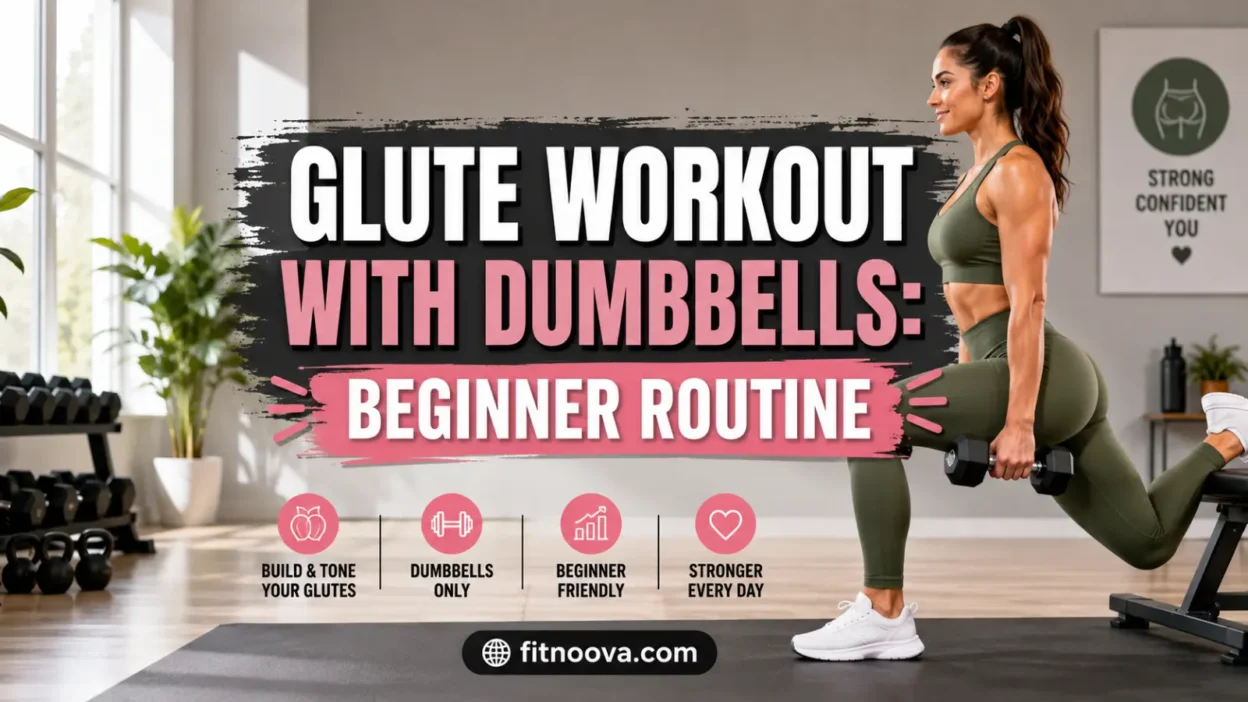
A good glute workout with dumbbells does not need complicated machines, heavy barbells, or a long list of exercises. With the right movements, a pair of dumbbells can train your glutes through hip extension, squats, lunges, hinges, and single-leg work — the same movement patterns your body uses when you stand up, climb stairs, walk uphill, run, and stabilize your hips.
The goal is not to chase soreness or rush into the heaviest weights you own. The goal is to use clean form, controlled reps, and steady progression so your glutes actually do the work instead of your lower back, quads, or momentum taking over.
Quick Answer
The best dumbbell glute workout combines hip thrusts or glute bridges, Romanian deadlifts, squats, lunges, step-ups, and optional abduction-focused work. Beginners can start with 2 to 3 sets of 8 to 12 reps per exercise, train glutes 2 times per week, and increase weight or reps gradually as form improves. Adults are generally encouraged to include muscle-strengthening activity at least 2 days per week, according to CDC and HHS physical activity guidance.
Why Dumbbells Work Well For Glute Training
Dumbbells are simple, adjustable, and easy to use at home or in the gym. They also let you train each side of the body more evenly, which is useful because many glute exercises involve split stances, step-ups, lunges, and single-leg stability.
Your glutes include the gluteus maximus, gluteus medius, and gluteus minimus. Together, they help support body weight, stabilize the pelvis, control hip movement, and power everyday actions like standing, walking, climbing, running, and jumping. The gluteus maximus is especially important for forceful hip extension, while the gluteus medius and minimus help with hip stability and side-to-side control.
That means a complete dumbbell butt workout should not rely on only one exercise. Hip thrusts are useful, but so are hinges, squats, lunges, step-ups, and controlled single-leg movements.
The Best Glute Workout With Dumbbells
This routine is designed for beginners and home workout users, but it can also work well for gym beginners who want a simple lower-body plan.
Do this workout 2 times per week with at least one rest day between sessions. Start light enough that you can complete every rep with control, but heavy enough that the final 2 reps of each set feel challenging without breaking form.
| Exercise | Sets | Reps | Rest |
|---|---|---|---|
| Dumbbell Glute Bridge Or Hip Thrust | 3 | 10–12 | 60–90 sec |
| Dumbbell Romanian Deadlift | 3 | 8–12 | 60–90 sec |
| Goblet Squat | 3 | 8–12 | 60–90 sec |
| Dumbbell Reverse Lunge | 2–3 | 8–10 per side | 60–90 sec |
| Dumbbell Step-Up | 2–3 | 8–10 per side | 60–90 sec |
| Dumbbell Frog Pump Or Bodyweight Glute Bridge Hold | 2 | 15–20 or 20–30 sec | 45–60 sec |
How To Warm Up Before A Dumbbell Glute Workout
A short warm-up helps you move better and notice how your hips, knees, and lower back feel before loading the exercises.
Try this 5-minute warm-up:
- Bodyweight glute bridges — 12 reps
- Hip hinges with hands on hips — 10 reps
- Bodyweight reverse lunges — 6 reps per side
- Step-ups or marching in place — 30 seconds
- Bodyweight squats — 10 reps
The warm-up should feel easy. Save your effort for the working sets.
Exercise Instructions And Form Tips
Dumbbell Glute Bridge Or Hip Thrust
This is one of the most direct dumbbell glute exercises because it trains hip extension without requiring much balance.
Lie on your back for a glute bridge, or place your upper back against a bench or sturdy couch for a hip thrust. Set one dumbbell across your hips, brace your core, and drive through your heels. At the top, your ribs should stay down and your hips should be fully extended without arching your lower back.
Form Tips
- Keep your chin slightly tucked.
- Push through the midfoot and heel.
- Pause briefly at the top.
- Stop if you feel the movement mostly in your lower back.
For beginners, start with the floor glute bridge. Move to hip thrusts when you can control the top position without overextending your spine.
Dumbbell Romanian Deadlift
The dumbbell Romanian deadlift trains the glutes and hamstrings through a hip hinge. It is one of the most useful lower-body strength exercises, but it requires patience because the form matters.
Stand tall with a dumbbell in each hand. Soften your knees, push your hips back, and lower the dumbbells along the front of your legs. Stop when you feel a stretch through the back of your thighs, then squeeze your glutes to stand tall again.
Form Tips
- Think “hips back,” not “bend down.”
- Keep the dumbbells close to your legs.
- Keep your back neutral.
- Do not chase the floor if your hamstrings are tight.
- Stand tall at the top without leaning backward.
The Romanian deadlift is commonly used to train the posterior chain, including the glutes and hamstrings. ACE describes the RDL as a traditional lift for developing posterior-chain strength.
Goblet Squat
A goblet squat trains your glutes, quads, and core while helping you practice a strong squat pattern.
Hold one dumbbell vertically at chest height. Stand with your feet about shoulder-width apart. Sit your hips down and slightly back, keeping your chest lifted and knees tracking in the same direction as your toes. Push through the floor to stand.
Form Tips
- Keep the dumbbell close to your chest.
- Do not let your knees cave inward.
- Use a range of motion you can control.
- Keep your heels grounded.
- Exhale as you stand.
If your hips feel tight, reduce the depth and focus on control. Depth can improve over time.
Dumbbell Reverse Lunge
Reverse lunges are often friendlier for beginners than forward lunges because they can be easier to control.
Hold dumbbells at your sides or use one dumbbell in a goblet position. Step one foot back, lower into a lunge, then push through the front foot to return to standing. Keep most of the work in the front leg.
Form Tips
- Take a long enough step back so the front heel stays down.
- Keep your torso slightly forward but not rounded.
- Push through the front heel and midfoot.
- Start with bodyweight if balance is difficult.
To make the move more glute-focused, use a slightly longer stride and keep the front shin fairly controlled instead of driving the knee far forward.
Dumbbell Step-Up
Step-ups train the glutes in a practical way because they resemble stair climbing. They also help build single-leg strength and hip stability.
Choose a step, bench, or box that lets you keep control. Place one foot fully on the surface, lean slightly forward, and push through the working leg to stand. Lower yourself slowly.
Form Tips
- Use a height that allows clean form.
- Avoid bouncing off the back foot.
- Keep your knee aligned with your toes.
- Control the lowering phase.
- Start with no weights if needed.
If the exercise turns into a calf push-off from the bottom leg, lower the step height or reduce the weight.
Dumbbell Frog Pump Or Glute Bridge Hold
A frog pump is a higher-rep finisher that can help you feel the glutes working after heavier exercises. Lie on your back, bring the soles of your feet together, let your knees open, place a dumbbell over your hips if comfortable, and lift your hips with short, controlled reps.
A glute bridge hold is simpler: lift into a bridge and hold the top position while keeping your ribs down and glutes engaged.
Form Tips
- Keep the movement controlled.
- Do not turn it into a lower-back arch.
- Use light weight or bodyweight.
- Stop before your form gets sloppy.
Beginner Modifications
A dumbbell glute workout should match your current strength, mobility, and comfort level. You do not need to do the hardest version of every exercise to make progress.
If you are new to strength training, start with these adjustments:
- Do glute bridges instead of hip thrusts.
- Do bodyweight reverse lunges before adding dumbbells.
- Use a lower step for step-ups.
- Hold one dumbbell instead of two.
- Do 2 sets per exercise instead of 3.
- Leave 2 to 3 good reps “in the tank” on each set.
Strength training should feel challenging, but it should not feel reckless. Mayo Clinic notes that strength training can support health and function when done properly, and beginners should learn correct technique before increasing resistance.
How Often Should You Do This Dumbbell Glute Workout?
For most beginners, 2 glute-focused sessions per week is a good starting point. This gives you enough practice to improve while leaving time for recovery.
A simple weekly setup could look like this:
| Day | Workout |
|---|---|
| Monday | Dumbbell Glute Workout |
| Tuesday | Walk, Mobility, Or Upper Body |
| Wednesday | Rest Or Light Cardio |
| Thursday | Dumbbell Glute Workout |
| Friday | Upper Body Or Core |
| Saturday | Walk, Easy Cardio, Or Rest |
| Sunday | Rest |
If you already train lower body often, you may not need a separate glute day. Instead, add 2 or 3 of these exercises into your existing lower-body routine.
Adults are advised to do muscle-strengthening activities for all major muscle groups on 2 or more days per week. That does not mean every session has to be long or intense; consistency and appropriate effort matter more than making every workout exhausting.
How Heavy Should Your Dumbbells Be?
Choose a weight that lets you complete the target reps with good form while making the last few reps feel challenging. If you finish every set easily, the weight is probably too light. If your form breaks down early, the weight is too heavy.
A useful beginner guide:
- Glute bridges and hip thrusts: usually your heaviest dumbbell
- Romanian deadlifts: moderate to heavy dumbbells
- Goblet squats: moderate weight
- Reverse lunges and step-ups: lighter to moderate dumbbells
- Frog pumps or holds: light dumbbell or bodyweight
Progress does not always mean adding weight. You can also add reps, slow down the lowering phase, pause at the hardest point, improve range of motion, or add one extra set.
How To Progress This Workout Safely
Use small progressions and change only one thing at a time.
For example:
- Week 1: 2 sets per exercise
- Week 2: 3 sets for the first 3 exercises
- Week 3: Add 1 to 2 reps per set
- Week 4: Increase dumbbell weight slightly
- Week 5: Add a pause to glute bridges and RDLs
- Week 6: Use a harder variation, such as hip thrusts instead of bridges
A good rule: progress only when your reps look clean and feel repeatable. If your lower back, knees, or hips start complaining, reduce load, shorten range of motion, or take an extra recovery day.
What This Workout Should Feel Like
During the workout, you should feel your glutes, hamstrings, and legs working. Some muscle fatigue is normal. Mild soreness 24 to 48 hours later can happen, especially if you are new or returning after time off.
Sharp pain, joint pain, numbness, tingling, or pain that changes how you walk is different. Do not push through those signs. Mayo Clinic guidance on overuse injuries recommends seeking professional input when pain does not go away, especially after changes in workout intensity, duration, frequency, or exercise type.
Common Mistakes To Avoid
Going Too Heavy Too Soon
Heavy dumbbells are only helpful if your glutes are doing the work. If you need to swing, bounce, twist, or arch your back to move the weight, reduce the load.
Turning Every Exercise Into A Quad Exercise
Squats, lunges, and step-ups naturally use the quads, but small changes can help your glutes contribute more. Use controlled reps, keep your working foot grounded, and avoid rushing out of the bottom position.
Arching The Lower Back At The Top
This is common during glute bridges and hip thrusts. The goal is hip extension, not a lower-back bend. Keep your ribs down, brace lightly, and stop the lift when your body forms a strong straight line.
Skipping Single-Leg Work
Single-leg movements help train balance, hip stability, and side-to-side strength. Reverse lunges and step-ups are worth keeping in the plan, even if you need to start with bodyweight.
Training Glutes Hard Every Day
More is not always better. Your muscles need time to recover from strength training. If performance drops, soreness lingers, or joints feel irritated, reduce volume or add rest.
FAQs
Can you build glutes with only dumbbells?
Yes, you can build stronger glutes with dumbbells if you train consistently, use enough resistance, and progress over time. Dumbbells can load hip thrusts, glute bridges, Romanian deadlifts, squats, lunges, and step-ups, which cover the main movement patterns your glutes need.
What is the best dumbbell exercise for glutes?
The dumbbell hip thrust or glute bridge is one of the best direct glute exercises. For a complete routine, pair it with dumbbell Romanian deadlifts, goblet squats, reverse lunges, and step-ups.
How many times a week should I train glutes with dumbbells?
Most beginners can train glutes 2 times per week. More advanced lifters may train them 2 to 3 times weekly, but total volume, recovery, and exercise selection matter more than frequency alone.
Should I feel dumbbell glute exercises in my lower back?
You may feel your core and back muscles helping stabilize your body, but the lower back should not be the main working area. If you feel back strain during hip thrusts, bridges, or Romanian deadlifts, reduce the weight and check your rib position, hip hinge, and range of motion.
Are dumbbell glute workouts good for beginners?
Yes. Dumbbell glute workouts are beginner-friendly because they are adjustable and can be done at home or in the gym. Start with basic versions, use lighter weights, and focus on controlled reps before adding load.
How long should a dumbbell glute workout take?
This workout should take about 30 to 45 minutes, depending on rest time and the number of sets. Beginners can start with a shorter version by doing 2 sets per exercise.
Conclusion
A smart glute workout with dumbbells should train more than one movement pattern. Use hip thrusts or glute bridges for direct glute work, Romanian deadlifts for the hinge pattern, squats and lunges for lower-body strength, and step-ups for single-leg control.
Start with weights you can control, train 2 times per week, and progress gradually. The best routine is not the one that leaves you the most sore; it is the one you can perform well, recover from, and repeat consistently.