
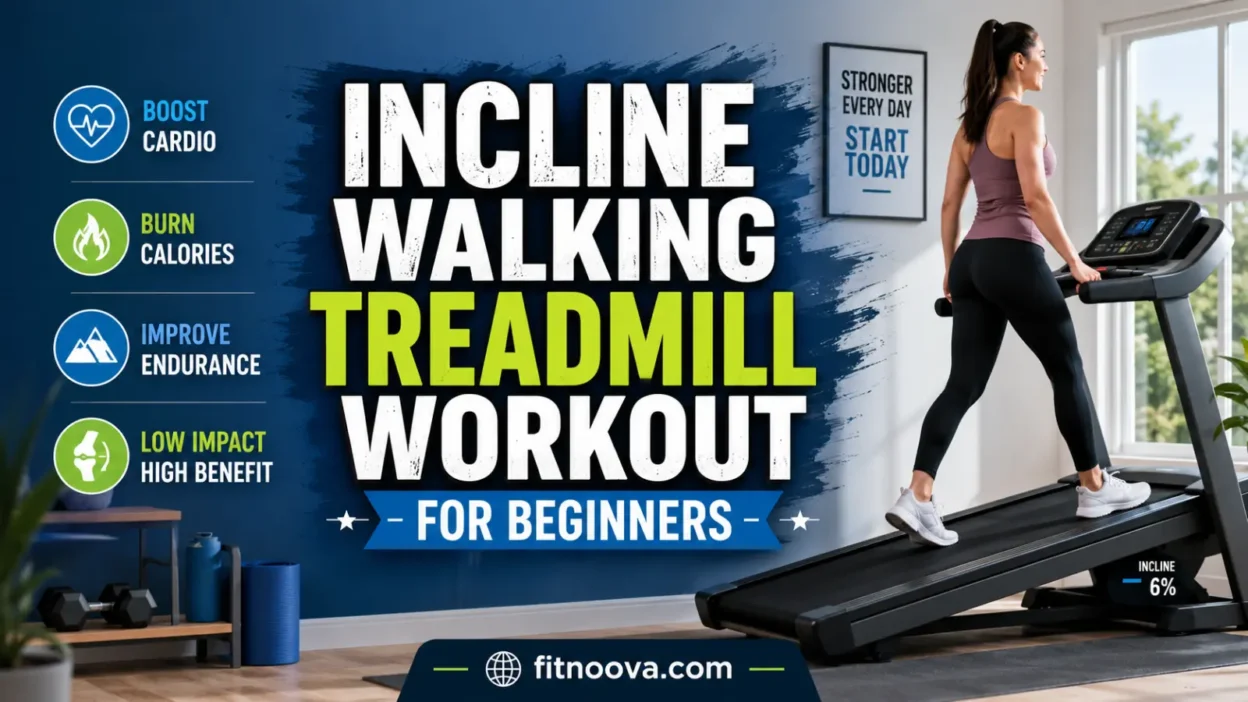
An incline walking treadmill workout is one of the simplest ways to make walking feel more challenging without switching to running. By raising the treadmill incline, you can increase your effort, elevate your heart rate, and train your legs and glutes while keeping the workout low impact and beginner-friendly.
The key is not to start too steep. A good incline walking workout uses a warm-up, manageable incline intervals, steady breathing, and a pace you can control without gripping the handrails or leaning over the console.
Quick Answer
A good beginner incline walking treadmill workout is 20 to 30 minutes long, using a 1% to 6% incline and a walking speed that feels brisk but controlled. Start with 5 minutes flat, alternate moderate incline intervals with easier recovery periods, and finish with a cool-down. You should be able to talk in short sentences for most of the workout, not feel like you are gasping.
Why Incline Walking Works So Well
Incline walking increases the workload without requiring you to run. That makes it useful for beginners, people returning to fitness, busy adults who want efficient cardio, and anyone who prefers a lower-impact treadmill workout.
Walking uphill asks more from your calves, hamstrings, glutes, quads, and core than flat walking. Research in older adults found that treadmill walking at 10% and 16% incline increased cardiopulmonary metabolic cost compared with flat walking, with greater lower-body muscle activity as incline increased. That does not mean beginners should jump to high inclines, but it does explain why even a modest incline can make a walking workout feel noticeably harder.
Incline walking can also help you reach moderate-intensity cardio without needing high speeds. The CDC describes moderate intensity as effort around 5 or 6 on a 0-to-10 scale, where your breathing and heart rate rise but you can still talk.
Incline Walking Treadmill Workout: Beginner Routine
Use this routine if you are new to incline walking, returning after a break, or looking for a safe treadmill incline workout that does not copy the intense 12-3-30 format.
| Time | Speed | Incline | Effort |
|---|---|---|---|
| 0:00–5:00 | 2.5–3.0 mph | 0%–1% | Easy warm-up |
| 5:00–8:00 | 2.7–3.3 mph | 3% | Moderate |
| 8:00–10:00 | 2.5–3.0 mph | 1% | Recovery |
| 10:00–13:00 | 2.7–3.3 mph | 4% | Moderate |
| 13:00–15:00 | 2.5–3.0 mph | 1% | Recovery |
| 15:00–18:00 | 2.7–3.3 mph | 5% | Challenging but controlled |
| 18:00–20:00 | 2.5–3.0 mph | 1% | Recovery |
| 20:00–23:00 | 2.7–3.3 mph | 3%–4% | Moderate |
| 23:00–25:00 | 2.3–2.8 mph | 0% | Cool-down |
If 25 minutes feels too long, stop after the 20-minute mark and cool down for 3 minutes. If it feels too easy, raise the incline by 1% before increasing speed.
What Incline Should Beginners Use?
Most beginners should start between 1% and 4% incline. A 1% incline can make treadmill walking feel closer to outdoor walking, while 3% to 6% usually gives enough challenge for a beginner cardio workout.
You do not need to chase a 10% or 12% incline right away. Steeper inclines can be useful later, but they also increase the demand on your calves, Achilles tendons, hamstrings, and lower back. A workout you can repeat consistently is better than one that leaves you sore, strained, or discouraged.
A simple progression looks like this:
| Fitness Level | Suggested Incline Range | Best Use |
|---|---|---|
| New Beginner | 1%–3% | Building the habit |
| Beginner With Some Walking Experience | 3%–6% | Improving cardio fitness |
| Intermediate | 6%–10% | Harder intervals or steady climbs |
| Advanced | 10%+ | Shorter, controlled incline blocks |
Use the lowest incline that makes the workout feel purposeful.
What Speed Should You Use?
The right treadmill speed depends on your height, stride, fitness level, and the incline. For many beginners, 2.5 to 3.3 mph is a practical range for incline walking.
Do not choose speed based on what someone else does online. Choose it based on control. Your stride should feel smooth, your feet should land under your body, and you should not need to hold the rails to keep up.
A good rule: if raising the incline ruins your posture, lower the speed first.
How Hard Should Incline Walking Feel?
For most general fitness and fat-loss support goals, incline walking should usually feel like a moderate workout, not an all-out test.
Use these signs:
- Easy: You can speak in full sentences.
- Moderate: You can talk, but singing would be difficult.
- Hard: You can only say a few words before needing a breath.
- Too Hard For This Workout: You are gripping the rails, hunching forward, or struggling to keep your footing.
The CDC’s talk test describes moderate-intensity activity as effort where you can talk but not sing, while vigorous activity makes it hard to say more than a few words without pausing.
Heart rate can also help, but it is not perfect. The American Heart Association notes that moderate-intensity exercise is roughly 50% to 70% of maximum heart rate, while vigorous intensity is about 70% to 85%; medications and heart conditions can change what is appropriate, so some people should ask a health professional about safe heart-rate targets.
Proper Incline Walking Form
Good form matters more as incline increases. The steeper the treadmill gets, the more tempting it is to lean forward, grab the rails, or shorten your stride too aggressively.
Use these cues:
- Stand tall with your chest open.
- Keep your eyes forward, not down at your feet.
- Let your arms swing naturally.
- Take shorter, controlled steps as the incline rises.
- Keep your feet landing under your hips.
- Avoid hanging your body weight from the handrails.
- Keep your core lightly braced without holding your breath.
Lightly touching the rails for balance is fine if needed. Using the rails to pull yourself uphill changes the workout and may encourage poor posture.
How Often Should You Do This Workout?
Start with 2 to 3 sessions per week if you are new to treadmill workouts. Leave at least one easier day between incline sessions at first, especially if your calves or shins get sore.
After 2 to 4 weeks, many people can build toward 3 to 5 walking workouts per week, depending on recovery, schedule, and overall activity level.
For general health, adults are encouraged to get at least 150 minutes of moderate-intensity physical activity per week, plus 2 days of muscle-strengthening activity. Incline walking can count toward the cardio side of that goal, but it should not be your only form of fitness if you want balanced strength, joint support, and long-term progress.
How To Progress Without Overdoing It
Progress one variable at a time. Do not raise speed, incline, duration, and frequency all in the same week.
Use this order:
- Improve Consistency: Complete the workout 2 to 3 times per week.
- Add Time: Increase total workout time by 3 to 5 minutes.
- Raise Incline Slightly: Add 1% to one or two work intervals.
- Increase Speed Carefully: Add 0.1 to 0.2 mph only if your form stays clean.
- Shorten Recovery: Reduce easy intervals once the workout feels comfortable.
A sustainable goal is to finish feeling like you worked, not like you survived.
A 30-Minute Incline Walking Workout
Once the beginner version feels comfortable, try this 30-minute option.
| Time | Speed | Incline | Focus |
|---|---|---|---|
| 0:00–5:00 | Easy walk | 0%–1% | Warm up |
| 5:00–9:00 | Brisk walk | 3% | Settle in |
| 9:00–11:00 | Easy walk | 1% | Recover |
| 11:00–15:00 | Brisk walk | 4% | Build effort |
| 15:00–17:00 | Easy walk | 1% | Recover |
| 17:00–21:00 | Brisk walk | 5%–6% | Strong interval |
| 21:00–23:00 | Easy walk | 1% | Recover |
| 23:00–26:00 | Brisk walk | 4% | Controlled finish |
| 26:00–30:00 | Easy walk | 0% | Cool down |
This routine is a better starting point than jumping straight into the popular 12-3-30 treadmill workout. Walking at 12% incline for 30 minutes can be too much for many beginners, especially if they are not used to incline training.
Is Incline Walking Good For Weight Loss?
Incline walking can support weight loss because it helps increase weekly activity and energy expenditure. But it does not guarantee fat loss on its own.
For weight loss, the bigger picture matters: total movement, nutrition habits, sleep, stress, consistency, and whether the routine is realistic enough to repeat. Incline walking is useful because it is simple, adjustable, and easier to recover from than many high-impact workouts.
A smart fat-loss approach is to use incline walking as part of a weekly routine that also includes strength training, daily steps, and meals that support your goals without extreme restriction.
Common Incline Walking Mistakes To Avoid
Holding The Rails The Whole Time
If you need to grip the rails tightly, the incline or speed is too high. Lower one of them until you can walk naturally.
Starting Too Steep
A 10% to 12% incline may look impressive, but it is not necessary for beginners. Start lower and earn your way up.
Leaning Over The Console
Leaning forward reduces the quality of the workout and can irritate your lower back. Stay tall and let the belt move under you.
Skipping The Warm-Up
Your calves, ankles, and hips need a few minutes to adjust before climbing. Warm up flat before adding incline.
Doing Hard Incline Walks Every Day
Incline walking is still training. Your calves, feet, shins, and hips need recovery, especially in the first few weeks.
Ignoring Pain
Muscle effort and mild next-day soreness can be normal. Sharp pain, chest pain, dizziness, unusual shortness of breath, numbness, or pain that changes your gait are signs to stop and seek appropriate medical guidance.
Who Should Modify This Workout?
Modify the workout if you are new to exercise, coming back after illness or injury, pregnant or postpartum, managing a heart condition, dealing with joint pain, or taking medication that affects heart rate or blood pressure.
That does not mean incline walking is off-limits. It means your starting point may need to be easier. Use lower inclines, shorter sessions, slower speeds, longer recoveries, and more rest between workouts.
If flat walking already feels challenging, begin with flat treadmill walking before adding incline.
FAQs
Is incline walking better than running?
Incline walking is not automatically better than running. It is better for people who want a lower-impact cardio option, dislike running, or need a more beginner-friendly way to raise workout intensity. Running may be better for people training for races or higher-impact conditioning, as long as their body tolerates it well.
How long should I do incline walking on a treadmill?
Most beginners should start with 20 to 30 minutes, including warm-up and cool-down. If that feels too hard, begin with 10 to 15 minutes and build gradually.
Can I do incline walking every day?
You can walk daily if the effort is easy to moderate and your body feels good, but hard incline workouts are better done 2 to 4 times per week. Rotate harder incline days with flat walking, strength training, stretching, or rest.
What incline is best for fat loss?
There is no single best incline for fat loss. The best incline is one you can sustain with good form while keeping your effort moderate to challenging. For many beginners, that is somewhere between 3% and 6%.
Is the 12-3-30 treadmill workout good for beginners?
The 12-3-30 workout can be too intense for true beginners because 12% incline for 30 minutes is a significant demand on the calves, hamstrings, glutes, and lower back. A better approach is to start with 3% to 6% incline intervals and progress over time.
Should I hold weights while incline walking?
Most beginners should not hold dumbbells during incline walking. Hand weights can change your arm swing, posture, and balance. If you want more strength work, do it separately with controlled exercises.
Conclusion
An incline walking treadmill workout is effective because it makes a basic walk more challenging without forcing you to run. Start with a modest incline, keep your posture tall, use a speed you can control, and progress slowly.
The best routine is not the steepest one. It is the one you can repeat consistently, recover from well, and adjust as your fitness improves.