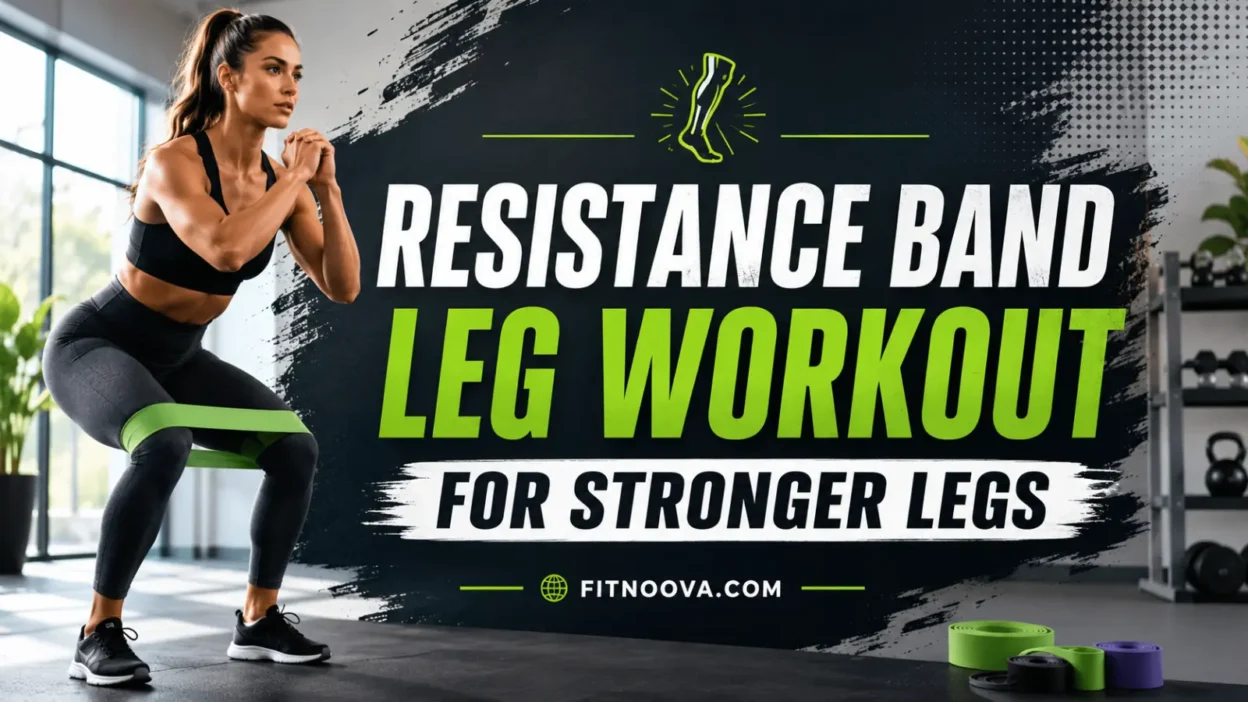
A resistance band leg workout can train your glutes, quads, hamstrings, calves, and hip muscles without a full gym setup. Bands are light, affordable, joint-friendly for many people, and surprisingly useful when you know how to place them, control the tempo, and choose the right resistance.
This guide gives you a complete lower-body routine, beginner modifications, form tips, progression options, and mistakes to avoid so you can train your legs safely and effectively at home or in the gym.
Quick Answer
A good resistance band leg workout should include a squat or lunge pattern, a hip-hinge movement, a glute exercise, a hamstring exercise, lateral hip work, and calf training. Beginners can start with 2 rounds, while more experienced exercisers can do 3 to 4 rounds with a stronger band or slower tempo. Aim to train legs with bands 2 to 3 times per week, leaving recovery time between harder sessions.
Why Resistance Bands Work for Leg Training
Resistance bands create tension as they stretch. That means many exercises feel harder near the top or end range of motion, where the band is most stretched. This can be especially useful for glute bridges, lateral walks, kickbacks, squats, and hip abductions.
Bands are not magic, and they do not replace every benefit of heavy weights. But they can build strength, improve muscular endurance, help beginners learn movement patterns, and make home workouts more practical. Research comparing elastic resistance with conventional resistance training has found that elastic resistance can produce similar strength gains when programs are structured well and progressed over time.
They also fit well with general activity guidelines. The CDC recommends adults do muscle-strengthening activities at least 2 days per week, working major muscle groups including the legs and hips.
What You Need Before You Start
You can do this workout with one or two bands, but having a few resistance levels makes progression easier.
Useful options include:
- A mini loop band for glute bridges, lateral walks, squats, and hip abductions
- A long loop band or tube band for Romanian deadlifts, split squats, and hamstring curls
- A chair, wall, or countertop for balance
- A mat if you are doing floor exercises
Choose a band that lets you finish each set with clean form. The last 2 to 3 reps should feel challenging, but you should not need to twist, bounce, or rush to complete them.
The Best Resistance Band Leg Workout
This routine is designed for beginners and home workout users, but it can be progressed for stronger lifters by increasing band tension, slowing the tempo, or adding rounds.
Workout Overview
Do this workout 2 to 3 times per week on nonconsecutive days.
| Exercise | Sets | Reps |
|---|---|---|
| Banded Squat | 2–4 | 10–15 |
| Banded Romanian Deadlift | 2–4 | 10–12 |
| Lateral Band Walk | 2–3 | 8–12 Each Direction |
| Banded Glute Bridge | 2–4 | 12–20 |
| Banded Reverse Lunge | 2–3 | 8–12 Each Leg |
| Banded Hamstring Curl | 2–3 | 10–15 Each Leg |
| Banded Calf Raise | 2–3 | 12–20 |
Rest 45 to 90 seconds between sets. Use the longer end of that range when your breathing or form needs more time to recover.
Warm Up First
Before you add band tension, spend 4 to 6 minutes preparing your hips, knees, ankles, and core.
Try this simple warm-up:
- 30 seconds of marching in place
- 10 bodyweight squats
- 10 hip hinges
- 10 reverse lunges, alternating sides
- 10 glute bridges
- 10 ankle rocks per side
The goal is not to tire yourself out. You are simply waking up the muscles and joints you are about to use.
How To Do Each Exercise
Banded Squat
Place a mini band above your knees. Stand with your feet about shoulder-width apart, toes slightly turned out. Push your hips back, bend your knees, and lower into a squat while keeping gentle outward pressure against the band. Stand back up by pressing through your whole foot.
Keep your chest tall, ribs stacked over your pelvis, and knees tracking in the same direction as your toes.
Make it easier: Use a lighter band or squat to a chair.
Make it harder: Pause for 2 seconds at the bottom or use a stronger band.
Banded Romanian Deadlift
Stand on the middle of a long band with both feet. Hold the ends of the band in your hands. Soften your knees, push your hips back, and lower your torso until you feel tension through your hamstrings. Stand tall by driving your hips forward and squeezing your glutes.
This is a hip-hinge exercise, not a squat. Your knees should bend slightly, but your hips do most of the movement.
Make it easier: Use a lighter band or reduce the range of motion.
Make it harder: Slow the lowering phase to 3 seconds.
Lateral Band Walk
Place a mini band above your knees or around your ankles. Slightly bend your hips and knees, then take small controlled steps to one side. Keep tension on the band the entire time. Avoid letting your knees collapse inward.
This exercise targets the glute medius, a key hip muscle that helps with stability during squats, lunges, walking, and running.
Make it easier: Place the band above your knees.
Make it harder: Place the band around your ankles or take slower steps.
Banded Glute Bridge
Lie on your back with a mini band above your knees. Bend your knees and place your feet flat on the floor. Press your knees slightly outward, drive through your heels, and lift your hips until your body forms a straight line from shoulders to knees. Pause at the top, then lower with control.
Do not overarch your lower back at the top. Think about lifting with your glutes, not your spine.
Make it easier: Remove the band and master the bodyweight version first.
Make it harder: Add a 2-second pause at the top of every rep.
Banded Reverse Lunge
Place a mini band above your knees, or hold a long band under your front foot and at shoulder height. Step one leg back, lower into a lunge, then press through the front foot to return to standing.
Keep most of your weight on the front leg. Your front knee should track over your toes without caving inward.
Make it easier: Hold a chair or wall for balance.
Make it harder: Use a longer range of motion or slow the lowering phase.
Banded Hamstring Curl
Anchor one end of a long band to a sturdy low point. Loop the other end around one ankle. Lie face down or stand holding a wall for support. Bend your knee to pull your heel toward your glutes, then return slowly.
Keep your hips steady. If your lower back starts to arch or your body rocks, use a lighter band.
Make it easier: Use a lighter band or reduce the range of motion.
Make it harder: Pause briefly when your heel is closest to your glutes.
Banded Calf Raise
Stand on the middle of a long band and hold the ends in your hands. Rise onto the balls of your feet, pause briefly, then lower your heels with control.
Use a wall or chair if balance is an issue. Avoid bouncing at the bottom.
Make it easier: Do bodyweight calf raises without the band.
Make it harder: Do single-leg calf raises or slow each rep down.
How Hard Should This Workout Feel?
Most sets should feel like a 6 to 8 out of 10 in effort. You should finish with about 1 to 3 good reps left in the tank.
That matters because beginners often make one of two mistakes: stopping every set too early or forcing sloppy reps after fatigue has already changed their form. Good training lives between those extremes.
A set is hard enough when the movement slows down, the target muscles are working, and you need focus to finish. It is too hard when you lose control, feel sharp pain, or start using momentum instead of muscle.
How Often To Do a Resistance Band Leg Workout
For most beginners, 2 lower-body band workouts per week is enough to build consistency and improve strength. After a few weeks, you can move to 3 sessions per week if your joints feel good, soreness is manageable, and your form is staying clean.
A simple weekly schedule could look like this:
- Monday: Resistance Band Leg Workout
- Tuesday: Walking or Upper Body
- Wednesday: Rest or Mobility
- Thursday: Resistance Band Leg Workout
- Friday: Walking or Core
- Weekend: Light Activity, Rest, or Optional Full-Body Workout
Muscle-strengthening activity on 2 or more days per week is consistent with public-health guidance for adults.
How To Progress the Workout
Progression is what turns a simple resistance band lower body workout into a real training plan. You do not need to make every workout harder, but over time your body needs a slightly greater challenge.
Use one progression at a time:
- Add 1 to 2 reps per set
- Add one extra set to your main exercises
- Use a stronger band
- Slow the lowering phase
- Add a pause where the exercise is hardest
- Reduce rest slightly while keeping form clean
- Move from supported to unsupported variations
For example, if you are doing 2 sets of 10 banded squats, build toward 2 sets of 15. Once that feels controlled, move to 3 sets or use a stronger band.
Beginner Modifications
If you are new to strength training, start with fewer exercises and fewer sets. A shorter workout done consistently is better than an ambitious routine that leaves you too sore to repeat.
Try this beginner version:
| Exercise | Sets | Reps |
|---|---|---|
| Banded Squat To Chair | 2 | 8–10 |
| Banded Glute Bridge | 2 | 10–12 |
| Lateral Band Walk | 2 | 6–8 Each Direction |
| Banded Romanian Deadlift | 2 | 8–10 |
Do this version for 2 to 4 weeks, then add lunges, hamstring curls, and calf raises when you feel ready.
What Muscles This Workout Trains
A complete band leg workout should train more than just the glutes. This routine covers the major lower-body muscle groups:
- Glutes: Squats, glute bridges, lateral walks, lunges
- Quads: Squats and lunges
- Hamstrings: Romanian deadlifts and hamstring curls
- Calves: Calf raises
- Hip stabilizers: Lateral walks, squats, lunges
- Core: All standing exercises require trunk control
This balance helps make the workout more useful for real movement, not just isolated muscle fatigue.
Common Mistakes To Avoid
Using a Band That Is Too Heavy
A stronger band is not always better. If the band pulls your knees inward, shortens your range of motion, or makes you rush, it is too heavy for that exercise.
Choose control first. Add resistance once your reps look consistent.
Letting the Knees Collapse Inward
During squats, lunges, and lateral walks, your knees should generally track in the same direction as your toes. A band can help teach that position, but only if you actively control it.
Think “knees follow toes,” not “force the knees as wide as possible.”
Rushing Through Reps
Fast, bouncy reps make band exercises less effective and harder to control. Use a steady tempo, especially during the lowering phase.
A good rule: lower for 2 seconds, pause briefly, then lift with control.
Skipping Hip-Hinge Exercises
Many home leg workouts focus only on squats, lunges, and glute bridges. Those are useful, but your hamstrings also need direct work. Banded Romanian deadlifts and hamstring curls help fill that gap.
Training Through Sharp Pain
Normal muscle effort can feel like burning, shaking, or fatigue. Delayed soreness can also show up after a new or harder workout, often 1 to 3 days later.
Sharp pain, sudden pain, joint pain that changes your movement, chest pain, dizziness, or unusual shortness of breath are different. Stop the workout and seek appropriate medical guidance if symptoms feel concerning or do not settle. Low-level soreness after training can be normal, but sudden, strong, sharp, or persistent pain is a warning sign.
Safety Tips Before You Train
This workout is general fitness education, not medical advice. If you are pregnant, returning after injury, managing a medical condition, or unsure whether strength training is appropriate for you, ask a qualified healthcare professional before starting or progressing.
Use these safety rules during the workout:
- Check bands for cracks, tears, or thinning before each session
- Anchor long bands only to sturdy objects
- Keep the band away from your face
- Move slowly when setting up or stepping out of a band
- Stop if a band slips, snaps, or feels unstable
- Prioritize smooth reps over more reps
Bands are simple tools, but they still create force. Treat them with the same attention you would give dumbbells or gym machines.
FAQs
Can you build leg muscle with resistance bands?
Yes, resistance bands can support leg muscle and strength development when exercises are challenging enough and progressed over time. They work best when you use controlled reps, train close enough to fatigue, and gradually increase difficulty.
Are resistance bands better than weights for legs?
They are not automatically better, but they are more portable and easier to use at home. Weights may be easier to load heavily for advanced strength goals, while bands are excellent for beginners, glute work, warm-ups, travel workouts, and joint-friendly accessory training.
How many times per week should I do this workout?
Most people can start with 2 days per week. If recovery is good and soreness is manageable, 3 days per week can work well. Avoid doing hard leg sessions on back-to-back days when you are still sore or your form feels off.
Where should I place the band for leg exercises?
For squats, glute bridges, and lateral walks, place a mini band above the knees to start. Around the ankles is usually harder. For Romanian deadlifts and calf raises, a long band under the feet works better.
What resistance band is best for beginners?
Start with a light or medium band that allows full range of motion and clean control. Beginners often do better with a lighter band and slower reps than with a heavy band that limits movement.
Can I do this workout for weight loss?
This workout can support a weight-loss plan by helping you build strength, stay active, and maintain muscle while improving fitness habits. Fat loss still depends on the bigger picture, including nutrition, daily movement, sleep, consistency, and overall calorie balance.
Conclusion
A resistance band leg workout can be simple, challenging, and effective when it includes the right movement patterns: squats, hinges, lunges, glute work, hamstring work, lateral hip training, and calves. Start with a band you can control, keep your reps smooth, train 2 to 3 times per week, and progress gradually instead of rushing to harder variations.
Done consistently, this kind of lower-body routine can help you build stronger legs at home without needing a full rack of weights or complicated equipment.