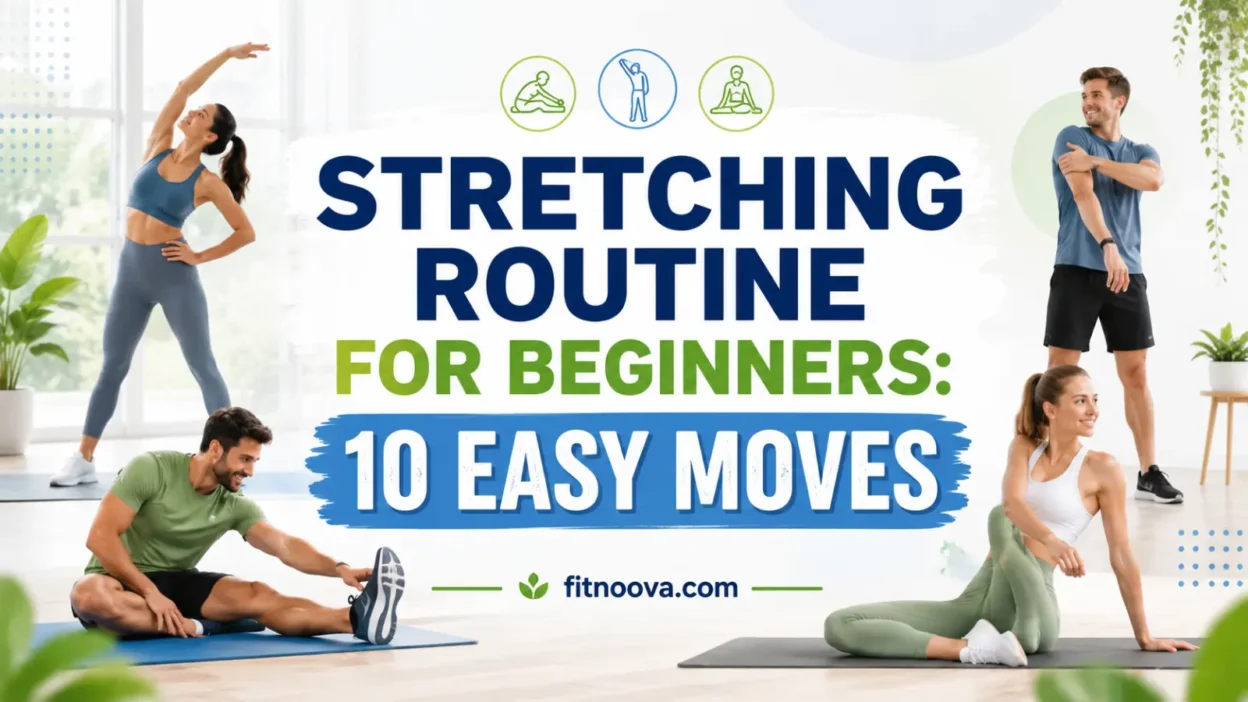
A good stretching routine for beginners does not need to be long, complicated, or painful. The best place to start is with a short full-body routine that targets the neck, shoulders, back, hips, hamstrings, calves, and ankles using slow, comfortable movements.
For most beginners, stretching works best when it feels calm and repeatable. You should feel mild tension, not sharp pain. Medical and fitness organizations consistently recommend gentle stretching, steady breathing, avoiding bouncing, and backing off if a stretch hurts.
Quick Answer
A beginner stretching routine should take about 8 to 12 minutes and include gentle stretches for the upper body, hips, legs, and calves. Hold each stretch for about 20 to 30 seconds, breathe normally, and avoid forcing your body into painful positions. Stretching is usually safest after a short warm-up or after exercise, when your muscles are warmer.
Why Beginners Should Keep Stretching Simple
Stretching helps you practice moving your joints through a comfortable range of motion. For beginners, that matters because stiffness often comes from long sitting, inconsistent movement, stress, or jumping into exercise without enough mobility work.
A simple routine can help you feel less tight, move more comfortably, and prepare your body for other activities. It should not be treated as a cure for pain, a replacement for strength training, or a test of flexibility.
The American Heart Association describes flexibility exercise as one part of a balanced fitness routine, alongside aerobic activity and strength work. Adults are also encouraged to include regular aerobic activity and muscle-strengthening exercise as part of general health guidelines.
Before You Start: Basic Stretching Rules
Stretching should feel controlled from beginning to end. Before static stretching, do 3 to 5 minutes of light movement such as walking in place, easy marching, arm circles, or slow bodyweight squats. Mayo Clinic notes that stretching is often best after a warm-up or after exercise, when muscles are warmer.
Use these rules during every stretch:
- Move slowly into position.
- Stop at mild to moderate tension.
- Breathe normally.
- Do not bounce.
- Do not push through sharp pain.
- Ease out of the stretch slowly.
If you have an injury, a medical condition, significant joint or back pain, or you are pregnant, choose modifications carefully and consider asking a healthcare professional which stretches are appropriate for you. The NHS gives similar guidance for people who may need individualized adjustments.
The Best Stretching Routine for Beginners
This routine is designed for home use, requires no equipment, and takes about 10 minutes. Do it after a short warm-up, after a walk, after a workout, or during a low-stress break in your day.
Start with one round. Hold each stretch for about 20 to 30 seconds per side where needed. If a stretch feels too intense, reduce the range of motion or skip it.
1. Neck Side Stretch
Sit or stand tall with your shoulders relaxed. Slowly tilt your right ear toward your right shoulder until you feel a light stretch along the left side of your neck. Keep your chin relaxed and avoid pulling your head down with your hand.
Hold, then switch sides.
This is useful for beginners who sit at a desk, look down at a phone, or carry tension through the upper traps.
2. Shoulder Cross-Body Stretch
Bring your right arm across your chest. Use your left hand or forearm to gently support the arm above or below the elbow. Keep both shoulders down instead of shrugging.
Hold, then switch sides.
You should feel this around the back of the shoulder, not in the front of the joint. If it pinches, lower the arm slightly.
3. Chest Opener
Stand tall and clasp your hands behind your back, or place your hands on your lower back if clasping is uncomfortable. Gently draw your shoulders back and lift your chest without arching hard through your lower back.
Hold while breathing slowly.
This stretch can help balance the rounded posture many people develop from sitting, typing, or driving.
4. Cat-Cow Stretch
Start on your hands and knees. Slowly round your back upward like a cat, then reverse the movement by gently lowering your belly and lifting your chest.
Move back and forth for 5 to 8 slow reps instead of holding one position.
This is a beginner-friendly mobility drill for the spine. Keep the movement smooth, and avoid forcing your neck up or down.
5. Child’s Pose
From hands and knees, shift your hips back toward your heels and reach your arms forward. Let your chest relax toward the floor as much as comfortable.
Hold and breathe into your back.
If your knees feel uncomfortable, place a folded towel under them or keep your knees wider. If your hips do not reach your heels, that is fine.
6. Seated Hamstring Stretch
Sit on the floor with one leg extended and the other knee bent. Sit tall, then hinge forward slightly from your hips until you feel a stretch behind the extended leg.
Hold, then switch sides.
Keep your back long instead of rounding aggressively. You do not need to touch your toes for this stretch to work.
7. Figure-Four Glute Stretch
Lie on your back with both knees bent. Cross your right ankle over your left thigh. If comfortable, lift the left foot and gently draw the legs toward you.
Hold, then switch sides.
You should feel this in the outer hip or glute area. If lying down is uncomfortable, do the same shape while seated in a chair.
8. Kneeling Hip Flexor Stretch
Kneel with your right knee on the floor and your left foot forward. Keep your torso upright and gently shift your hips forward until you feel a stretch in the front of the right hip.
Hold, then switch sides.
Avoid arching your lower back. Think about gently tucking your pelvis under before moving forward.
9. Standing Quad Stretch
Stand near a wall or chair for balance. Bend your right knee and bring your right heel toward your glutes. Hold your ankle or pant leg if comfortable.
Hold, then switch sides.
Keep your knees close together and your torso tall. If grabbing your foot is difficult, use a towel around the ankle or skip this stretch until it feels accessible.
10. Wall Calf Stretch
Place both hands on a wall. Step your right foot back, keep the heel down, and bend your front knee slightly. Lean forward until you feel a stretch in the back calf.
Hold, then switch sides.
This is especially helpful if you walk, run, stand often, or feel tight through the ankles.
How Often Should Beginners Stretch?
A realistic starting point is 2 to 4 days per week. If your body responds well, you can stretch most days, especially if the sessions are short and gentle.
Harvard Health notes that healthy adults should stretch major muscle-tendon groups at least two to three times per week, with a total of about 60 seconds per stretching exercise being a common target for flexibility work. Beginners do not need to reach that immediately. One 20- to 30-second hold is enough to start building the habit.
A simple weekly plan could look like this:
| Day | Stretching Plan |
|---|---|
| Monday | 10-minute full-body routine |
| Tuesday | Rest or 5-minute light mobility |
| Wednesday | 10-minute full-body routine |
| Thursday | Rest |
| Friday | 10-minute full-body routine |
| Saturday | Optional walk plus gentle stretching |
| Sunday | Rest or easy stretching |
Consistency matters more than intensity. Stretching too aggressively often makes beginners sore, frustrated, or less likely to continue.
Should You Stretch Before or After a Workout?
For most beginners, static stretching fits best after exercise or after a brief warm-up. Static stretching means holding a stretch in one position, such as a hamstring stretch or calf stretch.
Before a workout, use dynamic movement instead. That means gentle motion that prepares your body for activity, such as arm circles, marching, hip circles, bodyweight squats, or easy lunges.
After a workout, static stretching can be a calm way to cool down and target areas that feel tight. The NHS describes post-exercise stretching as a way to cool down gradually and relax after activity.
How Hard Should Stretching Feel?
Use a simple 1-to-10 scale.
A good beginner stretch should feel like a 3 to 5 out of 10: noticeable, but manageable. You should be able to breathe normally and hold the position without bracing your jaw, shoulders, or hands.
Back off if you feel:
- Sharp pain
- Numbness or tingling
- Joint pinching
- Pain that increases as you hold
- Pain that lingers after the stretch
Mild muscle tension is normal. Pain is not the goal. Mayo Clinic and Harvard Health both emphasize that stretching should not be painful and that bouncing should be avoided.
Easy Modifications for Tight Beginners
You do not have to look flexible to benefit from stretching. In fact, the best beginner routine is the one you can do without strain.
If floor stretches are uncomfortable, use a chair. A seated figure-four stretch, seated hamstring stretch, and seated neck stretch can cover a lot of the same areas.
If balance is difficult, keep one hand on a wall, chair, or countertop. This is especially useful for quad stretches and calf stretches.
If your knees hurt when kneeling, place a folded towel or cushion under the knee. You can also replace kneeling hip flexor stretches with a standing split-stance version.
If you are very stiff in the morning, start with smaller movements. Do not force deep stretches immediately after getting out of bed.
Common Stretching Mistakes Beginners Should Avoid
Stretching Cold Muscles Too Aggressively
Deep static stretching when your body is completely cold can feel harsh. Warm up first with light movement, or stretch after exercise.
Bouncing in the Stretch
Bouncing can make the stretch harder to control and may increase discomfort. Keep the movement steady and slow.
Holding Your Breath
Breath-holding usually means you are forcing the position. Breathe slowly and reduce the intensity if needed.
Chasing Flexibility Too Quickly
Flexibility improves gradually. Pushing harder does not automatically lead to better results and can make stretching feel unpleasant.
Ignoring Strength Training
Stretching can support movement quality, but it does not replace strength work. For a balanced routine, combine flexibility with walking, resistance training, and general physical activity over the week.
FAQs
How long should beginners stretch each day?
Most beginners can start with 5 to 10 minutes. A short routine done consistently is better than a long routine you rarely repeat.
Is it okay to stretch every day?
Yes, gentle stretching can be done daily if it feels good and does not cause pain. Start with a few days per week, then increase gradually based on how your body responds.
Should stretching hurt?
No. Stretching should create mild tension, not sharp or intense pain. If a position hurts, reduce the range of motion or stop that stretch.
Can stretching help with lower back tightness?
Gentle stretching may help some people feel less stiff, especially when tight hips, hamstrings, or prolonged sitting are involved. But persistent, sharp, radiating, or worsening back pain should be evaluated by a healthcare professional.
What is the best time of day to stretch?
The best time is when you can do it consistently. Many beginners prefer stretching after a walk, after a workout, during a work break, or in the evening.
Do beginners need equipment for stretching?
No. This routine can be done without equipment. A chair, wall, towel, or cushion can make some stretches more comfortable, but they are optional.
Conclusion
A stretching routine for beginners should be simple, gentle, and easy to repeat. Start with 8 to 12 minutes, warm up first, hold each stretch at a comfortable level, and avoid pushing into pain.
The goal is not to force your body into extreme positions. The goal is to build a steady habit that helps you move more comfortably and supports the rest of your fitness routine.